
Exness rebates on FXBee are cashback tied to volume, and the current listing does not use one formula for every account. Standard and Standard Cent are shown at 24% of the spread, Pro at 13.8% of the spread, and Zero, Raw Spread, and Standard Plus as a dollar amount per standard lot. A completed trade can still produce a credit when it loses money. The credit does not change the price you were filled at, and it does not make the account safer.
The number you can use is the cell for your account type and your symbol. "Up to $84.38" on Zero forex is a ceiling across forex symbols, not the cashback on every pair. Gold in that same Zero column is a flat $1.01 per standard lot. Before you multiply, match the column to the account you will actually trade, and match the company on the client agreement to the Exness entity that accepted you. You read the row and open the account from the Exness rebate page on FXBee. The trading account itself is held by the company named on that agreement.
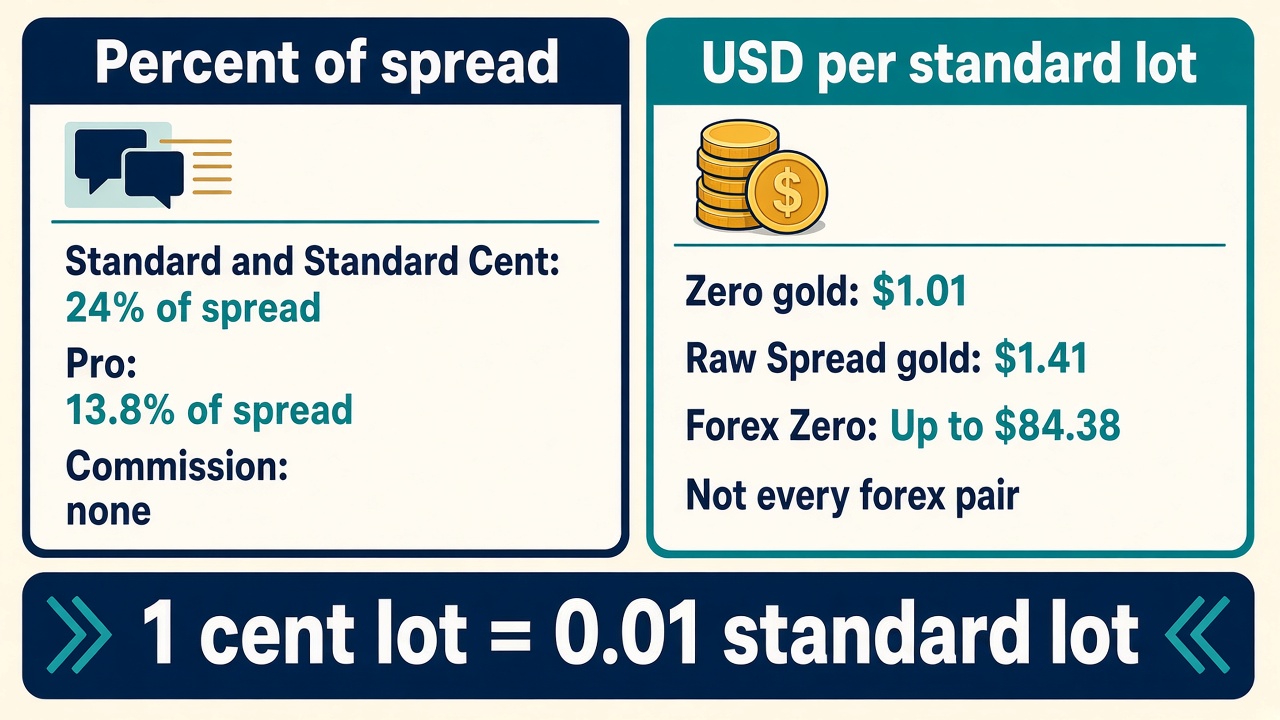
How Exness rebates are quoted per lot
Two formulas sit on one card. They answer different questions.
A percentage of the spread is a share of the spread cost on that trade. Exness states that Standard, Standard Cent, and Pro accounts have no trading commission. In the account-types article dated 2 October 2026, spreads start from 0.3 pips on Standard Cent, from 0.2 pips on Standard, and from 0.1 pips on Pro. "From" is a starting point. The spread on your ticket can be wider, and the percentage applies to the spread you actually paid, not to the minimum printed in a summary table. If you want the general method for turning a spread into money before taking a percentage, the note on a percentage of the spread is the longer version.
A dollar amount per standard lot ignores the pip width. You multiply the listed amount by standard-lot volume, and only for the symbol row you are on. That is a different object from a per-lot rebate explained in the abstract, because this card mixes percentage columns and dollar columns on the same page. Raw Spread commission is stated as up to 3.50 USD each side per lot. Zero commission starts from 0.05 USD each side per lot. The FXBee footnote says rebates are calculated per standard lot. It does not say per side. Do not subtract a per-side commission from a per-lot credit until both numbers are in the same unit. The difference is the one covered in per side and round turn.
| Symbol group | Standard and Standard Cent | Pro | Zero | Raw Spread | Standard Plus |
|---|---|---|---|---|---|
| Forex | 24% of spread | 13.8% of spread | Up to $84.38 | Up to $118 | Up to $630 |
| Gold | 24% of spread | 13.8% of spread | $1.01 | $1.41 | $5.9 |
| Index | 24% of spread | 13.8% of spread | Up to $14.25 | Up to $19.43 | Up to $157.5 |
| Crypto | 24% of spread | 13.8% of spread | Up to $6.75 | Up to $9.45 | Up to $42 |
Read that table as a screening card for the credit, then go back to the live page before you use a figure in a cost sheet. FXBee's cashback payment terms say offers can be changed or discontinued without notice, payments are made at FXBee's discretion, and a broker may refuse to pay. Rebate math can depend on trading activity the broker supplies. A custom rate needs written approval. None of those sentences is a reason to skip the cell. They are the reason a copied rate from a third-party page, or from an older screenshot, is a poor input.
Turn the listing into a credit you can recompute
The examples below use the rates in the table and a USD account. They are arithmetic, not a quoted payout. For a USD-quoted forex pair, one pip on a 100,000-unit lot is $10. Exness's common trading terms list that 100,000-unit contract size for forex, with gold at 100 troy ounces per standard lot.
Standard, 1.00 standard lot, EURUSD-style quote, spread 0.8 pips. Spread cost is 0.8 × $10 = $8. At 24% of the spread, the example credit is $1.92. If the spread on the ticket is 1.4 pips, the cost is $14 and 24% is $3.36. The percentage does not save you from a wide spread. It scales with it.
Standard Cent is the easy place to overstate the credit. The Standard Cent conditions, dated 6 October 2026, define 1 cent lot as 1,000 USD, which is 0.01 of a standard lot. The symbol carries a -c suffix, such as EURUSDc, and the balance is shown in a cent currency such as USC. One pip on 1.00 cent lot is about $0.10, not $10. A 1.0 pip spread then costs about $0.10, and 24% of that is about $0.024. The percentage column is the one Standard Cent shares with Standard. The dollar cells on Zero, Raw Spread, and Standard Plus are not the cent-account rate.
Zero, gold, 2.00 standard lots. The gold cell is $1.01 per standard lot, with no "up to" in front of it. Two lots come to $2.02. Because one standard gold lot is 100 troy ounces, that $1.01 is for the lot, not for each ounce. A reader who divides $1.01 by 100 and then multiplies by ounces a second time will not land on the listing.
The figure to keep out of the spreadsheet is 2.00 × $84.38. That treats the Zero forex ceiling as if it were the rate on the pair in front of you. Index and crypto dollar cells are ceilings too. Gold dollar cells on this card are flat amounts. The words in the cell decide which kind of math you are allowed to do.
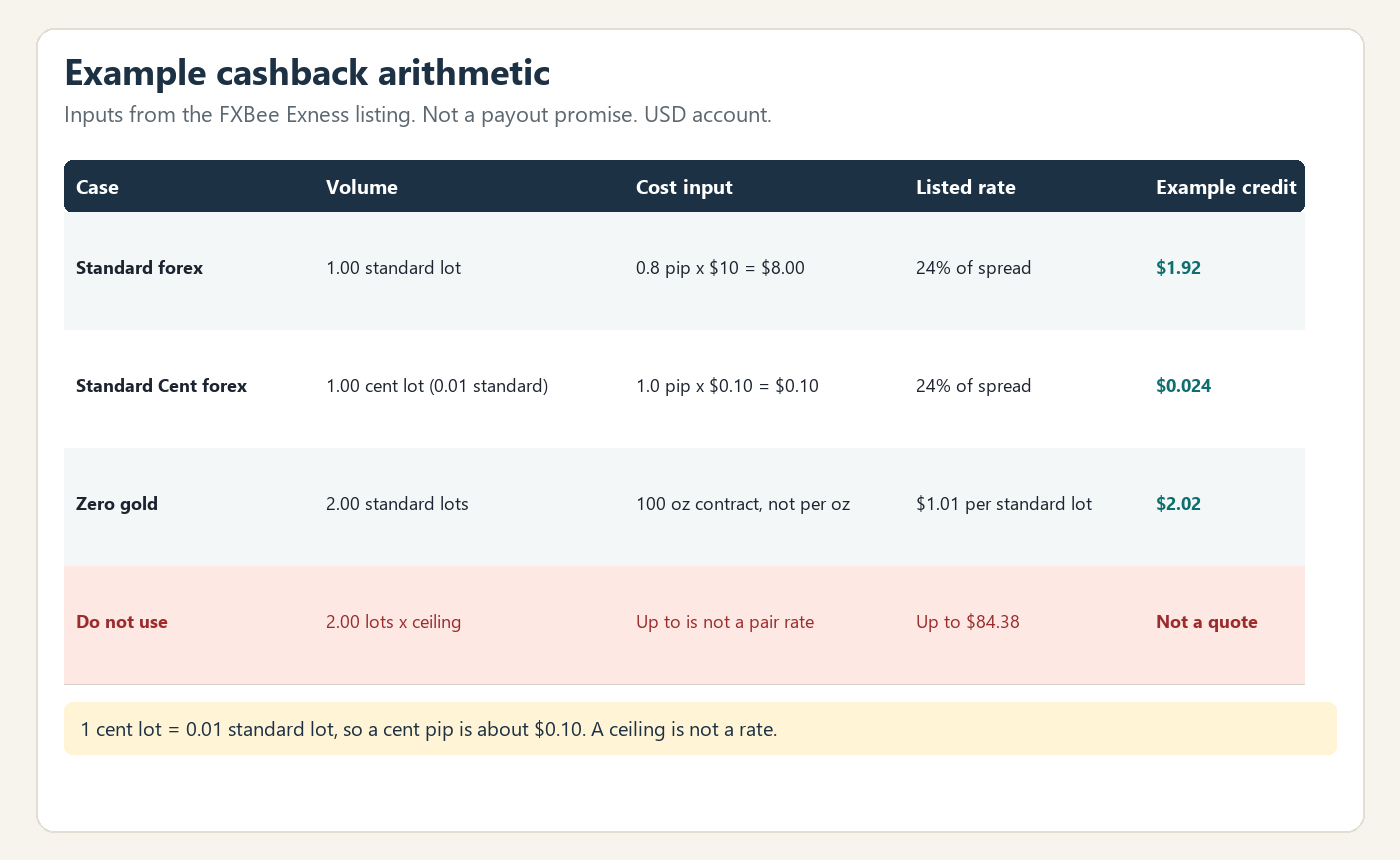
Account types behind the cashback column
The same help-center list names five account types: Standard Cent and Standard, then Pro, Raw Spread, and Zero. Standard types show no minimum initial deposit in that summary. Pro, Raw Spread, and Zero show a minimum that depends on region. A separate Zero account article says the Zero minimum starts from 200 USD and still depends on region. That 200 USD line belongs to Zero. It is not a deposit rule you can paste onto Standard.
| Account | Spread from | Commission | Lot unit that matters for the rebate |
|---|---|---|---|
| Standard Cent | 0.3 pips | None | Cent lot = 0.01 standard lot |
| Standard | 0.2 pips | None | Standard lot |
| Pro | 0.1 pips | None | Standard lot |
| Raw Spread | 0.0 pips | Up to 3.50 USD each side per lot | Standard lot |
| Zero | 0.0 pips | From 0.05 USD each side per lot | Standard lot |
Execution is not identical either. The forex conditions page describes market execution for Standard Cent, Standard, Raw Spread, Zero, and Standard Plus, and instant execution for Pro on forex. Leverage on that page is not one worldwide cap. It includes an unlimited line only where the client is eligible, and other conditions use a fixed range. The Standard Cent article prints 1:Unlimited in the main conditions and, in the same article, caps clients of the Kenyan entity at 1:400, with stop-out protection unavailable and BTCUSDc unavailable. Use the line that names your entity and your symbol.
Standard Plus is the awkward column. It is on the FXBee card, including a forex ceiling of $630 per standard lot, and the forex conditions page still names it under market execution. It is absent from the five-type list in the account-types article. If the account you hold is named Standard Plus, use that column and the contract specifications on the account. If it is not, do not borrow the Standard Plus dollars for a Standard account. Account suffixes are the practical check: Standard Cent uses -c, Standard often uses -m, Zero often uses -z, and Raw Spread may use -r or no suffix. Pro often has no suffix, so the suffix alone will not always name the account. Read the account type in the personal area as well.
Who the credit actually covers
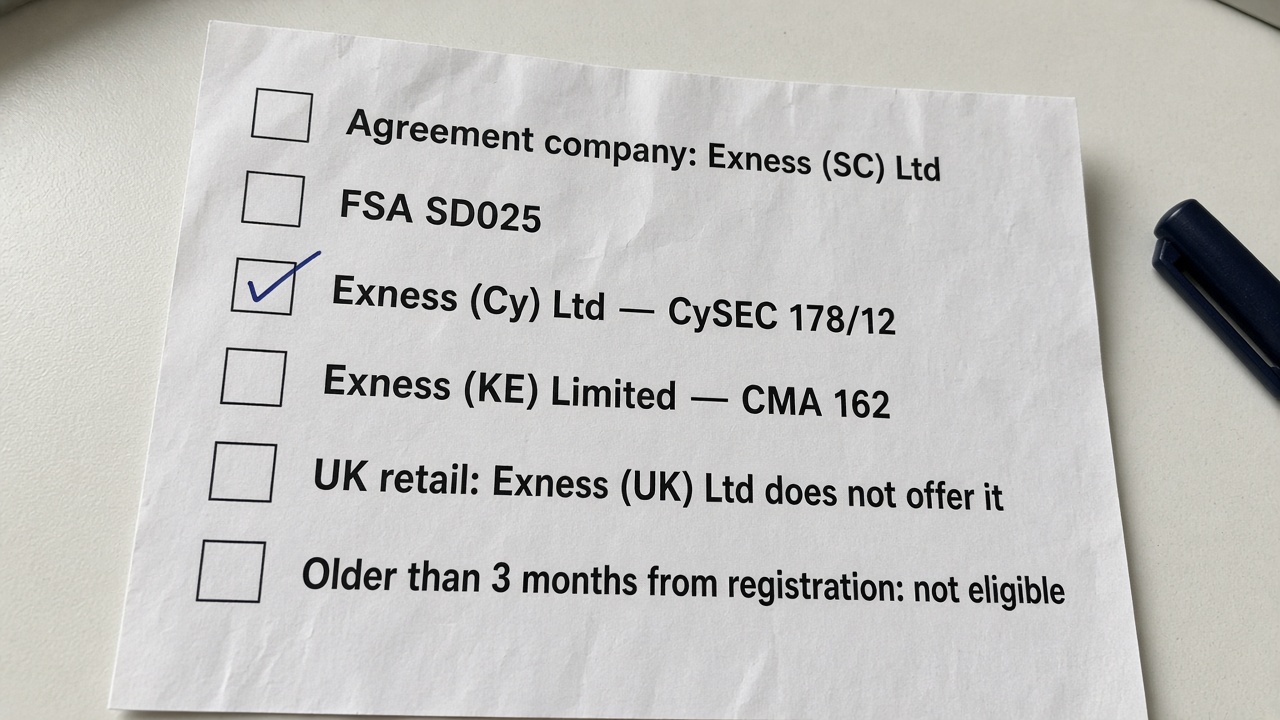
A listed rate becomes a possible credit only when the account, the symbol, the lot unit, and the timing all match. Miss one of them and the arithmetic in the last section describes a different trade.
The account is added on FXBee, using the column you intend to trade.
The account type matches that column. Standard and Standard Cent share the percentage column. Pro has its own percentage. Zero, Raw Spread, and Standard Plus are the dollar columns.
The symbol matches the row: forex, gold, index, or crypto. A gold rate is not a forex rate.
Volume is in standard lots when the cell is a dollar amount per standard lot. A cent lot is 0.01 of that unit.
The trade falls inside FXBee's window. Claims are limited to transactions in the last three months before the rebate account is added. Transactions older than three months from account registration are not eligible for payment.
The broker does not class the activity as churning. The terms say churning identified by a broker may void commissions and rebates.
An account opened earlier is a separate question from the rate card. Some arrangements can attach an eligible existing account, and many cannot if the account was never tracked. The checks in an existing broker account are the right next read, and which trades count covers the activity rules that are not specific to one broker. Get the answer for your entity and account type before you place trades in order to collect a credit.
The company on the client agreement is the one that holds the trading account. Exness publishes agreements for separate companies, including Exness (SC) Ltd, Exness (Cy) Ltd, Exness (KE) Limited, Exness (VG) Ltd, and Exness B.V., on its legal documents page. The Exness (SC) Ltd client agreement identifies the firm as a Securities Dealer with Seychelles Financial Services Authority licence SD025. The CySEC register lists Exness (Cy) Ltd under licence 178/12. Kenya's Capital Markets Authority licensee list includes Exness KE Limited under licence 162. A licence number belongs to that company. It does not travel with the brand to every client.
On its regulation page, Exness says Exness (UK) Ltd, Financial Services Register number 730729, does not offer services to retail clients. A retail reader should not treat that UK firm as the company on the agreement. If a page cites 730729, confirm the firm reference on the FCA register, then read the name on your own contract. FXBee's terms add a local-law limit of their own: services are not available where offering them would be illegal, and compliance with local law is the reader's responsibility. Margin trading carries a high level of risk and may not suit you. This page is not investment, tax, or legal advice.
Open the account from the Exness page on FXBee
Start on the Exness rebate page. Sign in, or create the FXBee account, and use the account path on that page for the column you have already read. After the trading account exists, open the client agreement and write down the company name. Then compare the symbol suffix and the account type with the column you used.
Keep the ticket: symbol, volume, account type, and the spread or commission on that fill. The examples above only work if those inputs are the ones on the ticket. The Exness page describes a daily rebate to an FXBee wallet or to the trading account. Use that choice only if it is still shown when you set the account up. Payment fees, including transfer costs, may be deducted from the amount. If a later credit does not match the row you saved, send the ticket to FXBee support and ask which input differed. The company on the agreement remains the party on the trading account.
What the cashback leaves unchanged
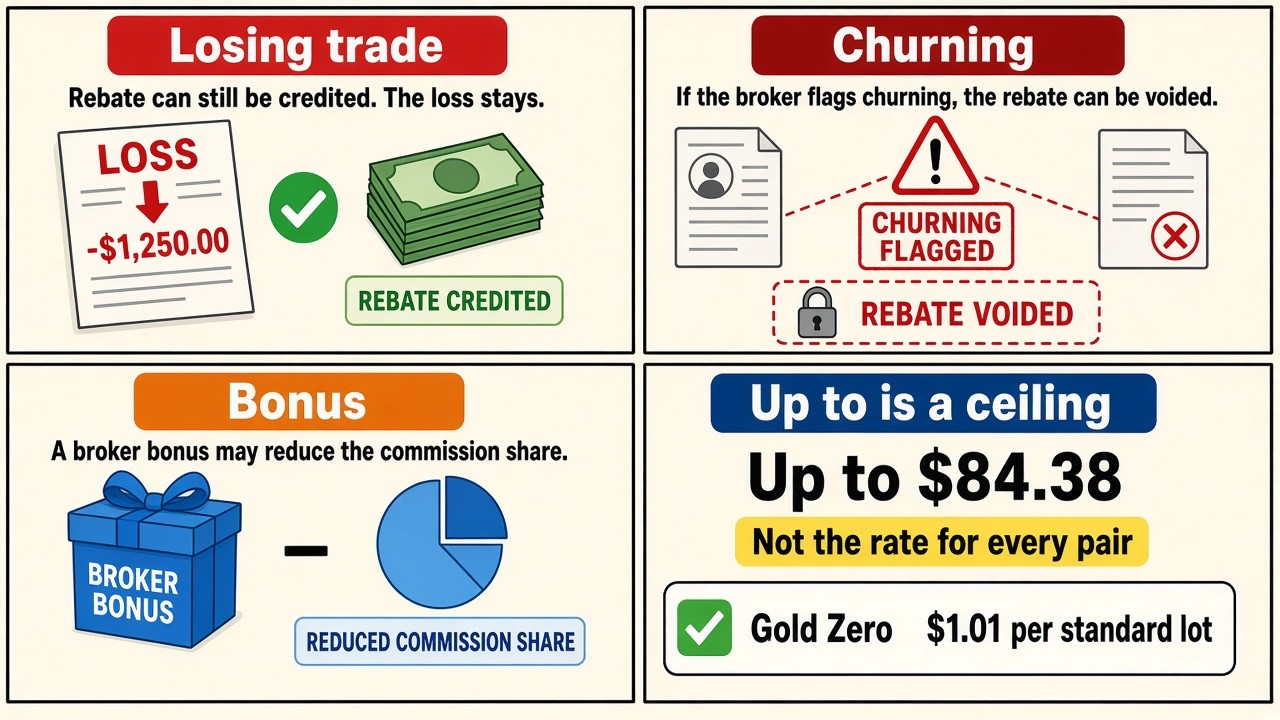
The spread on the ticket is still the broker's spread. On Raw Spread and Zero, the commission is still charged per side. If a rebate is paid, it arrives later as a separate credit. It is not a discount already inside the bid and ask.
A loss stays a loss. The Exness page describes the rebate as accumulating from completed volume, profit or not. That is a statement about cost, not about the trade's result. Extra size taken only to collect cashback adds market risk, and activity a broker identifies as churning can void the rebate rather than increase it.
A broker bonus can shrink the credit even when the public card looks the same. The terms say promotions are managed by third parties and that a bonus may reduce the commission FXBee receives, which can reduce the rebate. Read the bonus rules and the cashback row as two documents that can interact.
Leverage, margin call, stop-out, and any compensation or negative-balance wording follow the account and the entity. They are not set by the cashback card. Client money protection that exists for one licensed company is not a promise to clients of another company in the group. Recheck the live account after you know which agreement you signed.
Check the same trade twice before you count the credit
Pick one symbol, one account, and one holding period. Write the spread cost, the commission, and any swap or non-trading fee in one currency. Subtract a cashback amount only after you can recompute it from the live cell and the standard-lot volume. If the cell says "up to," leave the cashback blank until you have that symbol's rate. A ceiling is not an estimate.
That net figure is the useful comparison, which is why a headline percentage is a weak way to rank brokers. The walk-through of cost beyond the headline rebate, and the worksheet for an effective spread, both start from the same trade rather than from the largest number on a card. The broker rebate comparison is where the other listings sit if you are weighing more than one firm. Each of those listings has its own account rules.
Exness rebates are worth calculating when the column, the symbol, and the lot unit are the ones on your ticket, and when the trade still falls inside the registration window in the cashback terms. The company on the client agreement is the one whose register entry and trading conditions you use. The listing is the credit to check after that.
FAQ
What are Exness rebates?
Exness rebates on FXBee are cashback based on trading volume. The current listing shows Standard and Standard Cent at 24% of the spread, Pro at 13.8% of the spread, and Zero, Raw Spread, and Standard Plus as a dollar amount per standard lot. A completed trade can still accrue a credit if it loses money. The credit does not change the fill price and does not reduce the risk of the position.
How are Exness rebates calculated per lot?
Use the cell for that account and symbol. A dollar cell is multiplied by standard-lot volume: Zero gold at $1.01 times 2.00 standard lots is $2.02 in the example. A percentage cell needs a spread cost first. A 0.8 pip spread on 1.00 standard lot of a USD-quoted pair is about $8, and 24% of that is $1.92. These are examples from the listed rates, not a guaranteed payment.
Which Exness account types are on the cashback listing?
The FXBee Exness page lists Standard and Standard Cent, Pro, Zero, Raw Spread, and Standard Plus. The Exness Help Center list of account types names Standard Cent, Standard, Pro, Raw Spread, and Zero. Standard Plus is not in that list of five, although the forex conditions page still mentions it for market execution. Use the column that matches the account you hold, not a neighboring column with a larger number.
Is a Standard Cent lot paid as a standard lot?
No. Exness defines 1 cent lot as 1,000 USD, equal to 0.01 standard lot. Symbols use a -c suffix, and the balance is shown in a cent currency such as USC. The rebate note says calculation is per standard lot. On the percentage columns, which are the ones Standard Cent uses on this card, the pip value is about one hundredth of a standard-lot pip, so the cashback is smaller by about the same proportion.
What does "up to" mean on the forex, index, and crypto rows?
It is a ceiling for that symbol group, not the rate on every symbol. Zero forex is listed as up to $84.38 per standard lot, while Zero gold is a flat $1.01. Multiplying your lots by the ceiling will overstate the credit. Until you have the rate for the exact symbol, leave that cashback line out of the cost estimate.
Does a losing trade still earn Exness cashback?
The Exness page on FXBee says the rebate accumulates when the trade is completed, whether or not the trade made a profit. The loss remains a loss. Any credit that is later paid only returns part of an eligible trading cost. It is not a reason to increase size, and trading a broker identifies as churning can void the rebate.
Can an existing Exness account be added for cashback?
Sometimes an eligible existing account can be linked, and sometimes the account has to be opened through the tracked path. FXBee's terms limit claims to transactions in the last three months before the rebate account is added, and they exclude transactions older than three months from registration. Ask about your entity, account type, and country before you rely on a rate for an account that is already open.
How far back can trades be included?
Under the cashback terms, rebate claims are limited to transactions in the last three months before you add the rebate account to the system. Trades older than three months from the time of account registration are not eligible for payment. The same terms allow an offer to be changed or stopped without notice, so the window is not a promise that a past trade will be paid.
Does the rebate change the Exness spread when I click?
No. The spread, and any commission on Raw Spread or Zero, is charged by the broker on that ticket. A rebate is a later credit if the account, symbol, lot unit, and timing qualify, and if the payment is made. The terms say there is no obligation to pay in every case, and they give a broker's refusal to pay as one example of a payment problem.
Which company holds the Exness trading account?
The company printed on your client agreement. Exness groups agreements under separate firms, including Exness (SC) Ltd, Exness (Cy) Ltd, Exness (KE) Limited, Exness (VG) Ltd, and Exness B.V. The Seychelles agreement for Exness (SC) Ltd cites FSA licence SD025. CySEC lists Exness (Cy) Ltd as 178/12. Kenya's CMA list includes Exness KE Limited as licence 162. The register entry follows that company, not every client who uses the brand.
Does the UK Exness firm serve retail clients?
Exness's regulation page says Exness (UK) Ltd, Financial Services Register number 730729, does not offer services to retail clients. A retail reader should use the company named on their own agreement rather than treat the UK firm as the counterparty. Confirm the register entry if a page cites that number. Whether you can open an account still depends on the entity that accepts your application and on local law.
Can a broker bonus reduce the cashback?
It can. FXBee's terms say promotions and bonuses offered through the site are managed by third parties, and that a broker bonus may reduce the commission received, which can affect the rebate. The percentage on the public card can look unchanged while the credit on the account is smaller. Read the bonus conditions together with the cashback row before you assume both apply in full.
Why is commission quoted per side when cashback is per lot?
They come from different documents. The Exness account table states Raw Spread commission as up to 3.50 USD each side per lot, and Zero commission from 0.05 USD each side per lot. The FXBee footnote says the rebate is calculated per standard lot and does not say per side. A round turn can incur the per-side commission twice. Put both amounts in one currency for the same trade before you subtract.
How do I open the rebate account on FXBee?
Open the Exness rebate page, sign in to FXBee, and use the account path on that page for the column you plan to trade. When the trading account exists, read the company name on the client agreement and the symbol suffix, and compare both with that column. Choose a wallet credit or a trading-account credit only while that option is still shown. Keep the ticket so a later credit can be checked against the row.