
Trading costs are easy to underestimate because they arrive in different forms: the bid-ask spread, a stated commission, financing charges, conversion costs, and sometimes a later forex cashback credit. The useful number is not a headline spread or a rebate rate on its own. It is the cost that remains after every eligible charge and credit has been converted to the same unit.
This guide shows U.S.-based readers how to calculate that number, compare account structures, and assess a rebate arrangement without treating it as a reason to trade more. Forex and margin trading can result in substantial losses; this is educational information, not investment, legal, or tax advice.

Start with the effective forex trading cost—not the advertised spread
A tight raw spread can still be expensive if a commission is high. A commission-free account can still be costly if the spread is wider. And a cashback payment only lowers your cost when your account, trades, and payout method are eligible and the credit is actually received.
For a comparable round-turn trade, use this all-in formula:
Effective cost = spread cost + round-turn commission + other trade-related charges − eligible cashback actually credited
“Other trade-related charges” may include overnight financing (swap/rollover), account-currency conversion, and withdrawal or transfer charges where applicable. Keep them separate when comparing intraday execution cost with the cost of holding a position overnight.
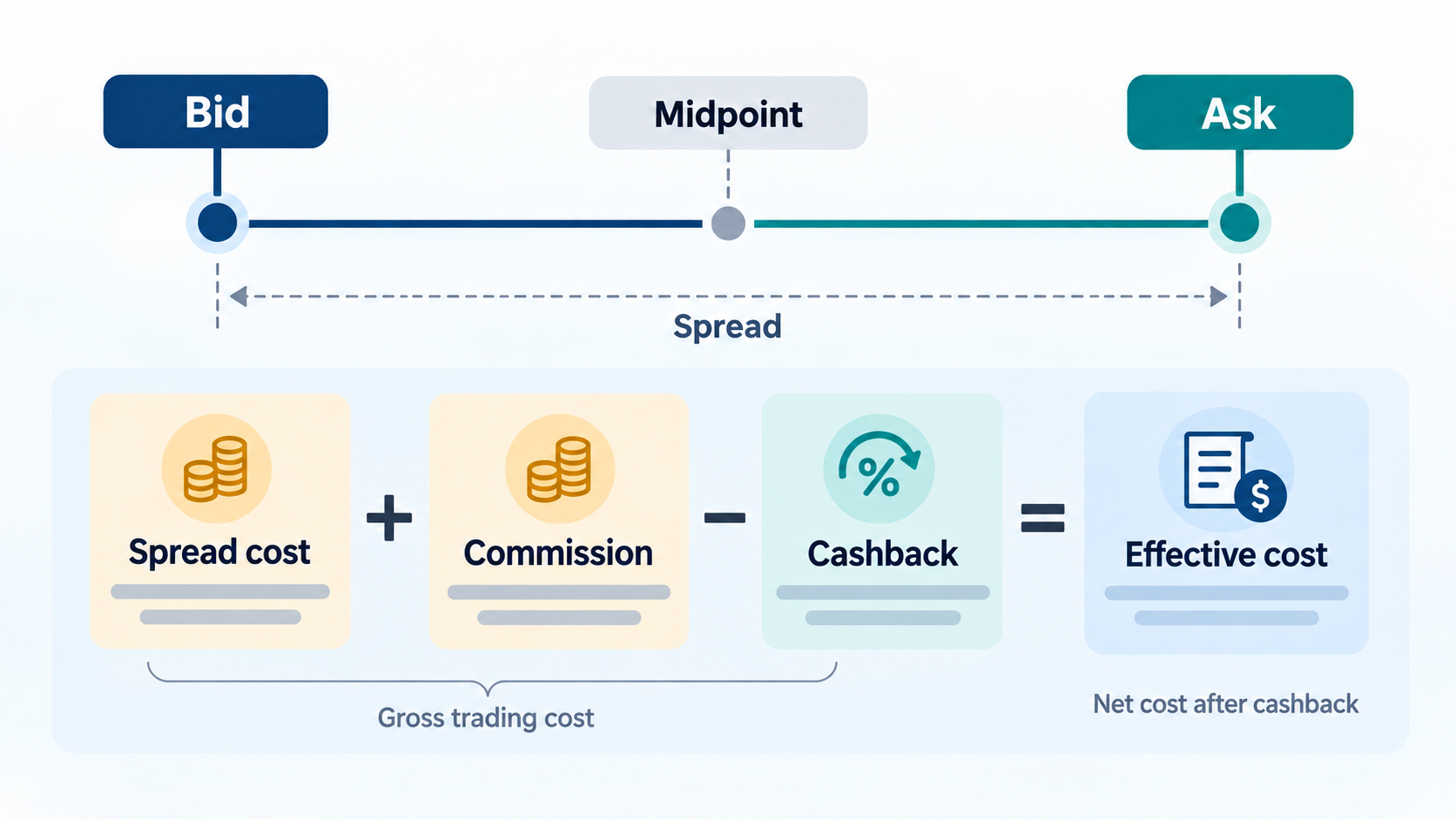
The U.S. SEC cautions that a “commission-free” forex transaction may still carry cost through a wider bid-ask spread, and that some dealers may charge both a commission and a markup. Read the trade confirmation and pricing disclosure rather than relying on a label alone. Read the SEC’s forex investor guidance.
Calculate the spread cost in dollars
The spread is the difference between the bid and ask quote. For a market buy, you normally enter at the ask; for a market sell, you normally enter at the bid. The price must move enough to overcome that difference before the position reaches the midpoint equivalent of break-even, before commission and other charges.
For a pair quoted in USD such as EUR/USD, a standard lot is commonly 100,000 units and one pip is approximately $10 per standard lot. That approximation is pair- and account-currency-specific, so calculate the pip value in your platform for each instrument.
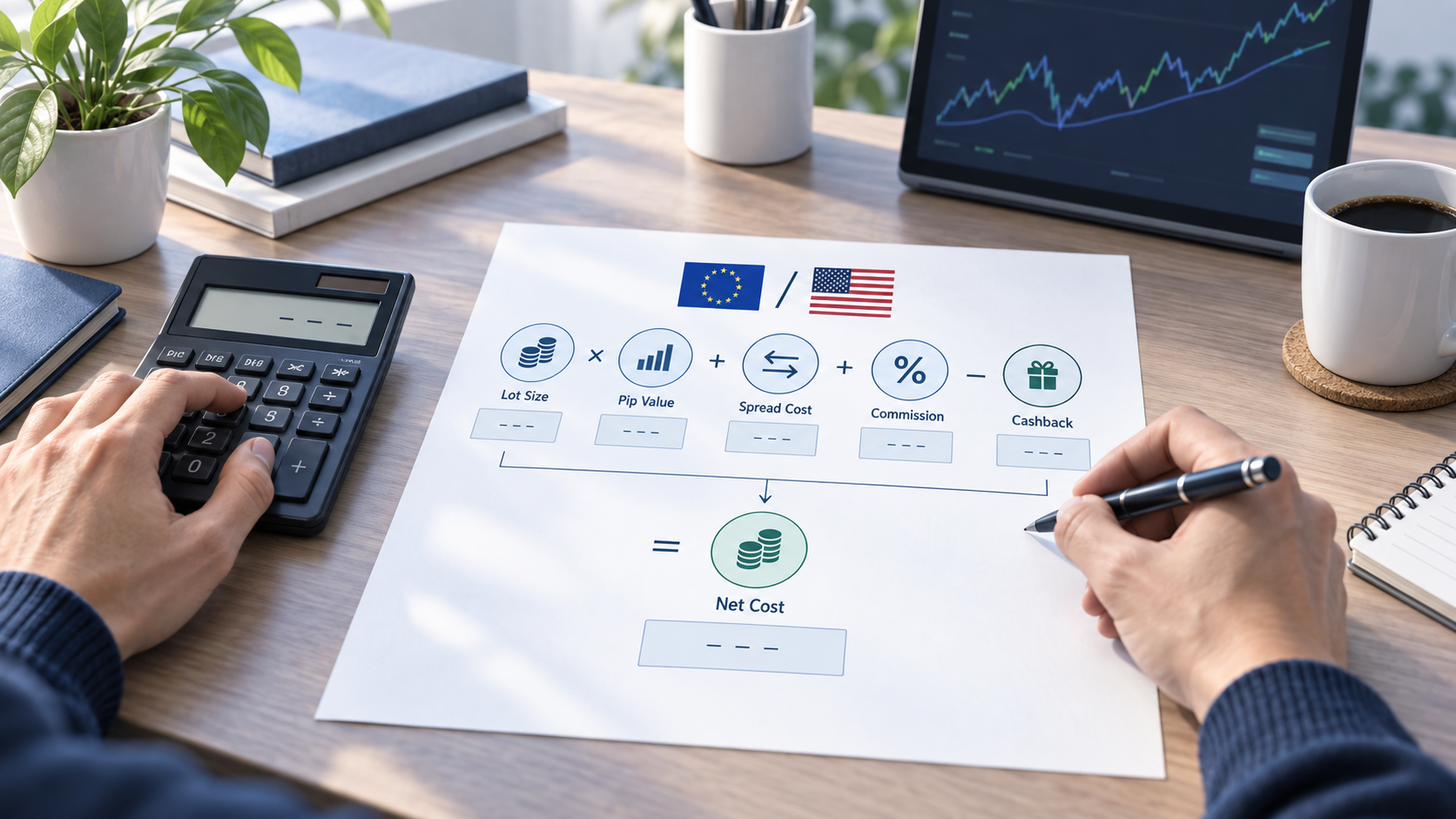
Spread cost (USD) = spread (pips) × pip value per lot (USD) × number of lots
Example: if EUR/USD has a 0.8-pip spread, the pip value is $10 per standard lot, and you trade one standard lot, the estimated spread cost is 0.8 × $10 × 1 = $8.00. A 0.10-lot trade would be about $0.80 under the same assumptions.
Do not assume the displayed spread is fixed. It can widen around economic releases, rollover, thin-liquidity periods, and fast markets. The execution price and confirmation are more useful records than an indicative quote seen before the order.
Add commission correctly: use the round-turn amount
Raw-spread accounts often quote commission per side or per lot per side. A round turn includes opening and closing the position. If the charge is $3 per standard lot per side, the commission for one standard-lot round turn is $6—not $3.
Round-turn commission = commission per side × 2 × number of lots
Check whether the broker’s price schedule is denominated in your account currency, whether it changes by instrument or volume tier, and whether the amount shown is a commission, a markup, or both. NFA rules require Forex Dealer Members to disclose applicable commissions and other fees on a per-trade basis; depending on the execution model, disclosures can also include markup/markdown or midpoint spread cost. See NFA Rule 2-36 transaction-disclosure requirements.
Worked example: converting a trade into an effective spread
Assume a one-standard-lot EUR/USD round turn in a USD account. This is an illustrative calculation, not an FXBee rate, a broker quote, or a prediction of trading results.
| Input | Example assumption | Calculation |
|---|---|---|
| Spread | 0.8 pips | 0.8 × $10 pip value = $8.00 |
| Commission | $3.00 per side | $3.00 × 2 sides = $6.00 |
| Eligible cashback credit | $2.40 per lot | Subtract $2.40 after it is credited |
| Effective cost | — | $8.00 + $6.00 − $2.40 = $11.60 |
| Effective spread equivalent | — | $11.60 ÷ $10 = 1.16 pips |
The effective-spread equivalent is a comparison tool: divide the cost remaining after credits by the pip value of the position. If you include swap or conversion costs, state that clearly because it is then an all-in holding-cost equivalent rather than an execution-only measure.
Compare spread-only and raw-spread accounts on the same basis
Use identical assumptions—pair, trade size, session, expected holding period, account currency, and rebate eligibility. Comparing a minimum spread in one account with an average spread in another, or comparing one-way commission with a round-turn spread, will distort the result.
| Question | Why it matters |
|---|---|
| Is the spread minimum, typical, or live at your trading hour? | Minimum spreads may not represent your actual fills. |
| Is commission quoted per side or round turn? | A per-side fee needs to be doubled for a full open-and-close cycle. |
| Does the rebate apply to this account type and instrument? | Eligibility can differ by broker, account, symbol, and jurisdiction. |
| When is cashback posted and can it be reversed? | Pending or reversed credits should not be treated as immediate cash savings. |
| Will the position be held overnight? | Rollover can outweigh a small execution-cost difference. |
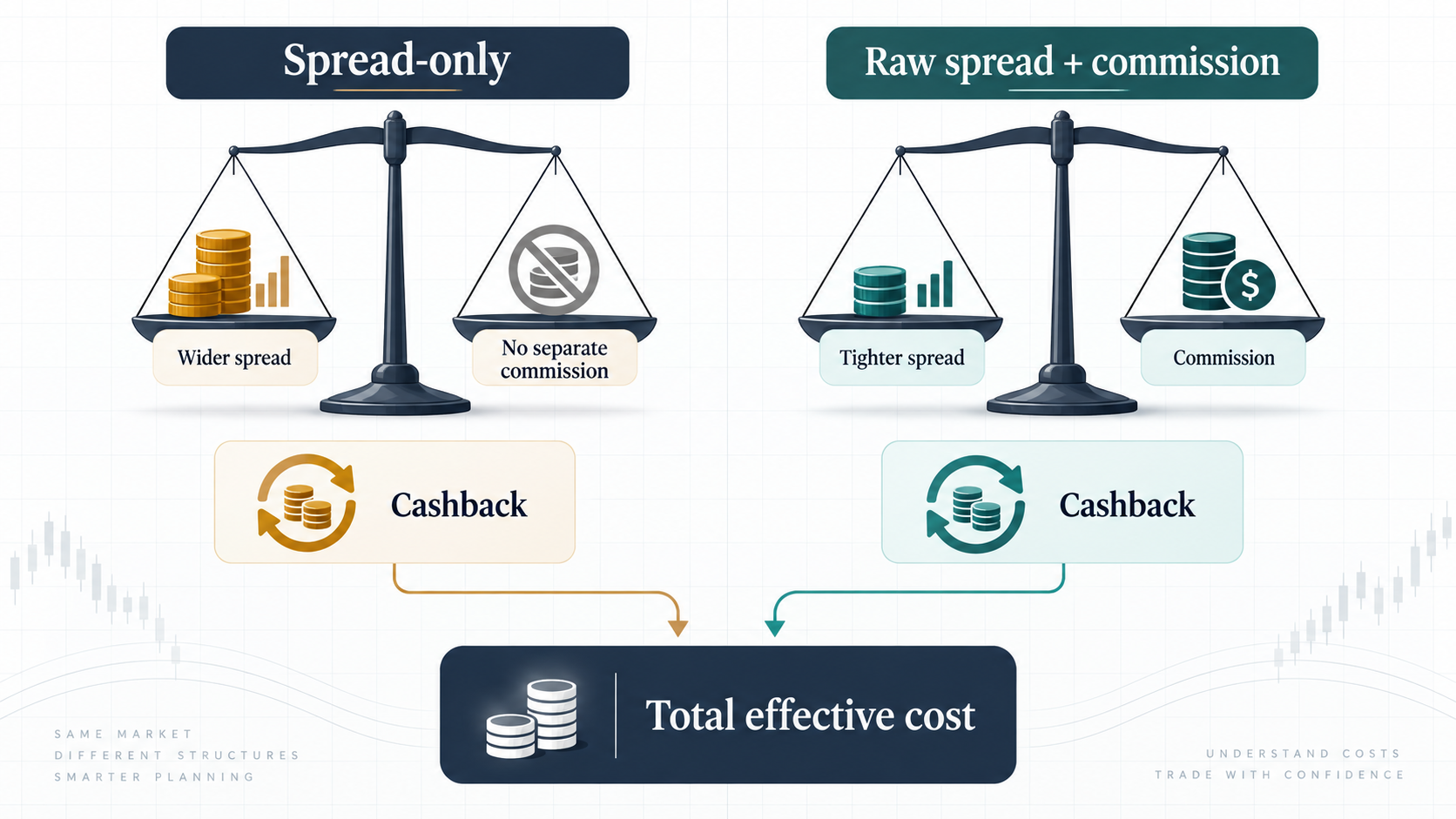
A lower effective cost does not establish that an account is suitable. Execution quality, available instruments, platform stability, financing, account protections, and legal availability matter too.
How forex cashback changes the math—and where it may not
A forex cashback or rebate program commonly returns part of the compensation generated by eligible trading activity. It does not change the broker’s quoted bid or ask at the time of execution. Instead, it is a later credit that may reduce your net cost if the program’s rules are met.
A sound forex cashback trading cost comparison treats the credit as one input in the calculation, not as a substitute for checking the broker’s complete pricing and execution terms.
FXBee describes itself as a third-party rebate platform and states that rebate amounts can vary by broker policy and account type. Its terms also say offers can change, payments may depend on broker data, and trading considered churning by a broker may void commissions or rebates. Review the current broker and rebate comparison page, support information, and terms of use before linking an account or building a cost model around a credit.
For a forex cashback trading cost worksheet, record the rebate in the same unit as the trading cost. A flat $2.40-per-lot credit is simple to subtract. A percentage-of-spread rebate requires you to calculate the actual spread cost first. A credit based on an introducing-broker arrangement may have additional exclusions, timing rules, or account-linking requirements.
Keep the incentive from changing your behavior
A rebate should not justify wider stops, larger positions, excess turnover, or trades that do not fit your plan. An avoided unnecessary trade has zero spread and commission cost. If a program rewards volume, use a written trade plan and review whether the incentive is affecting frequency rather than simply offsetting costs you already chose to incur.
U.S. checklist before opening or linking a retail forex account
Verify the firm and product are available to U.S. retail customers. Retail off-exchange forex has specific U.S. regulatory boundaries. The CFTC advises prospective traders to work with a CFTC-registered dealer, while NFA’s free BASIC database can be used to research derivatives-industry firms and professionals.
Read the broker’s current pricing and execution disclosures. Save the spread, commission, financing, and conversion terms used in your model.
Confirm the rebate path before trading. Ask whether an existing account can be linked, which account types and instruments qualify, when credits post, and what can cause a reversal.
Test your arithmetic on a small, permitted sample only if you independently decide to trade. Compare your confirmation and account history with the model; do not manufacture turnover to earn rewards.
Consider tax and recordkeeping separately. The tax treatment of foreign-currency transactions depends on facts and instruments. Keep confirmations, statements, and rebate records and consult a qualified U.S. tax professional for your circumstances.
For context on counterparty and pricing risks, the CFTC’s forex fraud guidance notes that retail traders typically connect to a dealer rather than a registered exchange. That makes it especially important to verify the firm, retain transaction records, and understand how the displayed price is formed.

The practical takeaway
Calculate every cost in dollars first, subtract only cashback that is both eligible and credited, then convert the remainder to pips if that makes account comparisons easier. Re-run the worksheet when your trade size, instrument, account currency, holding period, or broker terms change. A clear effective-cost number helps you compare like with like; it does not remove the risk of loss or replace due diligence.
Frequently asked questions
What is the effective spread in forex?
The effective spread is a way to express your net trading cost in pips after adding applicable commission and other costs, then subtracting eligible cashback credits. It is a comparison metric, not a broker quote. Use the actual pip value and completed-trade records for the relevant pair and lot size.
How do I calculate forex cashback trading cost?
Add spread cost, round-turn commission, and any relevant fees in the same currency. Subtract the cashback only after confirming the trade and account qualify and the rebate is credited. Divide the net dollar amount by your position’s pip value if you want a pip-equivalent cost.
Does cashback reduce the spread quoted by my broker?
Usually, no. The quoted bid-ask spread at execution remains the broker’s price. A rebate is generally a separate later credit, so it can reduce net cost but does not change the entry or exit price. Check the program’s current payment timing and eligibility rules.
Is a raw-spread account always cheaper than a spread-only account?
No. A raw spread can be offset by a per-side commission, and spreads can vary with conditions. Compare the same pair, lot size, trading hour, commission basis, financing assumption, and confirmed rebate eligibility. The lowest advertised component is not necessarily the lowest all-in cost.
Do I double a forex commission quoted per side?
For a normal open-and-close cycle, yes: multiply a per-side commission by two to obtain the round-turn commission. Also multiply by the number of lots and verify the broker’s unit. Some schedules present a round-turn rate already, so read the label carefully.
Should overnight swap be included in effective trading cost?
Include it when you are comparing the all-in cost of holding a position overnight or longer. Keep it separate for an execution-only comparison, because swap depends on the pair, direction, holding time, broker methodology, and changing interest-rate conditions.
Can a rebate be reversed or withheld?
It can. Terms may limit eligibility by account type, trade behavior, broker policy, account-linking date, instrument, or jurisdiction. Treat a pending rebate as pending, and keep a record of the completed trade, the rebate rate shown at the time, and the eventual credit.
Can U.S. residents use every forex rebate program?
No. Availability can depend on the broker, program, product, and applicable jurisdictional rules. Confirm that the dealer is permitted to serve U.S. retail clients and that the rebate arrangement is available for your account before opening, transferring, or linking an account.
Where can I verify a U.S. forex firm?
Start with the CFTC and NFA. NFA BASIC is a free official research tool for derivatives-industry firms and professionals. Check a firm’s status, disciplinary history, and the precise entity name rather than relying on a brand name or social-media profile.
What records should I keep for forex cost calculations?
Retain order confirmations, account statements, commission and financing records, broker pricing disclosures, rebate terms, and the actual rebate credit history. Good records help reconcile your model with real costs and support conversations with a qualified tax professional or the provider’s support team.
Risk disclosure
Forex trading on margin involves substantial risk and may not be appropriate for every investor. Cashback, lower fees, or a smaller effective spread do not protect against market loss, leverage risk, slippage, counterparty risk, or service interruption. Verify current terms and regulatory eligibility independently before acting.