
XM Rebates on FXBee are cashback on the volume you finish. The XM card offers two daily destinations: the FXBee wallet, or the trading account itself. The rate cell on that card says “Rebate Details Coming Soon.” There is no dollar-per-lot figure to copy yet. What you can settle now is the account name, the lot you close, and which of those two payouts you want.
A rebate changes one slice of trading cost. It is credited on a completed trade whether that trade made money or lost it. It leaves the spread, any commission, and the firm on the account agreement where they were. Forex and CFD trading can still consume the money you deposit. Cashback is a poor reason to increase size.
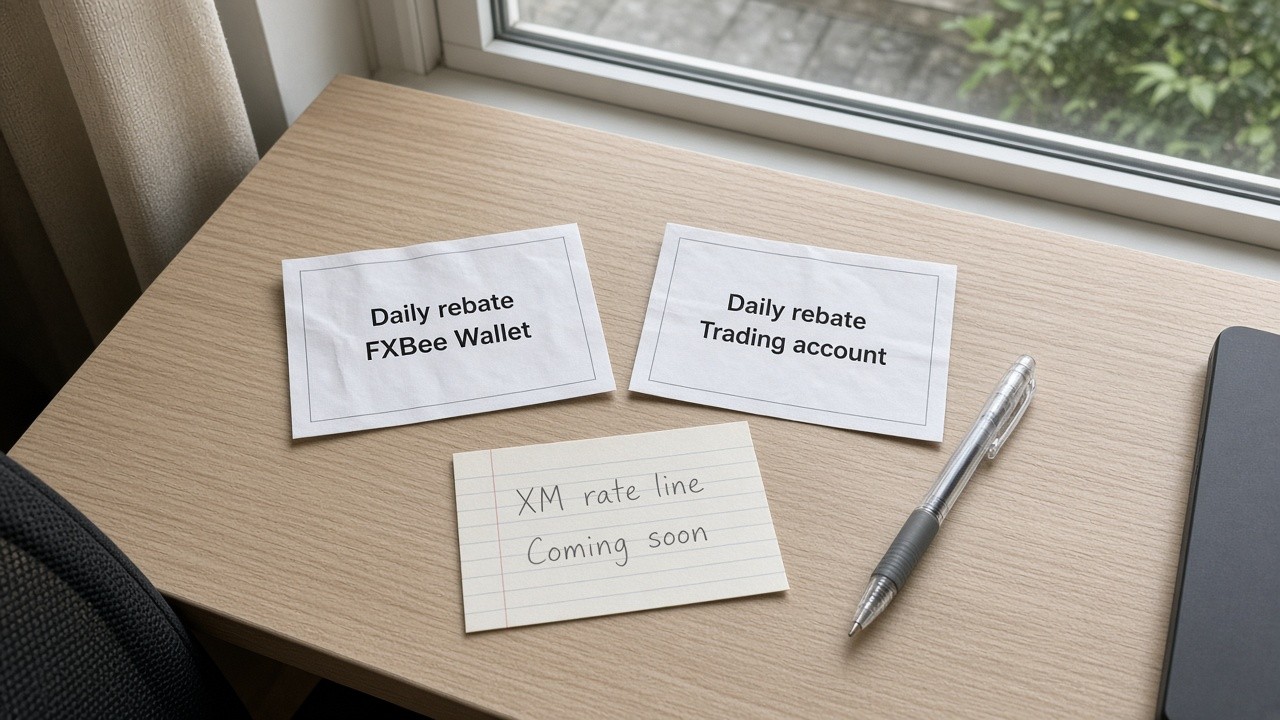
How XM Rebates are paid on this page
The card describes the cashback as a share of the lots you trade. When the trade is completed, the rebate accumulates. A winning ticket and a losing ticket are treated the same for that credit. The page then gives two methods: a daily rebate to the FXBee wallet, and a daily rebate to the trading account. Those are different places for the same idea. Wallet cashback sits with FXBee. A credit to the trading account sits with the balance you trade.
Other brokers on the broker comparison show weekly lines or an “up to” dollar amount. Those rows are their rows. The XM block is the one that still says the details are coming. Daily, weekly, and monthly schedules are compared in a separate article; for this card, both listed methods are daily.
New rebate signups start at Register. If you already use FXBee, Login is the same host. Someone who already holds an XM trading login, and wants to know whether cashback can be attached afterward, can read cashback on an existing account before assuming the wallet credit appears on the next ticket.
Account types on the XM card
The account line lists five names: Standard, Micro, Ultra Low Standard, Ultra Low Micro, and Shares. A future rebate row has to name one of them. A rate printed for Standard does not automatically price a Micro ticket, and a Shares trade is not a forex lot.
| Name on the card | What the rebate row has to match | What is easy to mix up |
|---|---|---|
| Standard | A forex lot row for that account, once one is published | Using another broker’s “up to” dollar figure |
| Micro | The micro contract, which is the smaller unit | Treating one micro lot as one standard lot |
| Ultra Low Standard | Its own row, even though the contract is a standard lot | Reusing the Standard cashback line |
| Ultra Low Micro | Its own row, on the smaller contract | Reusing the Ultra Low Standard line |
| Shares | A share commission schedule, if cashback is offered there at all | Dividing a forex per-lot rebate by a share quantity |
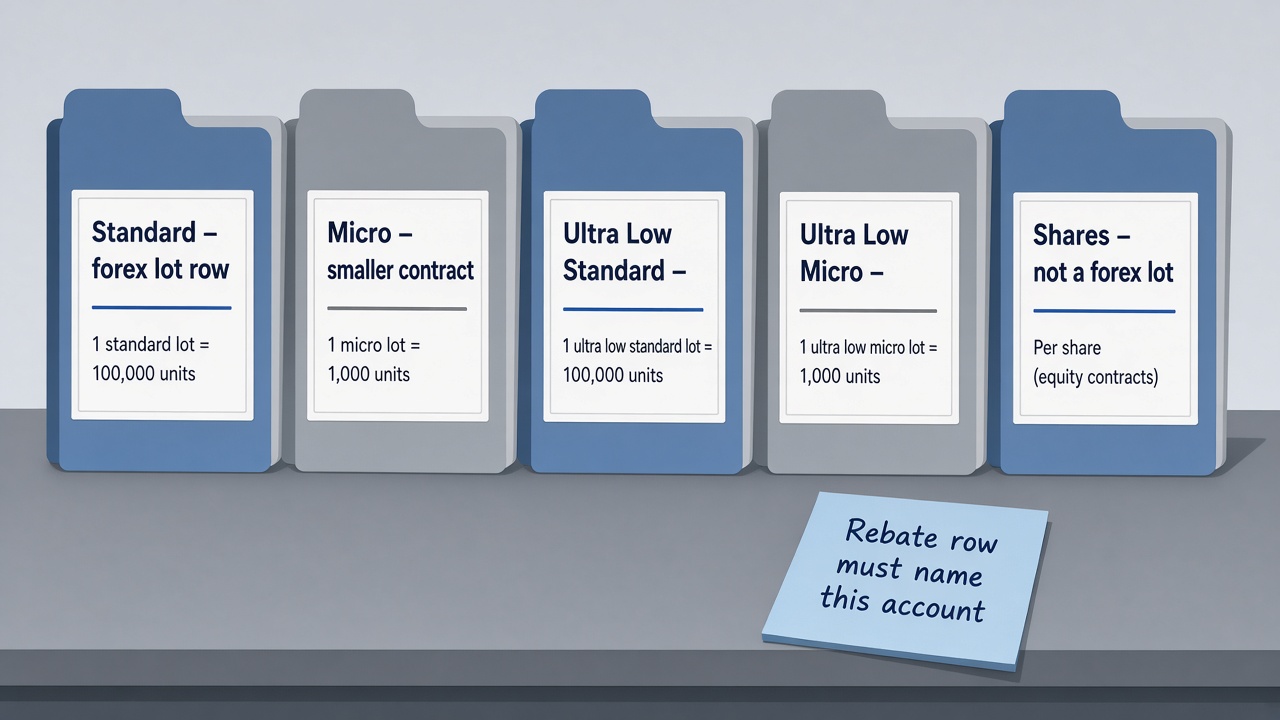
Standard and Ultra Low Standard are both standard-size contracts in ordinary lot language: 100,000 units of base currency. Micro and Ultra Low Micro are the smaller contract, 1,000 units. The card itself does not print those unit counts, so the specification on the account you open is the one to match. Ultra Low is a separate pricing plan from Standard. Sharing the word “standard” in the longer name does not make the cashback identical.
XM Zero is a different name, and it is absent from this five-name list. The costs-and-charges document for Trading Point of Financial Instruments Ltd describes a commission on XM Zero accounts of USD 7 per USD 100,000, and its worked example charges USD 3.50 when the position opens and USD 3.50 when it closes. That company is the CySEC firm, licence 120/10, company number HE 251334. A separate XM fee page has published a Zero commission of USD 10 per USD 100,000. Both numbers are commissions on an account this card does not list. Neither number is an FXBee rebate.
Cashback rates: read the row that is actually filled in
Until the XM table grows a symbol, an account name, and an amount, there is no XM cashback rate to quote. The comparison page is full of other people’s figures, including “up to” dollars per lot and a percentage of spread. Those belong to the broker block they sit in. Pasting one of them onto XM because the XM cell is empty prices the wrong firm.
When a row does appear, four fields decide whether the number is usable:
Symbol. A forex line and a gold line on other cards on this site are already different.
Account name. It has to be the account you trade, from the five names above.
Side of the trade. Per side and round turn change the total on a trade you open and close.
Lot unit. Cashback per lot only works after you know whether the line means a standard lot.
How forex cashback works is the general version of this mechanic. Which trades count is the filter for tickets that never enter the total: wrong symbol, wrong account, or a position the program excludes. Eligibility is worth reading before a volume target, because a lot that does not count contributes nothing to either payout.
Lot size scales the credit. Leverage scales the margin.
The card prints a minimum transaction size of 0.01 lots. If a future XM line is written per standard lot, the cashback moves in proportion to the lots you close. One tenth of a lot is one tenth of that line. One hundredth of a lot, the 0.01 size, is one hundredth of that line. The chart below is that fraction only. It is not a published XM dollar rate, because the card does not have one.
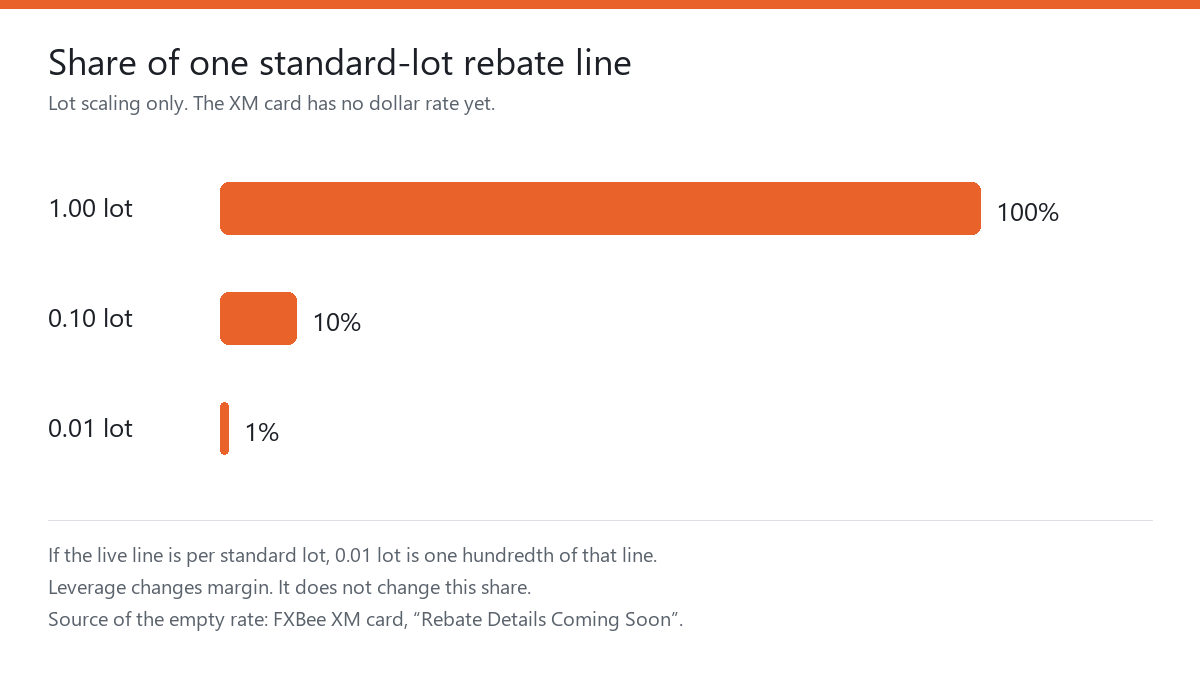
Leverage does something else. It changes how much margin a position uses. It does not multiply the rebate, and it does not change the pip value of a given lot. The XM card prints a maximum leverage of 1000:1. That field is not the retail rule for every company the card names. For a retail client of that CySEC firm, the European product-intervention measure caps major currency pairs at 30:1. ESMA’s March 2018 measures set that 30:1 major-pair limit, with lower caps on other underlyings. How leverage affects a result is about margin and loss, not about a larger cashback.
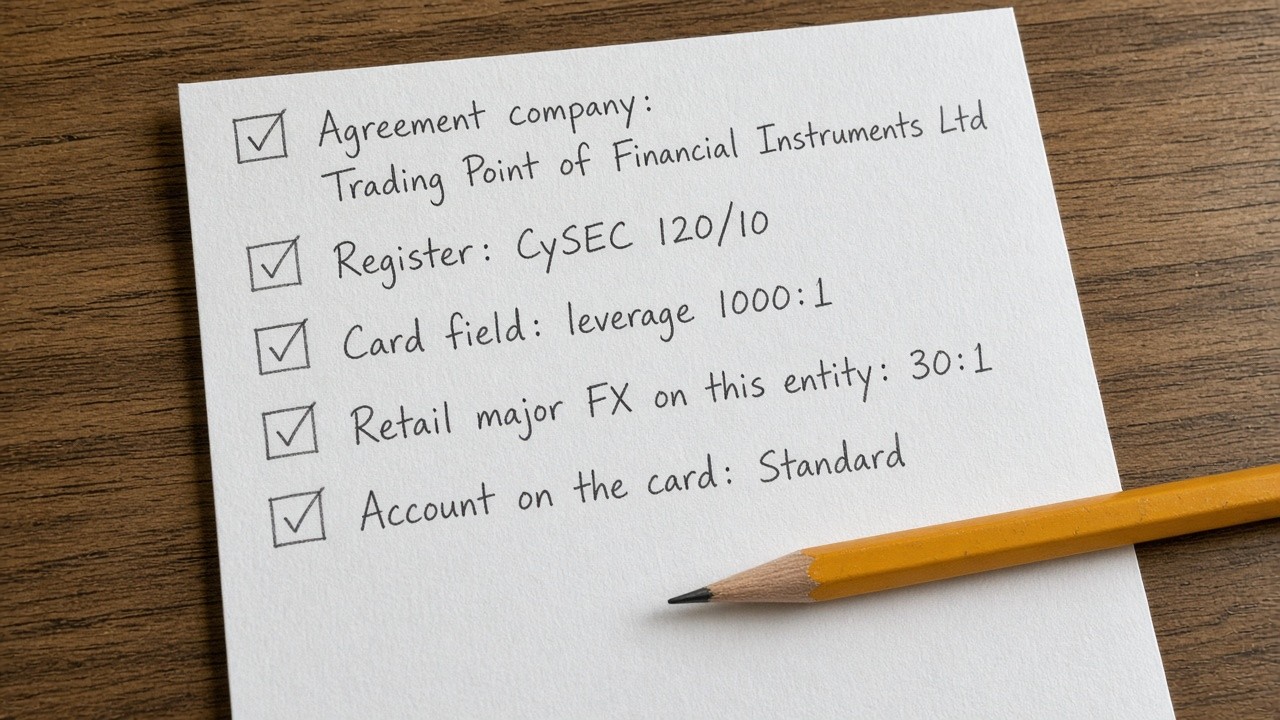
The same XM card names more than one company. A licence number belongs to the company that holds it. The 30:1 major-pair cap above is the retail rule attached to the CySEC firm, not a sentence that covers every company printed beside it. The listing also prints a minimum deposit of 5 USD. Treat that as a field on the card, and read the agreement for the company that will actually hold the account.
What to line up before you count on the cashback
The company name on the account agreement, and the register number that belongs to that company.
The account you will trade: Standard, Micro, Ultra Low Standard, Ultra Low Micro, or Shares.
The payout you selected: FXBee wallet, or the trading account, both described as daily on this card.
The lot you actually close, measured in the same unit as the rate line.
Whether that line, once it exists, is per side or round turn.
Which symbols and tickets the program counts.
A filled rate row can still move. Programs change by account, region, and the company on the agreement. The number you trade against is the one on the live card for your account on the day the ticket closes, not a screenshot of a neighbouring broker.
Questions about the XM cashback
What are XM Rebates on FXBee?
They are cashback on completed trading volume. The XM card pays that credit daily, either to the FXBee wallet or to the trading account. The rate table on the card does not yet show a dollar amount.
Why is there no cashback rate in dollars?
The rate cell says “Rebate Details Coming Soon.” Other brokers on the comparison page publish “up to” figures and percentages of spread. Those figures stay with their own blocks. They are not a stand-in for the empty XM cell.
Does a losing trade still earn the rebate?
The XM page says the rebate accumulates when the transaction is completed, whether the trade was profitable or not. The credit follows volume. It does not refund the loss, and it does not turn a losing ticket into a gain.
Wallet or trading account: what is the difference?
Both methods on this card are daily. The wallet credit stays in the FXBee wallet. The other credit is applied to the trading account. Pick the one that matches where you want the cashback to land, and keep that choice next to the account name when you reconcile a statement.
Which account types does the card list?
Standard, Micro, Ultra Low Standard, Ultra Low Micro, and Shares. A rebate row has to use the same name as the account you trade. Shares are priced as shares. They are not a forex lot with a new label.
Is a micro lot the same cashback as a standard lot?
Only if the rate line is explicitly per micro lot and you traded a micro lot. In ordinary contract sizes, a micro lot is 1,000 units and a standard lot is 100,000. One hundred micro lots equal one standard lot. Using the standard-lot dollar, once it exists, on a single micro lot overstates the credit by about a hundred times.
Where does XM Zero fit?
It does not appear on this card’s account list. The CySEC firm’s costs document describes a Zero-account commission of USD 7 per USD 100,000. Another XM fee page states USD 10 per USD 100,000. Those are commissions, and they follow the company on the agreement. They are not the FXBee rebate.
Is the 1000:1 leverage field the retail cap?
The card prints 1000:1 as a maximum. A retail client of the CySEC firm named in the article is under the European measure: 30:1 on major currency pairs, and lower caps on other underlyings. The card also names other companies. The cap you can use is the one in the agreement for the company that holds your account.
Does higher leverage increase the rebate?
No. Leverage changes the margin set aside for a position. The cashback, when a rate exists, follows the lots in the rate line. A 0.01 lot stays one hundredth of a standard-lot line if that line is per standard lot, whatever leverage the ticket used.
Per side or round turn: which one is XM?
The empty rate cell does not say. When a number appears, read whether it is charged once for the round turn or once on each side. A per-side figure on a trade you open and close is twice the one-side amount. Guessing from another broker’s row will not settle it.
I already have an XM account. Where do I start?
Start with the FXBee register or login, then the XM card, and read the note on cashback for an existing account. The trading account remains the one named in your client agreement. The rebate choice on this card is wallet or trading-account credit.
Which tickets might add nothing?
A ticket on a symbol the program skips, a ticket on an account the row does not name, or a position that never completes. The eligibility article is the checklist for those exclusions. Volume you hoped would count, and volume the program counts, are often different totals.
Can I treat the minimum deposit of 5 USD as universal?
The card prints 5 USD. That is a field on the listing. Shares accounts and accounts at other companies named on the same card can use a different minimum. The agreement for the company that holds the account is the figure to fund against.
Does the rebate make the account safer?
It reduces the cost slice the program pays back. The firm on the agreement, the leverage you are actually allowed, and the size of the position still decide the risk. A cashback credit is not protection against a loss, and it is not a forecast of profit.