
Leverage can make a modest forex price move meaningful to a small account—but it does exactly the same thing when price moves the wrong way. This guide shows how to use a forex profit calculator mindset: start with the price move and position size, then account for leverage, margin, spread, commissions, swaps, and your stop-loss. The examples are illustrative, not a recommendation to trade.

Leverage changes exposure, not the market’s direction
In forex, leverage lets a deposit known as margin support a larger position. A 1:30 ratio means that, subject to a provider’s rules, $1 of margin may control roughly $30 of notional exposure. The exchange rate does not become more predictable because leverage is available. What changes is the dollar value of each pip relative to the capital in your account.
That distinction matters. A 0.50% move on a $10,000 position has roughly the same gross dollar effect whether the position was funded with cash or margin. With leverage, however, the required deposit is much smaller—so the same dollar gain or loss becomes a much larger percentage of the funds set aside.
For U.S. retail forex, margin requirements set practical limits on leverage. The CFTC notes a 2% minimum security deposit for major currency pairs and 5% for other pairs, which correspond to maximum leverage of roughly 50:1 and 20:1, respectively. Rules, available instruments, and account terms can differ by jurisdiction and firm; confirm the current terms before trading. Read the CFTC’s retail forex advisory.
The forex profit calculator formula: calculate the trade before the leverage
A useful forex profit calculator separates three things that are often blended together: the price change, the position size, and the financing requirement. For a USD-quoted pair such as EUR/USD, a practical approximation is:
Gross profit or loss (USD) = pip movement × pip value × number of lots
For a standard lot of EUR/USD (100,000 units), one pip is commonly about $10. A mini lot (0.10 standard lot) is commonly about $1 per pip. The exact value can vary with the pair, contract specification, and the currency in which your account is denominated, so a calculator should use your broker’s current specifications.
Then estimate the capital tied up:
Required margin ≈ notional position value ÷ leverage ratio
Leverage belongs in the second calculation. It tells you how much margin is needed to open and maintain a position; it does not multiply the pips that occurred. This is why increasing leverage alone does not improve a trade’s gross dollar result if the lot size stays fixed. It simply makes it possible to take a larger position with the same deposit.
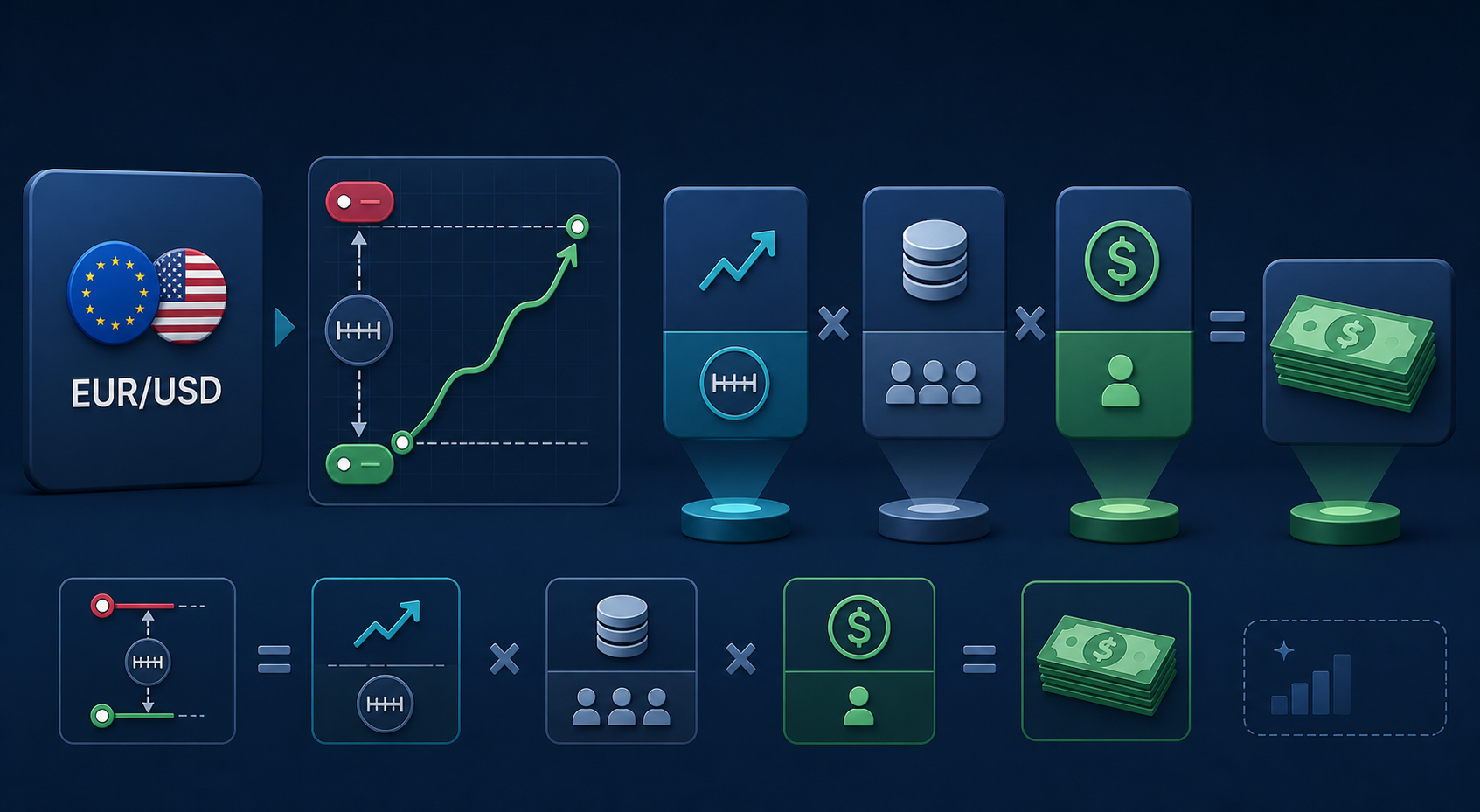
A step-by-step leveraged forex example
Suppose a trader buys 0.10 lot of EUR/USD at 1.0800 and later closes at 1.0850. This is a 50-pip favorable move. For this example, assume a USD account, an approximate pip value of $1 for 0.10 lot, and no costs yet.
The trade’s gross result is $50. At 30:1, the approximate margin is $360; at 10:1, it would be about $1,080. The gross $50 result does not change solely because the leverage setting changes. What changes is the amount of capital reserved and the pressure that a loss, drawdown, or margin requirement can place on the account.
Reverse the price move and the gross result becomes approximately -$50 before costs. That symmetry is the part of leverage that deserves the most attention. The SEC’s investor education site similarly warns that leverage magnifies both potential gains and losses, and that transaction costs can turn an otherwise profitable trade into a losing one. See Investor.gov’s forex overview.
Why return on margin can be misleading
Using the example above, $50 divided by $360 is about 13.9%. That percentage may look compelling, but it describes the gross result relative to the margin allocated, not the underlying market move and not necessarily the risk to the whole account. The EUR/USD move itself was about 0.46% from the 1.0800 entry level.
Return on margin can be useful for tracking capital efficiency, but it can also hide concentration. A position can consume only a portion of available margin while exposing a much larger share of account equity to a loss. For risk planning, calculate the loss at your stop price in dollars and as a percentage of total account equity—not just margin used.
Costs that a simple forex profit calculator can miss
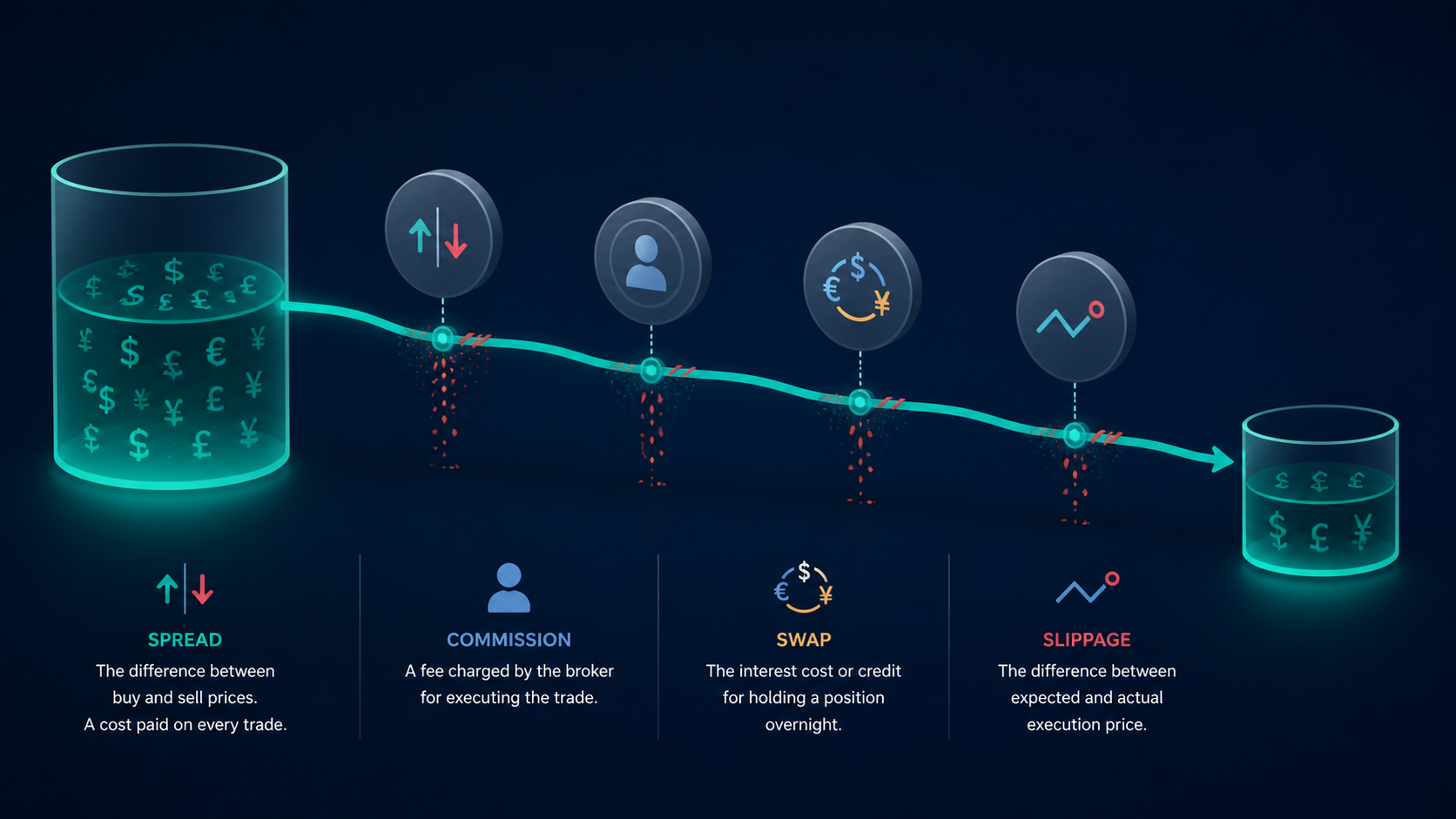
Gross pips are not net profit. A complete calculation should include the costs and execution effects that apply to your account:
Spread: The difference between bid and ask typically creates an immediate trading cost.
Commission: Some account types charge a separate fee per lot or per side.
Swap or financing: Holding a position past the provider’s rollover time can create a credit or debit.
Slippage: The fill can differ from the requested price, particularly during volatility, illiquidity, or market gaps.
Conversion and account fees: These may matter when the account currency differs from the quote currency or when a provider applies non-trading charges.
In the 50-pip example, a 1.2-pip spread at an approximate $1-per-pip value would reduce the gross $50 by about $1.20 before any commission, financing, or slippage. Exact charges depend on the provider, product, and account terms. Comparing disclosed costs is more useful than treating any advertised trading condition as universal.
Position size should come from risk, not the maximum leverage available
A disciplined order of operations is to choose a dollar amount you can afford to lose on one trade, place a logical stop-loss based on the trade idea, and then calculate the position size that fits those two inputs. Leverage is the final constraint check: can the account support that position while leaving enough free margin for normal price movement and costs?
For a USD-quoted pair, a simplified version is:
Position size (lots) ≈ dollar risk ÷ (stop-loss pips × pip value per lot)
Example: if the planned risk is $25 and the stop is 25 pips away, the position must have an approximate pip value of $1 per pip. On EUR/USD, that is commonly around 0.10 lot. A 50:1 setting does not mean this position should be enlarged; it only affects the margin required for the size already chosen.
A stop-loss is not a guarantee of the exact exit price. Fast markets, gaps, and platform conditions can produce fills worse than the stop price. Plan for that possibility rather than assuming a calculator’s output is a guaranteed maximum loss.

Use leverage responsibly in the United States
For U.S. readers, eligibility and regulation are part of the calculation. Before opening or funding an account, verify the firm’s registration and disciplinary history, read the risk disclosure and customer agreement, and confirm the margin policy for the exact instruments you plan to trade. The CFTC advises consumers to research OTC forex dealers and to check registration information; it also warns that high leverage can amplify losses and may require additional funds or a position closeout. CFTC: Eight Things You Should Know Before Trading Forex.
When comparing providers or rebate programs, keep that due diligence separate from the profit calculation. FXBee describes itself as a third-party platform for forex rebates and broker comparisons; review the broker comparison page, the relevant provider’s own disclosures, and FXBee’s Terms of Use before acting. Availability, account eligibility, costs, and regulatory status must be confirmed independently for your location.

A practical pre-trade calculator checklist
Confirm the direction, entry price, exit target, and stop price.
Enter the exact currency pair, account currency, and contract or lot size.
Calculate the pip value for that position—not a generic pip value from another pair.
Estimate the gross profit at the target and the gross loss at the stop.
Subtract the current spread, stated commission, and any likely financing charge.
Check required margin and retain a buffer rather than using all available buying power.
Recheck the provider’s current terms and risk disclosure before submitting the order.
FXBee’s support center and the selected provider’s documentation can help clarify program or account questions, but neither replaces an understanding of the trade’s own risk and costs.
Risk disclosure
Forex and CFDs involve substantial risk and may not be suitable for every investor. Leverage can magnify losses as well as gains, and you may lose all of the funds committed to a trade or, depending on the agreement and market conditions, more. This content is for general educational purposes only; it is not investment, legal, tax, or financial advice.
Frequently asked questions
What does leverage mean in forex?
Leverage allows a margin deposit to control a larger notional currency position. It increases the dollar impact of a price move relative to the margin committed, but it does not change the market’s direction or make a trade more likely to win.
Does higher leverage increase forex profit?
Not by itself. If the position size stays the same, the gross profit or loss from a given price move is unchanged. Higher leverage lowers the margin required for that position and can make it easier to take a larger, riskier size.
How does a forex profit calculator calculate profit?
A forex profit calculator generally combines entry price, exit price, direction, lot size, pip value, and account currency. For a complete estimate, include the applicable spread, commission, financing or swap, and possible slippage. Leverage is mainly used to estimate margin, not gross pips.
How much is one pip worth in forex?
It depends on the pair, position size, and account currency. For EUR/USD in a USD account, one standard lot is commonly about $10 per pip and 0.10 lot about $1 per pip. Cross pairs and non-USD accounts require conversion, so confirm the live contract specifications.
What is the difference between margin and leverage?
Margin is the capital a provider requires to support an open position. Leverage is the ratio between the position’s notional value and that margin. At 30:1, a roughly $10,800 position would require about $360 of margin before considering the provider’s detailed rules.
What is the maximum forex leverage for U.S. retail traders?
The CFTC identifies a 2% minimum security deposit for major currency pairs and 5% for other pairs, which equates to roughly 50:1 and 20:1 maximum leverage. Confirm current rules and the firm’s requirements, because product access and terms may vary.
Can I lose more than my margin in forex?
It may be possible, depending on your agreement, market conditions, and how a position is closed. Price gaps, fast markets, and execution conditions can produce losses beyond a planned level. Read the customer agreement and risk disclosure for the specific account.
Should I choose my lot size based on available leverage?
A risk-first method is usually more informative: select the dollar amount you are willing to risk, choose the stop-loss distance, then calculate a position size that fits both. Treat available leverage as a margin constraint, not a target position size.
Do spreads and commissions matter on small forex trades?
Yes. On a small target or a frequently traded strategy, spreads, commissions, financing, and slippage can materially reduce or erase gross gains. Enter the actual account costs into the calculation rather than relying only on pips.
What should I check before using a forex broker or rebate program?
Confirm whether the service is available and appropriate in your jurisdiction, verify registration where relevant, read risk disclosures and account terms, and understand all trading and withdrawal charges. Do not treat a rebate, promotion, or leverage offer as a substitute for due diligence.