
Free Forex Trading signals sound like free pizza at midnight—hard to resist, easy to regret. The catch is they often cost you in execution and trust fast.
Retail traders chase alerts; pros chase data quality. If you're serious about scaling, freebies can nick your margins and rattle your nerves. Pick precision over cheap thrills now.
Why “Free Forex Alerts” Sound Too Good
Free alerts in Forex Trading often look like easy money. A ping, a price, and boom—you’re in. But real Forex trading runs on speed, depth, and sharp judgment. In currency trading, tiny delays can flip profits into losses. Let’s break down what’s really going on.
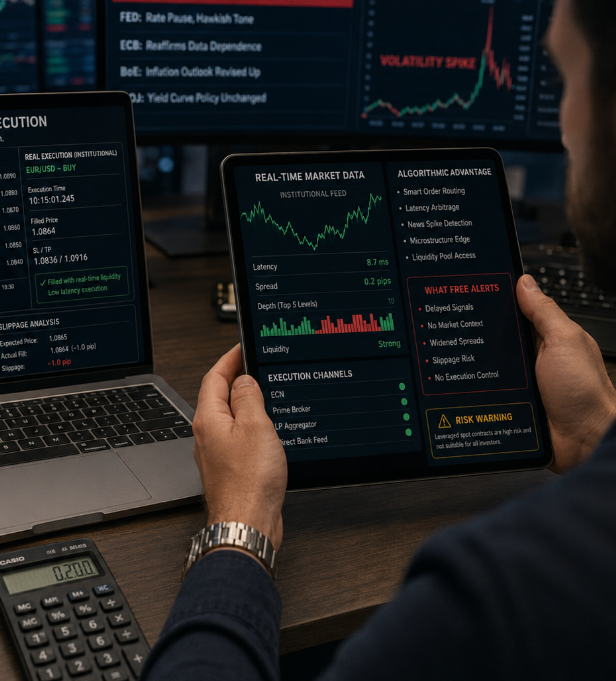
Instant Signals vs. Real-Time Market Data Reality
In Forex Trading, timing is everything. Free signals rarely match true real-time market data, and that gap hurts.
Data Source Layer
Delayed information
Slower execution channels
Direct liquidity feeds
Ultra-low latency routing
Institutional desks access:
Free alert services rely on:
Market Reaction Layer
Missed entries
Banks push large orders
Spreads widen fast
During heavy trading volume:
Result:
Practical Impact on Forex Trading
Entry price differs
Risk-to-reward shifts
Strategy edge fades
That “instant” alert? Often late by seconds. In currency trading, seconds matter.
Algorithmic Trading Hype Behind Currency Pair Recommendations
Many providers hype secret algorithms and elite trading systems. Sounds cool. Proof is rare.
No verified backtests.
No stress-tested strategies across volatile currency pairs.
Vague indicators driving buy/sell recommendations.
Some mix buzzwords like AI and automation, but skip transparency. Real quantitative analysis should show drawdowns, sample size, and execution rules.
Smart Forex Trading demands clarity. Platforms like Fxbee focus on education and risk context, not mystery boxes. That’s a big difference in foreign exchange trading.
The Illusion of Zero Risk in Spot Contracts
Free alerts love to downplay risk. Spot contracts in Forex Trading carry exposure that’s very real.
Market Mechanics
Sudden market fluctuations
News-driven spikes
Amplifies gains
Multiplies losses
High leverage
Sharp volatility
Capital Pressure
Small capital base
Forced liquidation
Speculation Reality
No guaranteed floor
Emotional decisions escalate damage
Fxbee consistently reminds traders that Forex Trading is speculation, not a cheat code. Trade smart, respect risk, and treat every alert as input—not gospel.
5 Hidden Costs You’ll Face With Free Signals
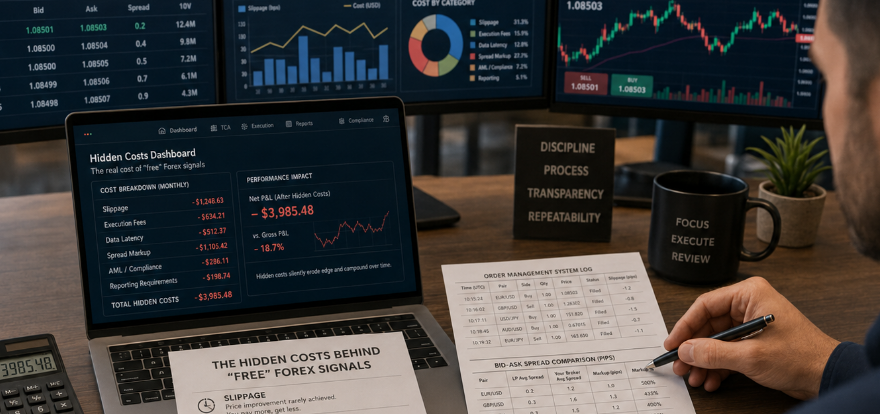
Free signals look tempting when you’re getting into Forex Trading, currency trading, or online FX trading. But in real-world forex trading, “free” often hides small leaks that drain your account over time. Here’s what quietly chips away at your edge.
Slippage and Execution Fees on Order Management Systems
In Forex Trading, speed is money. When free signals hit your trading platform, delays creep in.
Slippage widens the gap between signal price and actual fill.
Extra execution fees stack inside the order management system.
Higher transaction costs show up through your brokerage report.
Look deeper:
Signal leaves provider.
It travels through public servers with higher latency.
Your trading platform routes it via standard brokerage channels.
Market moves.
Fill price slips.
In active FX trading, even 1–2 pips per trade compounds fast.
Inferior Market Data Feeds That Delay Your Entries
Not all market data is equal in forex trading. Free providers often use slower data feeds with noticeable data latency.
Inside many systems:
Data feed
No depth-of-book
Limited liquidity view
Level 1 pricing only
Real-time data
Causes entry delay
Impacts trading decisions
Delayed milliseconds
Here’s how feed quality affects outcomes in Forex Trading:
| Feed Type | Avg Latency (ms) | Slippage (pips) | Impact on Trading Decisions |
|---|---|---|---|
| Tier-1 Institutional | 5–10 | 0.1–0.3 | Minimal |
| Premium Retail | 20–40 | 0.3–0.8 | Moderate |
| Standard Free Feed | 80–150 | 0.8–1.5 | High |
| Delayed Web Feed | 200+ | 1.5–3.0 | Severe |
| Aggregated Public | 120–250 | 1.0–2.5 | High |
Small numbers. Big difference in currency trading.
Limited Coverage of Exotic Currencies and Major Currency Pairs
Free alerts mostly stick to major currency pairs like EUR/USD. But the forex market is wider.
Trading instruments
Majors
Minors
Exotic currencies
Within asset classes in FX trading:
Major pairs
Tight spreads
High liquidity
Exotic currencies
Wider spreads
Higher volatility
More liquidity risk
In Forex Trading, ignoring exotic currencies limits strategy options. Some arbitrage and carry setups live outside the usual pairs. A serious currency trading approach needs broader market coverage, not just the popular tickers.
Hidden Spread Markups from Liquidity Providers
Free signals can be offset elsewhere.
Inside pricing layers:
Liquidity providers
Raw interbank price
Broker
Expands bid-ask spread
Increases real trading costs
Adds spread markup
You won’t see a line item labeled “markup.” It blends into the quote. In Forex Trading, even a 0.5 pip markup per trade raises cumulative brokerage fees significantly. That lack of pricing transparency shifts the edge away from you and toward market making desks.
Platforms like Fxbee focus on clear cost breakdowns, which matters when every pip counts.
Compliance Pitfalls: AML and Reporting Requirements
Signals don’t carry legal protection. You still hold the bag for compliance.
Under financial rules:
AML (Anti-Money Laundering)
Source-of-funds checks
Suspicious activity monitoring
Tax filings
Cross-border transaction reports
Due diligence
Broker verification
Record keeping
In Forex Trading and broader online FX trading, regulators expect proper documentation. Ignoring financial regulations increases regulatory risk and potential penalties.
Using structured platforms such as Fxbee helps traders align trading activity with core legal obligations. Free signals may guide entries, but responsibility in currency trading always stays with you.
How to Spot Reliable Forex Trading Alerts
Forex Trading moves fast, and bad alerts can drain an account quicker than you think. In Forex Trading, accuracy beats hype. Smart currency trading starts with proof, clean tech, and solid economic logic—not flashy screenshots.
Evaluating Track Records with Historical Data Analysis
In Forex Trading, numbers tell the real story.
Core performance metrics
True win rate versus marketing claims
Maximum drawdown during volatile Forex markets
Realistic risk-reward ratio
Confirm third-party validation
Check transparency of backtesting models
Review verified historical data stored in secure systems
Study statistical analysis breakdowns
Track monthly consistency, not one lucky spike
Good Forex Trading alerts show stable currency trading results across different market cycles. If returns collapse during high volatility, that’s a red flag. Fxbee encourages traders to compare long-term Forex Trading data instead of chasing short-term hype.
Verifying Alerts via Your Execution Management System
Signal quality means little without clean execution.
Inside your trading platform
Validate timestamps
Confirm accurate real-time processing
Measure latency under live conditions
Monitor slippage in active Forex markets
Audit trade execution speed
Use order management logs
Enable automation for objective signal validation
Reliable Forex Trading setups must match actual fills. If live results differ from shared signals, something’s off.
Assessing API Integration and Platform Stability
Strong Forex Trading providers focus on tech depth.
API connectivity
Clean data feed flow
Enforced security protocols
Stable integration with your broker
Operational strength
High system uptime
Proven platform reliability
Scalable infrastructure
Fxbee supports traders who rely on smooth API-based Forex Trading, helping reduce operational risk in currency trading environments.
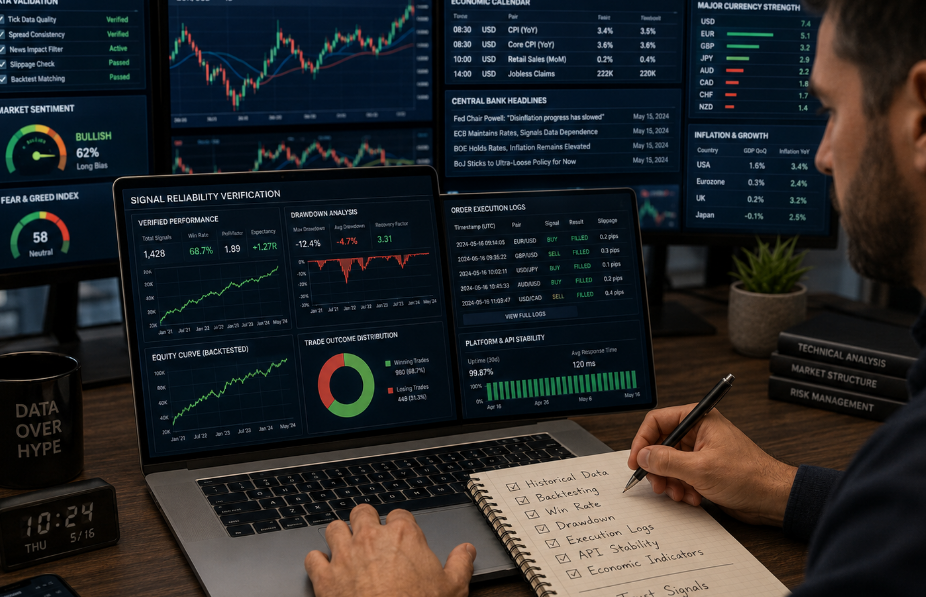
Cross-Checking Signals Against Key Economic Indicators
Forex Trading never runs on signals alone.
Review major economic indicators
Latest GDP reports
Fresh inflation data
Current employment statistics
Track central bank policies and rate guidance
Scan news events shaping market sentiment
Blend insights with your fundamental analysis
Forex Trading works best when technical alerts align with macro data. If a signal ignores obvious economic pressure, pause. Smart traders in Forex Trading always double-check before clicking buy or sell.
Cost-Free Strategies to Verify FX Alerts
Forex Trading sounds exciting, but jumping into live trades without proof can burn cash fast. Smart traders test, tweak, and double-check alerts before risking real money. In foreign exchange trading, validation is king. Here’s how to pressure-test signals the right way.
Backtesting Alerts Using Machine Learning Models
When validating alerts for Forex Trading, structure matters:
Core Data Layer
Collect clean historical data for major and minor pairs.
Filter noise before feeding trading algorithms.
Modeling Framework
Train machine learning systems on past forex signals.
Apply strict model validation rules to avoid curve fitting.
Compare outputs using consistent performance metrics.
Risk Review
Stress-test across volatile periods.
Evaluate drawdowns before trusting live Forex Trading setups.
The BIS 2025 Triennial Survey reported that OTC FX markets reached $9.6 trillion per day in April 2025, reinforcing why data quality, liquidity awareness, and execution discipline matter in modern currency trading.
Platforms like Fxbee simplify backtesting, making Forex Trading research less intimidating.
Demo Trading Spot and Forward Contracts for Proof
Signal testing in a simulated environment keeps your wallet safe.
Execution Check
Run demo trading on spot contracts.
Monitor slippage in forward contracts.
Capital Simulation
Use virtual capital to measure consistency.
Track trade execution speed and pricing gaps.
In online Forex Trading, practice accounts expose weak entries before real exposure. Fxbee offers clean dashboards for signal verification, helping traders refine foreign exchange trading tactics without stress.
Leveraging Sentiment Analysis to Confirm Entries
Entry timing improves when you blend data with crowd mood.
Data Sources
Scan headlines through news analysis tools.
Monitor social media data for sudden spikes.
Interpretation
Align market sentiment with technical trading indicators.
Weigh psychological factors before pulling the trigger.
If price momentum in Forex Trading matches positive sentiment, confirmation strengthens. Add this layer to your currency trading plan and your Forex Trading decisions feel less like guesswork, more like strategy.
Free Forex Trading Alerts: Friend or Foe?
Free alerts pop up everywhere in Forex Trading. Some help, some hurt. In online forex trading circles, opinions split fast. Let’s break down how trading alerts fit into real currency trading workflows.
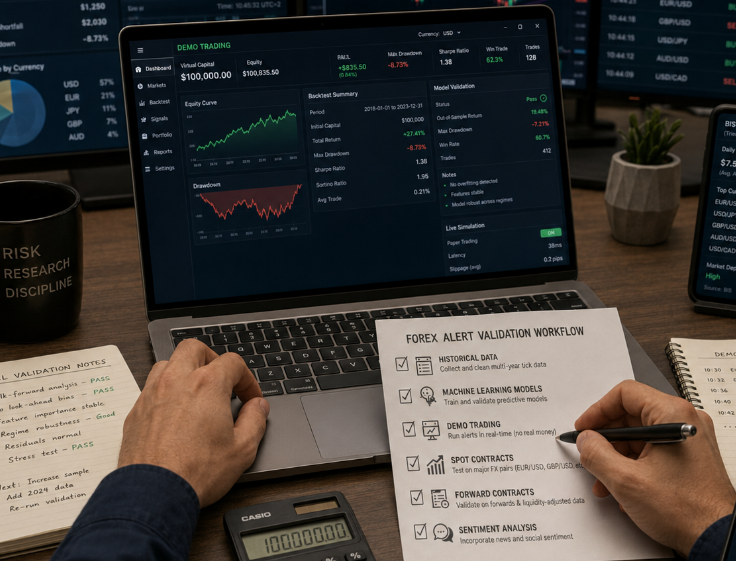
When Free Alerts Support Your Carry Trade Strategy
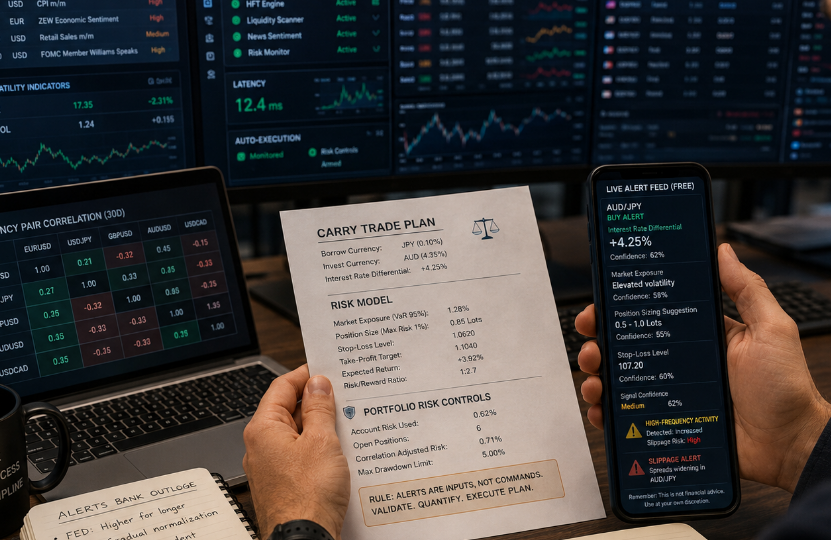
In Forex Trading, a solid carry trade lives and dies by the interest rate differential between currency pairs. Free Forex signals can support that edge, but only when filtered through clear strategy development rules.
Macro Alignment
Low shock risk
Consistent fiscal tone
Stable or rising rates in the base currency
Predictable inflation path
Central bank outlook
Political backdrop
Signal Screening
Swing-based, not scalp noise
Trend continuation alerts
Breakout alerts aligned with broader market trends
Type of trading alerts
Time horizon
Execution Fit
Swap consideration
Position duration tolerance
In practical forex trading, alerts should confirm your bias, not create it. If the free signal supports the rate gap logic behind your carry trade, it earns attention. If not, skip it. No drama.
The Pitfalls of High-Frequency Trading Tips
High-speed trading tips sound exciting. In reality, high-frequency trading requires tech most retail traders just don’t have.
Latency issues
Execution challenges
Platform limits
Short-term trading at that speed faces brutal slippage, especially during spikes in market volatility. A signal that says “buy now” is useless if price has already jumped.
Alert triggers.
You react manually.
Market moves.
Entry worsens.
Without institutional-grade automated systems, high-frequency ideas in Forex Trading often turn into frustration. Fast alerts don’t equal fast profits. In currency trading, speed without infrastructure is just noise.
Integrating Free Signals into Your Risk Models
Free trading signals can fit into structured risk management, but only through a controlled process in Forex Trading.
Step 1: Run risk assessment.
Check total market exposure, correlation across pairs, and capital at risk.
Step 2: Adjust position sizing.
If signal confidence is low, reduce size. Keep allocation consistent with your portfolio management rules.
Step 3: Define protection.
Set stop-loss levels based on volatility, not hope.
Step 4: Model integration.
Feed the signal into your system as a secondary input, not the core driver.
Used this way, free alerts become data points, not commands. That mindset keeps your Forex Trading steady and your trading account intact.
How to Transition From Free to Paid
Moving from free tools to paid services in Forex Trading feels like leveling up. In forex trading, smart upgrades boost currency trading results, tighten execution, and keep your FX trading edge sharp.
Choosing Premium Plans with Real-Time Market Data
In Forex Trading, timing is cash. A solid subscription unlocks serious live data and sharper market analytics.
Core service comparison
Exportable performance logs
Advanced charting tools
Multi-asset watchlists
Streaming quotes latency (ms)
Depth of liquidity levels
Data speed
Platform features
Reporting
| Provider Type | Avg Latency (ms) | Monthly Cost ($) | Pairs Covered | Uptime (%) |
|---|---|---|---|---|
| Basic Free | 450 | 0 | 20 | 97.5 |
| Standard Pro | 120 | 49 | 45 | 99.2 |
| Advanced Pro | 60 | 99 | 65 | 99.5 |
| Institutional | 25 | 249 | 80 | 99.9 |
| Enterprise | 10 | 499 | 120 | 99.99 |
Fxbee integrates tight streaming quotes with stable uptime, making Forex Trading execution smoother when volatility spikes.
Upgrading to Quantitative Models and Paid Signals
Free indicators are fine. Paid systems push deeper into algorithms and statistical analysis.
Clean historical data for proper backtesting
AI-driven predictive strategies
Real-time trade alerts
Clear execution signals
In forex trading, edge comes from testing ideas across cycles. Add expert commentary and expert recommendations, then plug signals straight into your FX trading platform. Fxbee connects paid signals to automated order routing, so Forex Trading decisions move from theory to action fast.
Short story: better models, tighter risk, cleaner logs.
Negotiating Enterprise Terms with Prime Brokers
Institutional-level Forex Trading runs on structure.
Draft the institutional agreement
Define legal terms
Confirm compliance standards
Secure liquidity
Direct liquidity provision lines
Tiered pricing by volume
Lock execution quality
Dedicated execution services
Slippage reporting
Build the corporate partnership
Customized services
Quarterly performance audits
For high-volume currency trading desks, tighter spreads plus reporting clarity can shift annual returns significantly. Fxbee supports scalable Forex Trading setups aligned with prime broker frameworks, keeping trading and forex operations efficient as capital grows.
References
[OTC foreign exchange turnover in April 2025 - https://www.bis.org/statistics/rpfx25_fx.htm]
[Forex Frauds - https://www.cftc.gov/LearnAndProtect/forexfrauds]
[CFTC/NASAA Investor Alert: Foreign Exchange Currency Fraud - https://www.cftc.gov/LearnAndProtect/AdvisoriesAndArticles/cftcnasaaforexalert.html]
[Foreign Currency Trading - https://www.cftc.gov/LearnAndProtect/AdvisoriesAndArticles/ForeignCurrencyTrading/index.htm]
[Forex Transactions: Regulatory Guide - https://www.nfa.futures.org/members/member-resources/files/forex-regulatory-guide.html]
[Understanding Slippage in Finance: Key Insights and Examples - https://www.investopedia.com/terms/s/slippage.asp]
[Gross Domestic Product - https://www.bea.gov/data/gdp/gross-domestic-product]
[CPI Home - https://www.bls.gov/cpi/]
[Employment Situation Summary - https://www.bls.gov/news.release/empsit.nr0.htm]
[The Federal Open Market Committee - https://www.federalreserve.gov/monetarypolicy/fomc.htm]
FAQ
How do free Forex Trading alerts compare with institutional-grade systems?
Free alerts often arrive seconds late—and in Forex Trading, seconds hurt.
Institutional-grade setups usually include real-time market data feeds with low-latency connectivity, execution management systems linked to prime brokers and liquidity providers, and order management systems validating spreads on major currencies and key currency pairs.
Free services tend to rely on slower trading platforms, exposing traders to slippage on spot contracts, wider spreads on exotic currencies, and higher liquidity risk during central bank announcements.
For institutional investors and hedge funds, timing is not convenience—it is survival under market risk and value at risk limits.
What hidden costs can impact large-scale Forex Trading operations?
Behind every “low-cost” signal lies a chain of expenses.
Transaction Layer: Spread markups from liquidity providers, slippage on currency futures and forward contracts, and pricing gaps during high-frequency trading bursts.
Infrastructure Layer: Co-location services near major commercial banks, API integration with trading platforms, and maintenance of market data feeds and historical data storage.
Compliance Layer: Anti-money laundering and know your customer checks, reporting requirements across jurisdictions, and oversight from compliance officers under financial regulations.
For multinational corporations and hedge funds, these costs accumulate quietly, shaping credit risk, operational risk, and overall risk models.
How can firms verify the credibility of Forex Trading signals before allocating capital?
Capital moves on trust—but trust must be tested.
A disciplined review often combines data, strategy, and oversight.
Firms can backtest signals against historical data using machine learning models and predictive analytics.
They should compare performance under stress testing during central bank shocks and measure risk-adjusted returns, value at risk, and drawdowns inside data warehousing systems.
Trade ideas such as carry trade, arbitrage strategies, and momentum trading should also be cross-checked against economic indicators and sentiment analysis.
Institutional investors also confirm that algorithmic trading logic aligns with internal market surveillance standards and regulatory reporting requirements. In Forex Trading, confidence is earned through numbers, not promises.