
Picking a 0.001 lot size broker isn’t about playing small—it’s about playing smart. In a roughly $9.5 trillion-a-day forex market tracked by the Bank for International Settlements, precision is survival. One oversized trade can feel like showing up to a chess match swinging a baseball bat. You don’t need more noise. You need control.
As the BIS shows, FX trading remains heavily concentrated in major currencies, key trading hubs, and large dealers. Translation? The big players thrive on precision. Micro-lot access gives you that same dialed-in control—test the waters, scale carefully, keep risk on a tight leash.
This guide cuts through the hype and gets straight to the brokers built for that kind of accuracy.
Precision Hedging
Tailor exposure with micro-lot trades to align with institutional flows and reduce Value at Risk.
Leverage Control
Optimize leverage and margin requirements while using smaller trade sizes to keep risk tighter.
Broker Selection
Choose ECN or STP models for deep liquidity and seamless execution, but always verify the broker’s actual minimum trade size before assuming it supports true 0.001-lot forex trading.
3 Reasons 0.001 Lot Size Broker Matters
Trading big isn’t always smart. Sometimes the real edge comes from going small and staying precise. A 0.001 lot size broker lets traders break positions into micro units—0.001 lot, micro lot size, nano lot trading—so risk stays tight and flexible. That’s why many active traders now look for a true 0.001 lot size broker instead of standard-only platforms.
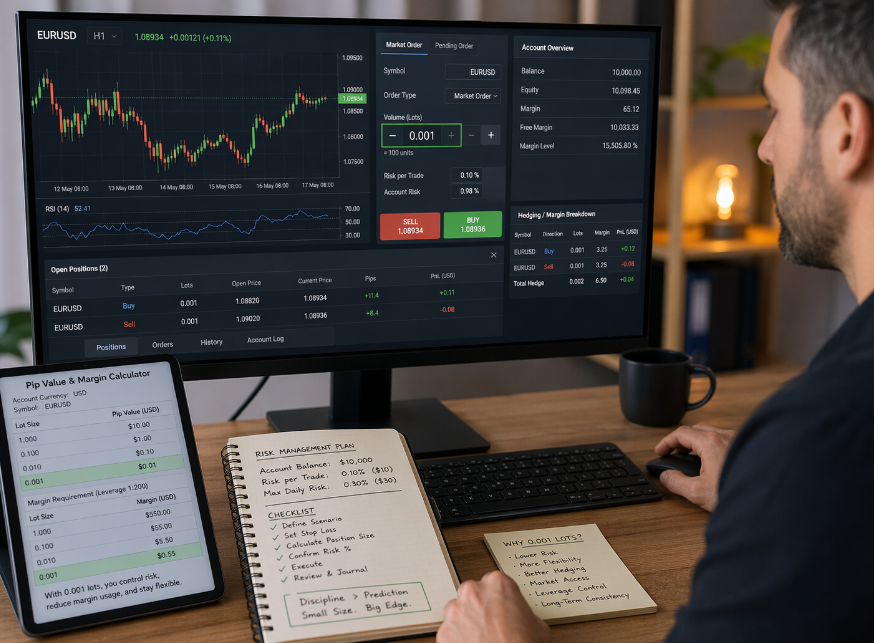
Improved Hedging Strategies with 0.001 Lots
Working with a 0.001 lot size broker changes how hedging and risk management feel in daily trading.
Smaller units mean sharper position sizing
Cleaner trade execution
Better control of overall market exposure
Under the hood, the advantage becomes clearer:
Strategy layer
Spot hedge against futures exposure
Offset partial positions during volatile sessions
Risk layer
Adjust portfolio protection in 0.001 lot steps
Reduce drawdown spikes without closing core trades
Execution layer
Scale in gradually
Scale out without shocking liquidity
Here’s how nano lot trading can shift Value at Risk in practical terms:
| Position Size | Approx. Pip Value (EUR/USD) | Relative VaR Impact | Margin Usage (%) |
|---|---|---|---|
| 1.0 lot | $10 per pip | High | 100% baseline |
| 0.1 lot | $1 per pip | Medium | 10% |
| 0.01 lot | $0.10 per pip | Low | 1% |
| 0.001 lot | $0.01 per pip | Very Low | 0.1% |
With this flexibility, traders using Fxbee can fine-tune hedges instead of overcorrecting. That precision keeps financial exposure aligned with real account goals, not guesswork. Standard lot conventions and pip-value scaling are widely used across retail FX education and broker documentation.
Access to Major and Minor Currency Pairs
A solid 0.001 lot size broker opens doors across the Forex market without forcing oversized bets.
At the top level:
Currency exposure across liquid majors
Controlled entries into minor pairs
Access to metals and broader trading instruments
Drill down further:
Major pairs
Benefit: deep liquidity, tighter spreads.EUR/USD
USD/JPY
GBP/USD
Minor pairs
Benefit: targeted regional plays with smaller size control.EUR/GBP
AUD/NZD
Market access
ECN routing
Transparent pricing
Flexible nano lot trading
Using a micro lot broker structure, traders can test correlations across multiple pairs without loading up huge positions. That means smoother diversification and steadier market access, even when volatility kicks up.
Enhanced Leverage Management and Margin Requirements
A true 0.001 lot size broker reshapes how traders handle margin and risk control.
Break it into layers:
Capital structure
Account balance stays less exposed per trade
Trading capital stretches across more setups
Leverage dynamics
Fine-tuned leverage through smaller contracts
Reduced forced liquidation risk
Exposure management
Controlled financial exposure
Lower stress during news spikes
Regulatory alignment
Transparent margin calculation
Clear compliance with global standards
With 0.001 lot, 0.001 lot trading, and full 0.001 lot size broker functionality, traders avoid the “all-in or nothing” trap. Platforms like Fxbee support this micro lot size approach, giving room to grow steadily instead of swinging big on limited capital.
Small sizing. Smarter control. That’s the real edge.
Which Brokers Offer 0.001 Lot Size?
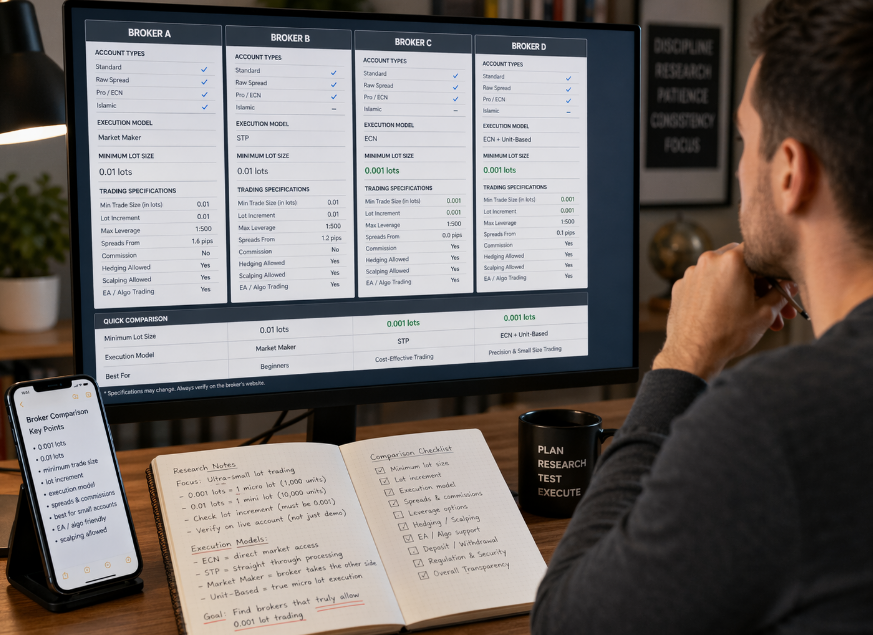
Trading tiny volumes isn’t just for beginners testing the waters. A 0.001 lot size broker lets you fine-tune risk down to almost surgical precision. If you’re hunting for a 0.001 lot broker or comparing micro lot size broker options, the key data point is the broker’s official minimum trade size. On official broker pages, IC Markets, Pepperstone, FP Markets, and XM generally start forex trading from 0.01 lots, not 0.001 lots. For genuinely finer sizing, traders more often look at unit-based execution such as OANDA, which allows trades from 1 unit of currency, or at cent-account structures such as RoboForex ProCent, which advertises a 0.001-lot minimum order volume.
IC Markets with ECN Pools
When reviewing a 0.001 lot size broker, structure matters.
Execution Framework
No internal dealing desk filter
Transparent order matching
Orders routed to multiple liquidity providers
Pricing derived from the interbank market
Access via electronic communication network
True direct market access
Pricing Environment
Raw spreads from transparent pricing
Depth of Market view
Designed for institutional grade flow
If you’re scaling in with tiny entries, this setup helps keep slippage tight. But the official IC Markets account page says traders can place trades as small as 0.01 lots, so it is more accurate to treat IC Markets as a strong micro-lot broker rather than a confirmed true 0.001-lot forex broker. Tools highlighted on Fxbee also show how micro-sizing works smoothly in ECN conditions.
Pepperstone STP Execution Model
Pepperstone runs on straight through processing. That means:
Orders pass through an execution model built on no dealing desk logic.
Pricing comes from liquidity aggregation, not manual intervention.
Fills rely on automated execution and rapid market access.
For a trader using a very small-size account, speed still matters. Small size doesn’t mean small impact if you’re scalping.
Clean routing
Competitive spreads
Rapid order fulfillment
The feel is simple: place the trade, get filled, move on. That’s what most traders want from a micro lot size broker. Official Pepperstone materials, however, list the minimum trading size at 0.01 lots, so Pepperstone belongs in the micro-lot category unless a specific account, symbol, or platform setting states otherwise.
FP Markets and Prime of Prime Brokers
FP Markets connects through layered liquidity:
Prime brokerage relationships
Access to institutional liquidity
Multiple aggregated feeds
Pricing depth
Consistent interbank rates
Support for institutional clients
Advanced execution services
Stable fills for algorithmic flow
A BIS Quarterly Review noted that liquidity conditions in major FX pairs remain structurally deep, while fragmentation across venues makes efficient aggregation more important. That’s exactly where Prime of Prime access helps. But FP Markets’ official forex account-type page lists a 0.01-lot minimum trade size, so it is again a micro-lot broker by default rather than a confirmed 0.001-lot forex broker. Traders comparing the brand can still use the fp markets demo resource on FXBee for platform familiarization.
XM Market Maker Liquidity Provider
XM operates under a market making setup. Here’s how that plays out:
Internal liquidity provision
In-house internal matching
Controlled bid-ask spread
Managed counterparty risk
Regulated dealing desk
Stable price quotes
For beginners searching “0.001 lot size broker” three times before opening an account, this model feels straightforward. You click, you trade, margin stays flexible.
But the official XM execution policy states that the minimum size of an order is 0.01 lots. XM’s product documents also show that its micro accounts use a smaller contract size of 1,000 units per lot, which reduces notional exposure, yet the minimum tradable order still starts from 0.01 lots. That makes XM useful for smaller traders, but not a clean confirmed answer to “which broker allows 0.001 lot size?” in mainstream forex account terms.
Many comparisons on Fxbee break down how a 0.001 lot size setup works under ECN, STP, or market maker conditions. Bottom line? If your goal is true 0.001-lot sizing, verify the contract specs first. Among the sources checked here, OANDA clearly supports sub-micro exposure through unit-based sizing, while RoboForex ProCent explicitly advertises 0.001 lots on its cent account offering.
Scalping Strategies With 0.001 Lots
Scalping with micro positions is not just for pros with giant accounts. Using a 0.001 lot size broker, traders can test sharp ideas with tiny exposure while staying flexible. When you break down “0.001 lot size broker” into 0.001 lot / lot size / broker, it becomes clear: precision, sizing, and execution matter. Let’s keep it practical and real.
Maximizing Minor Currency Pairs via Market Depth Analysis
When working with minor currency setups, tight control over lot size makes a big difference. A reliable 0.001 lot size broker lets you tap small inefficiencies without blowing margin.
Core Focus Areas
Sudden thinning before news
Spread widening during rollover
ECN order book imbalance
Visible bid/ask stacking
Crosses like EUR/GBP, AUD/NZD
Lower liquidity windows during Asia or post-NY close
Currency pairs
Market depth
Liquidity shifts
Execution Framework
Monitor Level II market depth data.
Spot micro gaps in liquidity.
Enter using 0.001 lot entries via a micro lot broker.
Exit within 3–8 pips, no greed.
Sample Minor Pair Micro-Scalp Metrics
| Pair | Avg Spread (pips) | Depth Imbalance % | Typical Move (pips) | Suggested Lot |
|---|---|---|---|---|
| EUR/GBP | 1.2 | 18% | 6–10 | 0.001 lot |
| AUD/NZD | 1.5 | 22% | 7–12 | 0.001 lot |
| GBP/JPY* | 2.0 | 15% | 12–18 | 0.001 lot |
*Higher volatility cross.
With Fxbee, traders using a 0.001 lot size broker model can adjust exposure trade by trade. That’s pure analysis meeting practical trading.
Algorithmic Trading Systems: Seamless 0.001 Lot Scalps
Small size, fast logic. That’s the vibe of modern algorithmic trading on micro accounts.
System Architecture
Market execution
Slippage cap at 0.3 pips
MT5 EA or FIX API
VPS latency under 5ms
Signal engine (EMA crossover + tick volume filter)
Spread protection module
Trading systems
Automation layer
Execution strategy
Operational Flow
Code entry logic in MQL5 or Python bridge.
Backtest with 0.001 lot position sizing.
Optimize for high-frequency scalping bursts.
Deploy live through a 0.001 lot size broker.
Risk Controls
Max 1% equity exposure
Hard stop-loss at 5 pips
Auto shut-off after 3 consecutive losses
Using a broker offering 0.001 lot execution keeps efficiency high and drawdown chill. On Fxbee, automation blends smoothly with micro-lot flexibility, making algorithm-driven scalping accessible without heavy capital.
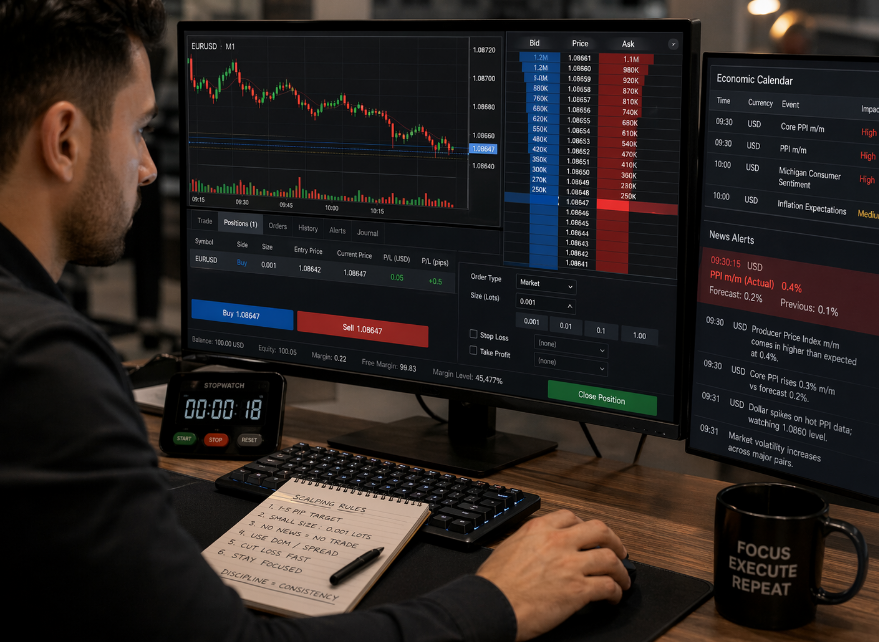
News Feeds–Driven Scalping Around Economic Calendars
When big data drops, spreads jump and volatility wakes up fast.
Traders tracking news feeds and the economic calendar focus on:
Inflation data
Central bank rate decisions
GDP surprises
Quick setup:
Check event time.
Reduce exposure before release.
Enter 0.001 lot trades seconds after the spike direction confirms.
Exit within the initial impulse.
This is pure event-driven fundamental analysis, but sized tiny. A proper 0.001 lot size broker allows you to test reactions without stressing margin. Even during sharp market reaction swings, using a micro lot broker keeps risk cool.
Many traders on Fxbee combine calendar alerts with ultra-small 0.001 lot size broker execution to scalp announcements while keeping exposure light. It’s simple: small size, fast reaction, strict exits. That’s how 0.001 lot trading stays sharp instead of reckless.
References
Pepperstone – Ways to trade - https://pepperstone.com/en/ways-to-trade/
FP Markets – Forex Account Types - https://www.fpmarkets.com/account-types/forex-account-types/
XM – Account Types - https://www.xm.com/account-types
XM – Order Execution Policy - https://www.xm.com/assets/pdf/docs/XM_Order-Execution-Policy.pdf
OANDA – Do you offer micro lots? - https://help.oanda.com/us/en/faqs/micro-lots.htm
OANDA – What is the minimum trade size? - https://help.oanda.com/ca/en/faqs/minimum-trade-size.htm
FAQ
Why is a 0.001 lot size broker attractive to Institutional Traders and Corporate Treasuries?
For large desks, precision is power. A 0.001 lot size broker allows fine-tuned Hedging Strategies across Spot Forex and Currency Futures, tighter adjustment of Value at Risk (VaR) for Hedge Funds and Corporate Treasuries, and controlled exposure in Major Currency Pairs and Minor Currency Pairs without shifting overall portfolio balance.
Behind the scenes, access to ECN Pools and pricing from Tier 1 Banks or Prime Brokers lets positions mirror interbank conditions while keeping risk disciplined.
How does 0.001 lot trading improve margin control and risk management?
Smaller trade units reshape capital control in measurable ways: lower incremental Margin Requirements per position, smoother Leverage Management during volatile sessions, and reduced sudden spikes in Counterparty Risk.
Under FCA, CFTC, or MiFID II oversight, this granular sizing helps desks stay aligned with internal compliance rules while trading through Market Execution or Limit Execution models.
Which instruments and execution models typically support 0.001 lot size trading?
A micro-lot environment often spans multiple asset classes and routing methods.
| Category | Examples | Execution Access |
|---|---|---|
| FX | Major Currency Pairs, Minor Currency Pairs, Non-Deliverable Forwards | ECN, STP, NDD |
| Metals | Precious Metals | Market Execution |
| Institutional Flow | Currency Futures | RFQ, FIX API Connectivity |
Liquidity may come from Non-Bank Liquidity Providers, Market Makers, or Interbank Dealers, with pricing depth visible through Market Depth tools.
What regulatory and operational safeguards matter in a 0.001 lot size broker?
In fast markets, protection defines trust. A reliable broker should provide clear Regulatory Compliance under the Financial Conduct Authority (FCA) or Commodity Futures Trading Commission (CFTC), strict AML and KYC enforcement, and transparent routing via Electronic Communication Networks (ECN) or Straight Through Processing (STP).
For Investment Banks, Central Banks, or algorithm-driven desks using Algorithmic Trading Systems and News Feeds, stability is not optional. Micro-sizing reduces operational strain, but regulatory discipline keeps the structure standing.