
Table of Contents
Part 1 - Why Is the usd to mxn forecast Uncertain in 2025?
Part 2 - Struggling with Rate Volatility? Forecast Strategies to Stabilize
Part 3 - 5 Economic Indicators Shaping the usd to mxn forecast
Part 4 - Importers’ Scenario: Managing Costs with USD to MXN Forecast
Part 5 - 3 Steps to Master usd to mxn forecast
for 2025? You’re not alone. From small business owners to global traders, everyone’s feeling the squeeze as the dollar and peso bounce around like it’s a game of financial ping pong.
One month you’re getting solid margins—next month you’re bleeding cash on currency swings. Yeah, it’s frustrating. Rate volatility isn't just annoying—it messes with budgets, pricing, and planning.

We’ve seen this story play out before. “The difference between a lucky guess and a smart plan,” says Sarah Lopez, Senior Analyst at Fxbee, “comes down to knowing what moves the market—and when.”
This guide is your cheat sheet. You’ll get real-world scenarios, a quick-read breakdown of economic signals, and smart ways to time your forecast updates.
No fluff. No finance jargon maze. Just clear, straight-up strategies to help you stay ahead and keep your numbers tight. Let’s get to it.
Why Is the usd to mxn forecast Uncertain in 2025?
2025's looking shaky for the peso-dollar forecast. Here’s why everyone’s second-guessing it lately.
Understanding Political Events Driving Uncertainty
Political instability throws a wrench in currency confidence fast.
Elections in both the U.S. and Mexico could shift economic direction overnight.
Government regulations often change with leadership — think new tax rules, trade restrictions.
Geopolitical risks like regional tensions or international conflicts? Huge mood killers for investor confidence.
When international relations sour (say, tariffs flying or visa restrictions tightening), the peso often catches heat.
Expect swings before, during, and after major political events — especially in election years like 2025.
How Trade Agreements Shape Forecast Predictability
Trade agreements like define the rules of the game between the U.S. and Mexico.
Any new tariffs or restrictions instantly ripple through exchange rate forecasts.
Ongoing trade negotiations make the outlook murky — investors hate guessing.
If one country tweaks its import/export rules, it can slam the peso or boost the dollar overnight.
Unpredictable trade wars or retaliatory tariffs? Those can swing the in either direction fast.
Forecasts thrive on stability — and unstable trade policy kills that vibe real quick.
The Role of Central Banks in Forecast Instability
The and don’t just move numbers — they move markets. When central banks shift interest rates or drop hints about monetary policy, it lights up currency traders. Inconsistent or surprise changes? That's where the mess starts. Imagine the Fed raises rates while Banxico cuts theirs — boom, peso dips.
???? Interest Rate Comparison Table (2023–2025 Projections)
| Year | Fed Rate (%) | Banxico Rate (%) | Forecast Impact |
|---|---|---|---|
| 2023 | 5.25 | 11.25 | USD weakens |
| 2024 | 5.50 | 10.00 | Neutral pressure |
| 2025 | 5.00 | 8.75 | USD strengthens |
Quick shifts, surprise announcements, or conflicting inflation targets make forecasts harder to pin down.
Consumer Spending Trends and Their Hidden Impact
“Retail spending is a reflection of real economic confidence,” says Lucía Díaz, FX Strategy Lead at Fxbee Mexico.
Short-term demand surges can push the peso up, while drops in retail sales and consumer confidence often suggest economic slowdowns — and investors adjust their FX models accordingly.
Mexican consumers are pulling back on retail spending — red flag.
In the U.S., disposable income is climbing, fueling stronger dollar demand.
Weak consumer sentiment in either country tips the scale on exchange rate expectations.
Holiday seasons, stimulus packages, or gas prices? These shape spending habits and influence forecasts, often in ways algorithms can’t predict.
It’s less about math and more about mood — and that’s tricky to forecast.
Struggling with Rate Volatility? Forecast Strategies to Stabilize
If currency swings are driving you nuts, here’s where you fix it. These strategies will help you ride out the USD/MXN waves like a pro.
Short Term Planning with Currency Prediction Models
Use short-term currency prediction models to project USD/MXN movement within weeks.
Time Series Analysis helps you understand recent trends and volatility spikes.
Algorithmic trading models adapt quickly to new economic data.
Don't ignore past patterns—many models rely on historical performance.
Combine data-driven models with your own judgment for smarter planning.
???? Short-term planning isn't about being psychic—it's about stacking the odds in your favor using volatility-sensitive prediction tools.
Hedging Strategies for USD and Mexican Peso Volatility
Options Contracts: Lock in future USD/MXN rates to dodge nasty surprises.
Currency Swaps: Perfect for businesses operating across both countries.
Futures Contracts: Great for standardizing large currency deals.
Layered Hedging: Mix strategies to balance flexibility and protection.
You’re not trying to win the FX game—just not lose big. The right mix of tools can save your margins when volatility hits.
Using Financial Analysts to Read Market Trend Analysis
Financial analysts are your secret weapon when the USD/MXN forecast gets messy. Their job? Break down complex data into usable insights.
They monitor economic indicators like inflation and trade balances.
Experts often use qualitative analysis to spot hidden market signals.
Investment decisions often rely on analyst sentiment, not just raw numbers.
Analyst reports can help confirm or challenge your gut instincts.
“Reading raw data isn’t enough. The interpretation is where the real edge lies.” – Camila Ortega, FXBee Senior Analyst
Inflation Rate Adjustments and Exchange Rate Forecast Stability
Here's a table showing the correlation between inflation rates and exchange rate forecast stability for the past three quarters.
| Quarter | US Inflation Rate (%) | Mexico Inflation Rate (%) | Forecast Stability Index |
|---|---|---|---|
| Q1 2025 | 3.2 | 5.6 | Medium |
| Q2 2025 | 2.8 | 4.9 | High |
| Q3 2025 | 3.5 | 6.2 | Low |
Inflation rate adjustments mess with purchasing power parity, which throws off forecast accuracy. Stable inflation and interest rate differentials = more stable exchange rate forecasts.
Smart Use of Trade Balance Data in Volatile Periods
isn’t just boring economics—it’s a cheat code during volatility.
Quick Wins:
Rising U.S. exports? Expect USD pressure to ease.
Ballooning Mexican imports? Peso could weaken soon.
Look at the current account alongside trade stats—it paints a fuller picture.
Combine this with market sentiment to avoid getting blindsided.
The USD/MXN impact of trade flows may lag, but in wild markets, it’s a leading indicator for smart import/export decisions.
5 Economic Indicators Shaping the usd to mxn forecast
Want to stay one step ahead with the USD to MXN forecast? These five indicators do most of the talking.

GDP Growth in the US and Mexico: What to Watch
Economic indicators don't lie — GDP growth tells us who's thriving and who's lagging. Here's what you should track:
U.S. GDP Growth in 2025: Expected to grow around 2.1%, driven by tech and service sectors.
: Forecasts show a 1.0% bump, helped by strong manufacturing exports.
Impact on USD to MXN Forecast: A faster-growing Mexico could push MXN gains if the U.S. slows.
Watch Out: GDP surges often signal a stronger local currency — but only if paired with low inflation.
Why Interest Rates Influence the Exchange Rate Forecast
Interest rates can make or break your forex game. Higher rates? Higher demand for that currency. Here's the lowdown:
Rising U.S. interest rates typically strengthen the USD, making imports from Mexico cheaper.
If Mexico hikes its interest rates more aggressively, the MXN could gain ground fast.
A major shift in economic policy—say, a surprise cut—can send the exchange rate spinning.
Even interest rate rumors trigger trader reactions. Eyes on central bank comments.
Quote: "Interest rate signals are like currency traffic lights. Miss the change, and you could crash your forecast." — Luis Vega, Senior Economist, Fxbee
Unemployment Rate Signals for Long-Term Projections
This one’s about people, jobs, and money — and yes, the helps predict the USD to MXN game long-term.
Lower unemployment = more people with money to spend = stronger economy = stronger currency. Simple math, right?
But here’s what you really need to watch:
Mexico’s labor market is improving, especially in manufacturing — a long-term MXN strength factor.
U.S. job numbers, especially in retail and tech, are strong but plateauing.
Expect slower USD appreciation if U.S. unemployment ticks up in 2025.
Inflation Rate Trends Across Borders
Table:
| Country | Inflation Rate (%) | Central Bank Target | Trend Direction | Currency Impact |
|---|---|---|---|---|
| United States | 3.2% | 2.0% | Slightly Declining | Mild USD Weakness |
| Mexico | 4.8% | 3.0% | Stabilizing | MXN Neutral / Slight Strength |
| Forecast Avg | — | — | — | USD to MXN: Neutral Bias |
The inflation gap between countries affects relative purchasing power.
If Mexico keeps inflation in check while the U.S. struggles, the peso could surprise everyone.
Inflation often triggers central bank rate changes — and that’s what moves the currency.
Trade Balance as a Currency Forecast Predictor
Trade balance is like a scoreboard for how much each country is buying or selling abroad — and it packs a punch in forecasts.
• A U.S. trade deficit usually pressures the dollar. • A Mexican trade surplus, especially in auto exports, supports the peso. • When both countries shift — like when U.S. oil exports rise — it messes with the usual rhythm. • 2025’s currency forecast? Analysts say: Watch for Mexico’s growing non-oil exports — they’re the quiet power behind the MXN.
Importers’ Scenario: Managing Costs with USD to MXN Forecast
Getting a grip on the USD to MXN forecast can seriously save your margins if you're importing. Here’s how to make it work for you.
How Importers Can Use Exchange Rate Forecasts
Stay informed on short-term USD to MXN movements
Compare forecasted rates to current spot rates
Lock rates with forward contracts to avoid surprises
Use hedging tools to manage big orders
Monitor announcements from central banks regularly
Importers often get burned by sudden currency swings. Forecasting helps you prep for these shifts—so you’re not panic-buying pesos at bad rates. Don’t just guess; use the tools, follow the banks, and time your buys right.
Practical Peso Budgeting Based on Financial Outlooks
Convert projected USD invoices using forecasted MXN rates
Set upper/lower buffer zones in your budget for currency wiggle room
Track financial outlooks monthly—don’t “set and forget”
Revisit peso allocations each quarter
Adjust your cost management strategy if forecasts shift hard
Accurate peso budgeting is where cost control begins. Don’t just react—predict and prep. Use rate forecasts in your financial outlooks, so you’re not stuck overspending when the peso spikes.
Planning for the Next Quarter with Market Trend Insights
Market trends give you clues — follow them and your quarterly planning becomes smarter. See what’s coming, not just what’s happening.
A weaker USD could mean cheaper imports next quarter
A strong peso might signal a good time to stock up
Watch geopolitical news—like U.S. policy shifts or trade talks
Central banks’ inflation goals can shape import costs
Quote: "Great importers don’t just budget — they forecast with purpose." — Luis Ortega, FX Market Manager @ Fxbee
Role of Commercial Banks in Import Forecast Adjustments
| Bank Name | Service Type | FX Tool Offered | Use Case |
|---|---|---|---|
| Banorte | FX Hedging | Forward Contract | Lock rate on big orders |
| BBVA México | Currency Advisory | FX Alerts | Rate monitoring |
| CitiBanamex | Financial Planning | Forecast Integration | Budget optimization |
Commercial banks do more than wire your funds — they help manage import forecast adjustments too. From hedging with contracts to getting real-time FX alerts, these banks offer tools that reduce risk and tighten your financial planning.
3 Steps to Master usd to mxn forecast
This cluster is your shortcut to building a real grip on forecasting USD to MXN — quick, practical, and smart.
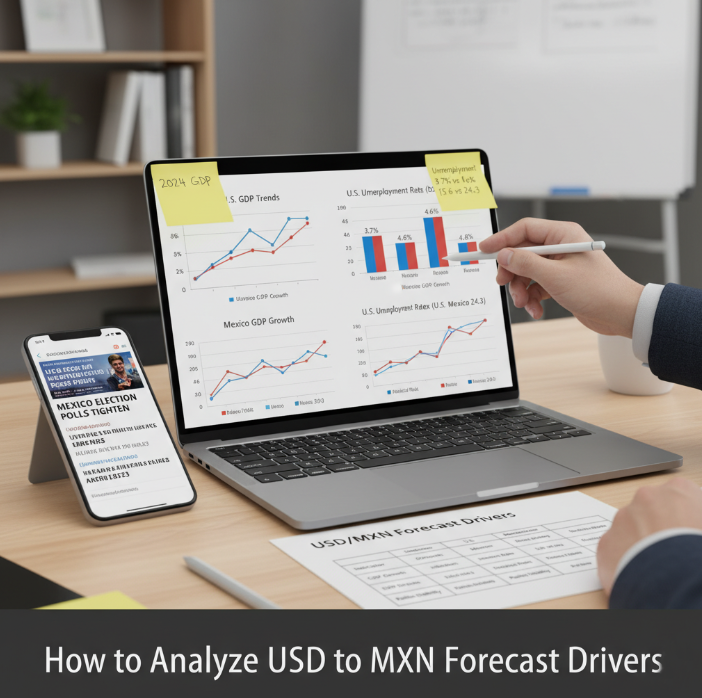
Step 1: Analyze Economic Output and Political Stability
Keep an eye on both economies — U.S. and Mexico.
USD’s strength often mirrors U.S. GDP trends and job creation.
MXN reacts quickly to political swings and reforms in Mexico.
Changes in political stability (e.g. elections, policy shifts) can spike currency risks.
For reliable forecast analysis, pair economic output stats with recent political headlines.
| Metric | U.S. 2024 | Mexico 2024 | Forecast Impact |
|---|---|---|---|
| GDP Growth Rate | 2.1% | 2.8% | Neutral |
| Unemployment Rate | 3.7% | 4.6% | USD Slightly Up |
| Political Risk Index | 15.6 | 24.3 | MXN More Volatile |
Step 2: Use Currency Prediction Tools Effectively
Start with basics: Use moving averages to smooth out USD to MXN price noise.
Upgrade with indicators: RSI and MACD reveal hidden momentum shifts.
Test accuracy: Backtest forecasts against past rate movements to avoid wild guesses.
Balance tools: Mix technical tools with economic reports like inflation or trade balance for deeper analysis.
Avoid tool overload: Too many indicators can confuse, not clarify.
Whether you're a rookie or a vet, smart use of currency prediction tools is the key to boosting forecast effectiveness without overcomplicating things.
Step 3: Interpret Central Bank Announcements
Sometimes, a sentence from a central bank can shift the peso or dollar like a wrecking ball. Don't miss it.
The U.S. Fed talking interest rates? USD will twitch.
Banco de México hinting at inflation fears? MXN’s going to jump.
Timing is everything — watch for announcement schedules.
Always ask: “What does this mean for my forecast?”
???? “We watch both banks like hawks,” says Diego Montoya, senior FX analyst at Fxbee. “One policy sentence can shake three months of modeling.”
When to Update Your usd to mxn Forecast?
Markets move fast—miss a beat, and you're working with stale numbers. Here's how to stay sharp.
The Forecast Clock Never Stops
In currency trading and business planning, timing isn’t just important—it’s everything. Updating your usd to mxn forecast too late could cost you thousands in missed opportunities or poor decisions. Here’s when you really need to refresh your data.
Keep Your Radar On: Watch for These 6 Triggers
Interest Rate Changes When the Federal Reserve or Banco de México adjusts rates, it’s game on. These changes can spark wild moves in the USD/MXN exchange rate—your forecast needs a reboot right after.
Inflation Data Releases Monthly CPI numbers from either country? Don’t skip 'em. Rising inflation in Mexico or the U.S. often leads to rate speculation, shifting currency values.
Major Trade Agreement Updates Deals like or announcements around tariffs can flip expectations overnight. Forecasts must reflect the new political temperature.
Central Bank Policy Announcements Even without actual rate changes, signals from central bank governors can shift the peso or greenback. Look out for press conferences and policy meeting minutes.
Shocking Geopolitical Events Think elections, resignations, border crises, or even diplomatic tensions. Political stability is one of the strongest drivers of peso volatility.
Quarterly Economic Reports GDP growth, unemployment data, and consumer spending updates shape sentiment. New numbers = new expectations = new forecast.
Need Help Spotting Patterns? Check This Table
| Event Type | Suggested Forecast Update | Impact Level (1–5) | Notes |
|---|---|---|---|
| Interest Rate Decision | Immediately (within 1 day) | 5 | High market sensitivity; instant reaction |
| Inflation Data | Monthly | 4 | Impacts both short-term & long-term trends |
| Political Event | Within 48 hours | 5 | Especially if tied to leadership or policies |
| Economic Report | Every quarter | 3 | Combines multiple economic indicators |
Hear It From an Fxbee Risk Strategist
“One time, we waited 72 hours after a surprise interest rate hike from Mexico’s central bank. By then, the peso had already moved 4%. That delay cost us a six-figure trade margin. Now, we update within hours.” — Tasha Lin, Currency Risk Manager, Fxbee
Quick Signs Your Forecast Is Outdated
Your model still uses GDP growth estimates from last quarter.
You missed last week’s central bank minutes drop.
Your inflation assumptions haven’t been updated in 30 days.
A new trade policy just made headlines—but your forecast didn’t flinch.
✅ Pro Tip
Set alerts on financial news apps for central bank decisions, interest rate news, and political events in Mexico and the U.S. Better to tweak your forecast 5 times a month than run off bad info once.
Conclusion
After all’s said and done, one thing’s clear: navigating currency shifts isn’t just for Wall Street suits anymore. The usd to mxn forecast matters—big time—if you’re moving money, managing imports, or planning a trip south of the border. We’ve unpacked how interest rates, inflation, and even global politics can move the needle, and knowing how to read those signs is a must. It’s like weather for your wallet—don’t leave home without checking the forecast.
Here’s your cheat sheet:
Check in on your forecast every quarter—or sooner if big headlines hit
Keep an eye on inflation and central bank chatter
Don’t wait to hedge if your business depends on predictable costs
Talk to your bank—they’re not just for loans
As former Fed chair Alan Greenspan once said, “Uncertainty is the defining feature of the modern economy.” In other words—stay alert, stay smart. You’ve now got the tools to stop guessing and start planning.
FXBee Resources for Further Learning
To sharpen your currency planning beyond the usd to mxn forecast, explore FXBee’s guides on , choosing the right , comparing , reading a , and understanding the . You can also boost your strategy with and track potential earnings using a .
US Dollar to Mexican Peso Forecast 2025 – exchangerates.org.uk -
Federal Reserve Board – Home -
Banco de México – Home -
United States-Mexico-Canada Agreement (USMCA) – Office of the U.S. Trade Representative -
Mexico Overview – World Bank -
United States Economic Forecast – Deloitte Insights - https://www2.deloitte.com/us/en/insights/topics/economy/us-economic-forecast/united-states-outlook-analysis.html
World Economic Outlook, October 2025 – International Monetary Fund -
Current Account Deficits and Trade Balance – International Monetary Fund -
Forward Contract Definition – Investopedia - https://www.investopedia.com/terms/f/forwardcontract.asp
Balance of Trade Explanation – Investopedia -
FAQ
Elections and policy shifts in the U.S. or Mexico
Changes in trade deals like USMCA
Government rules on trade or currency movement
Global conflicts that affect investor confidence
Central banks reacting to external pressures
Every few months is smart, or right after major news—like interest rate changes, central bank decisions, or sudden economic surprises.
Use contracts to lock in today’s exchange rates
Time purchases when the USD is stronger
Work with banks to get rate protection options
Track short-term market signals
Build in a little extra budget room just in case
Yes. If prices rise faster in Mexico, the peso may lose value. If it happens in the U.S., the dollar could weaken. It works both ways.
Interest rate changes
Inflation trends
Trade reports between the two countries
GDP growth in both economies
Any big announcements from central banks
The U.S. dollar is used globally and backed by a big economy. The peso reacts more to local events, making it more sensitive to change.
Set interest rates that move money in and out
Step in when markets swing too much
Share updates that shape expectations
Fight inflation, which helps support their currency
Signal what may come next
When a country’s economy grows, it draws investors. That boosts demand for its currency, which can make it stronger over time.
Ignoring the political side of things
Trusting one forecast too much
Forgetting that banks can move the market
Treating short-term dips like long-term trends
Not matching forecasts to your goals
Short-term helps with timing. Long-term helps with planning. Most businesses need both to stay flexible and ready for changes.