
Forex Trading isn’t a casino thrill; it’s a high-stakes chess match moving at light speed. If your signals lag, your profits vanish.
Markets don’t wait for gut feelings. Traders need sharp analysis, clean data, and execution that doesn’t choke when volatility hits like a summer storm.
FXBee’s forex trading support and platform materials emphasize disciplined algorithms, compliance controls, and human oversight as core parts of sustainable currency strategies for global firms.
Key Insights for Forex Trading Fundamentals
AI-Driven Signals
Leverage AI-driven signals by integrating real-time market data and robust algorithms to capture fleeting arbitrage opportunities.
Human Oversight
Balance model outputs with human oversight to mitigate data bias, ensure compliance, and adapt to macroeconomic shifts.
Low-Latency Execution
Employ low-latency connectivity and FIX Protocol streams for seamless order routing and precise execution in high-volatility environments.
Risk Management
Incorporate comprehensive risk management—Value at Risk, hedging strategies, stress testing—to safeguard portfolios across spot, forward, and options markets.
Can ChatGPT Really Generate Forex Trading Signals?
Forex Trading sounds high-tech, yet at its core it’s just people buying and selling currencies for profit. Add AI into the mix and things get interesting fast. In today’s forex market, traders want signals that react in real time, not yesterday’s news. So can ChatGPT Search actually power forex trading signals that hold up in live currency trading?
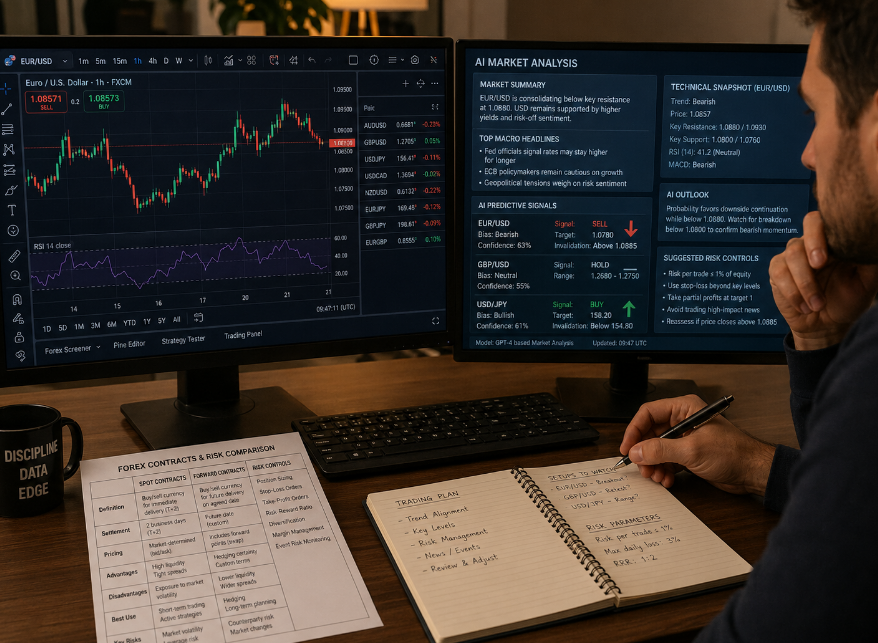
Understanding Spot and Forward Contracts with AI Predictions
In Forex Trading, price forecasts often begin with two core Financial instruments:
Spot contracts
Forward contracts
Both sit at the heart of Currency exchange and shape how Predictive models interpret market direction.
Spot layer
Short-term AI predictions for major pairs in Forex trading.
Historical tick data
Interest rate spreads
Macro indicators
Immediate settlement of Spot contracts based on live quotes.
Definition
AI input
Output
Forward layer
Medium-term projections in currency trading portfolios.
Volatility curves
Yield differentials
Customized Forward contracts as Derivative contracts tied to future rates.
Structure
Model calibration
Forecast use
Integrated predictive stack
Blending spot liquidity with forward premiums.
Aligning AI predictions with cross-border capital flows.
That’s where platforms like FXBee plug in, feeding structured data into Predictive models so Forex trading decisions feel less like guesswork and more like calculated risk. Traders exploring this angle often compare it with broader ai forex trading workflows.
Integrating Real-Time Market Data via API Integration
Real-time reaction is the name of the game in Forex Trading. Static data just won’t cut it.
Core pipeline:
Real-time data from ECNs
Institutional Market data streams
Multi-source Data feeds
Connectivity architecture
Order book depth
Volatility spikes
Broker bridges
Cloud execution nodes
Secure endpoints
Millisecond latency routing
API integration
System connectivity
Continuous Information flow
Signal adjustment cycle
Detect liquidity shift
Recalculate bias
Push alert to dashboard
According to the BIS Triennial Central Bank Survey, global FX turnover reached $7.5 trillion per day in April 2022.
Here’s how real-time data types typically influence AI-driven Forex trading signals:
| Data Type | Update Frequency | Signal Impact (%) | Avg Latency (ms) |
|---|---|---|---|
| Spot Price Feed | Tick-by-tick | 35 | 5–20 |
| Order Book Depth | Sub-second | 20 | 10–30 |
| Interest Rate Futures | 1–5 minutes | 15 | 50–120 |
| Volatility Index (FX) | 1 minute | 10 | 40–80 |
| Macro News Feed | Event-driven | 20 | 100–300 |
FXBee integrates these Data sources into a unified trading dashboard, keeping Forex Trading signals synced with actual market flow.
Evaluating ChatGPT’s Algorithmic Trading Systems
When people talk about AI in Forex trading, performance is everything.
Key evaluation pillars:
Strategy backtesting
Risk management
Performance evaluation
Model design
Automated execution via broker API.
Statistical filters in Algorithmic trading modules.
ChatGPT interpreting macro text signals.
Core engine
Quant overlay
Execution bridge
Risk control matrix
Position sizing rules
Value at Risk thresholds
Drawdown caps
Performance scoring
Historical simulation
Forward demo testing
Live Trading systems audit
In practice, ChatGPT acts as a signal interpreter, not a magic money printer. Its edge in Forex Trading lies in processing news, sentiment, and structured Market data fast. The final outcome still depends on disciplined risk settings and clean execution. For traders evaluating providers behind the stack, broker quality still matters, which is why many compare best forex brokers before relying on automated workflows.
3 Key Benefits of ChatGPT in Forex Trading
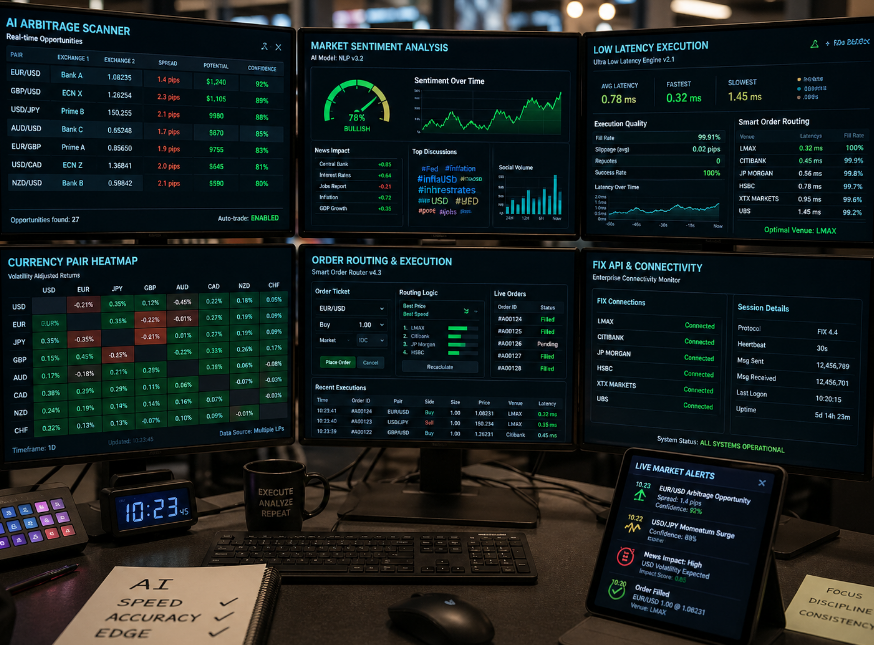
Forex Trading moves fast. Blink, and price action shifts. In modern forex trading and currency trading, speed, data, and execution decide who wins. Smart tools now reshape Forex Trading by combining automation, artificial intelligence, and tight infrastructure. Here’s how it plays out in real-world FX trading.
Automated Arbitrage Strategies for Faster Gains
In Forex Trading, arbitrage lives in milliseconds. AI-driven algorithms scan price gaps across liquidity venues.
Core automation framework
ECNs
Dark pools
Cross-matching networks
Data ingestion
Signal detection via pricing efficiency models
Smart execution routing
Performance factors
Network latency
Order book depth
Fill ratio
Arbitrage Efficiency Snapshot (FX Markets 2025)
| Venue Type | Avg Latency (ms) | Price Deviation (pips) | Fill Rate (%) | Estimated Micro Profit (%) |
|---|---|---|---|---|
| ECN A | 1.2 | 0.3 | 96 | 0.08 |
| ECN B | 1.8 | 0.4 | 94 | 0.06 |
| Dark Pool X | 2.5 | 0.6 | 91 | 0.05 |
| Cross Net Y | 1.5 | 0.2 | 97 | 0.09 |
| Hybrid Z | 2.0 | 0.5 | 93 | 0.07 |
FXBee integrates these algorithms into Forex Trading dashboards, helping traders tighten execution cycles and squeeze small but repeatable gains in foreign exchange trading.
AI-Powered Sentiment Analysis on Major Currency Pairs
Forex Trading isn’t just charts. It’s mood.
Artificial intelligence models scan macro data, speeches, and headlines to read sentiment across major currencies like EUR/USD and USD/JPY.
News parsing
Pattern detection in macro releases
Prediction scoring
Real-time market mood mapping
Short bursts of volatility often reflect shifts in analysis outputs. When central banks hint at rate changes, AI detects language tone shifts before retail forex trading desks react.
FXBee applies this intelligence directly to Forex Trading workflows, translating raw patterns into practical trading cues. Traders who want to compare automated output with human-curated alerts often also review free forex signals.
Low-Latency Connectivity with Execution Management Systems
Speed wins trades. In Forex Trading, latency is money.
Infrastructure layer
Co-location services
Cross-connect fiber
Redundant systems
Routing layer
FIX API bridges
Smart order execution logic
Risk filters
Platform layer
Institutional trading platforms
OMS and EMS integration
Direct market access controls
Tighter connectivity boosts speed, cuts slippage, and improves fill quality in FX trading. For active Forex Trading strategies, that edge compounds daily. FXBee connects traders to high-performance infrastructure, keeping currency trading smooth and sharp.
How Does ChatGPT Analyze Currency Data?
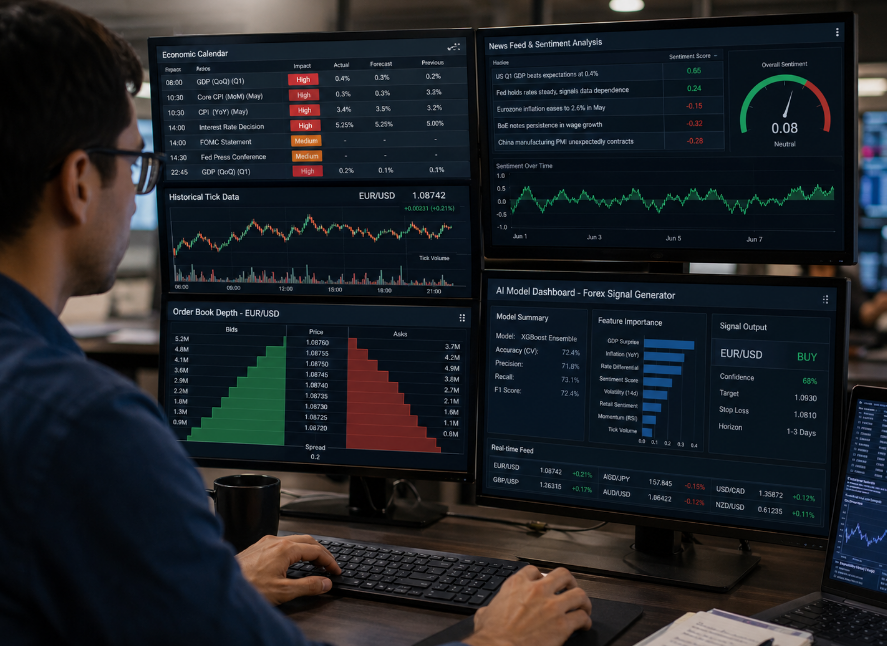
Forex Trading moves fast, and serious traders know raw data alone is not enough. To stay sharp in currency trading and the broader FX market, you need structured insight. Here’s how data modeling supports smarter Forex Trading decisions in real-world market conditions.
Parsing Historical Tick Data and Economic Indicators
In Forex Trading, price action starts with Historical data and granular Tick data, feeding structured Time series analysis models that examine:
Price Behavior
Micro-movements inside one-minute candles
Volatility clustering during news hours
Spread shifts in active Forex markets
Macro Drivers
Core Economic indicators shaping sentiment
Scheduled GDP reports and Inflation data releases
Central bank Interest rate decisions
Regime Detection
Correlation changes across currency pairs
Policy divergence between economies
Capital flow shifts in global FX trading
This layered view helps traders filter noise. On platforms like FXBee, structured datasets allow Forex Trading models to align macroeconomic data with short-term trading signals without guessing. Beginners building that foundation usually start with Learn Forex Trading.
Sentiment Analysis from News Feeds
Currency trading reacts to headlines in seconds. Using Sentiment analysis powered by Natural language processing, systems scan:
Real-time News articles
Institutional Financial news releases
Market chatter reflecting Emotional tone
Processing works in tiers:
Text Collection
Aggregating verified Textual data
Context Mapping
Identifying policy hints or risk warnings
Sentiment Scoring
Translating narrative into measurable Market sentiment
For anyone active in Forex Trading, this means narrative shifts often precede price swings in the foreign exchange market.
Order Book Depth Insights via FIX Protocol
Short-term Forex Trading thrives on liquidity awareness. Through FIX Protocol feeds, models interpret Market depth inside the Order book:
Bid Layer
Aggregated Limit orders
Compression of the Bid-ask spread
Ask Layer
Stacked liquidity zones
Absorption patterns
Microstructure Signals
Sudden imbalance shifts
Liquidity withdrawal events
This Liquidity analysis highlights stress before retail traders notice it. Understanding Market microstructure keeps FX trading decisions grounded in actual flow, not hype.
Quantitative Strategies in Macro Trading Signals
Advanced Forex Trading blends data streams into structured Quantitative strategies. The logic unfolds in connected layers:
Signal Construction
Factor-based Statistical models
Cross-asset Forecasting models
Execution Logic
Automated Algorithmic trading triggers
Macro-aligned Trading signals
Control Framework
Dynamic Risk management filters
Drawdown thresholds for macro trading exposure
When traders combine macro trading insight with disciplined Forex Trading systems, consistency improves. FXBee supports this approach by aligning Forex Trading analytics with practical execution tools, helping traders stay steady in volatile FX market cycles.
Speed
AI processes structured data and news flow faster than manual review in volatile markets.
Pattern Recognition
Neural networks and predictive analytics highlight structures human eyes may miss.
Risk Control
Value at Risk thresholds, hedging logic, and stress testing keep signals grounded.
Human vs. AI: Signal Accuracy Compared
Forex Trading moves fast, and signal accuracy can make or break your day. In Forex trading, real gains often depend on how traders read the market and how systems process data. From classic foreign exchange trading desks to mobile FX trading apps like FXBee, the debate between human instinct and automation keeps heating up.
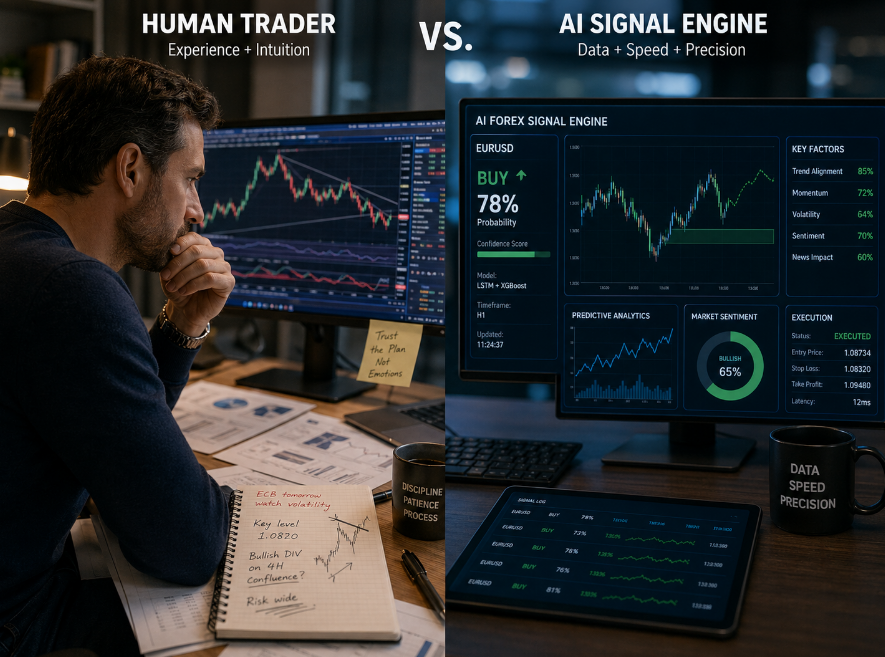
Human
In Forex Trading, human performance often unfolds in layers shaped by experience, emotion, and real-time judgment.
Core Drivers of Human Decision-Making
Traders lean on years of chart exposure in currency trading.
Analysts connect macro headlines to price action in foreign exchange trading.
Expertise grows through wins, losses, and long screen time.
Internal Processing
Intuition reacts to subtle shifts in Forex sentiment.
Judgment filters noise from meaningful movement.
Discretion allows flexibility when the market breaks its own rhythm.
Psychological Influence
Confidence after a strong run.
Hesitation after drawdown.
Overtrading when volatility spikes.
In Forex Trading, that human stack can shine during news shocks where context matters. A seasoned trader might scale out early or hold longer based on gut feel. Still, psychology cuts both ways. Emotional bias can cloud otherwise sharp analysis. Execution speed may lag compared to automated Forex systems. Yet many currency trading veterans argue that pattern recognition built through lived exposure gives them an edge no code fully mirrors.
AI
AI-driven Forex Trading runs on structured logic and rapid execution.
Short, sharp, data-heavy.
Algorithms scan thousands of price points in seconds.
Models adjust when volatility shifts.
Machine learning tools refine signals after each trade.
Automation removes hesitation.
Data analysis powers consistent entries in FX trading.
Predictive analytics forecasts probability zones.
Neural networks detect patterns invisible to manual review.
Data ingestion from multiple currency pairs.
Signal calculation through statistical rules.
Instant order placement in foreign exchange trading platforms.
★ No fatigue. No second-guessing.
Platforms like FXBee integrate structured automation with risk controls, giving Forex traders access to machine-led precision while keeping oversight in human hands. In active Forex Trading, that hybrid edge often feels like the sweet spot—discipline from machines, perspective from people.
Uncertain About Signals? ChatGPT as Your Forex Trading Aid
Cross-Border Regulations and Compliance Officers Support
Forex Trading across borders depends on regulatory frameworks, international law, and strict legal requirements.
Financial compliance monitoring tracks reporting duties across jurisdictions.
Governance standards align trading desks with internal audit rules.
Policy adherence checks reduce penalties and operational friction.
Identify jurisdiction exposure in currency trading accounts.
Map obligations under regional risk management rules.
Automate alerts for AML and KYC triggers.
Archive reports for regulatory audits.
FXBee integrates monitoring dashboards so compliance officers see cross-border Forex exposure in real time. That means fewer manual spreadsheets and fewer late-night panic emails. In active Forex Trading environments, staying clean legally is just as important as catching pips. When evaluating counterparties, many traders start with a forex broker regulated screening process.
Hedging Strategies Powered by AI Recommendations
Forex Trading without hedging is like driving without brakes. AI-assisted risk mitigation blends financial instruments with live volatility metrics.
Core hedge structures in currency trading portfolios:
Spot offset positions
Futures overlays
Options collars
Algorithmic trading engines scan correlation shifts.
Predictive analytics models test downside thresholds.
Machine learning adjusts hedge ratios as market volatility expands.
FXBee evaluates portfolio protection through Value at Risk bands, then suggests hedge combinations aligned with liquidity depth. In practical Forex Trading, that means fewer emotional exits and more structured defense. Traders comparing protective tools may also review broker-side forex options access.
Direct Market Access Simplified Through Chatbot API
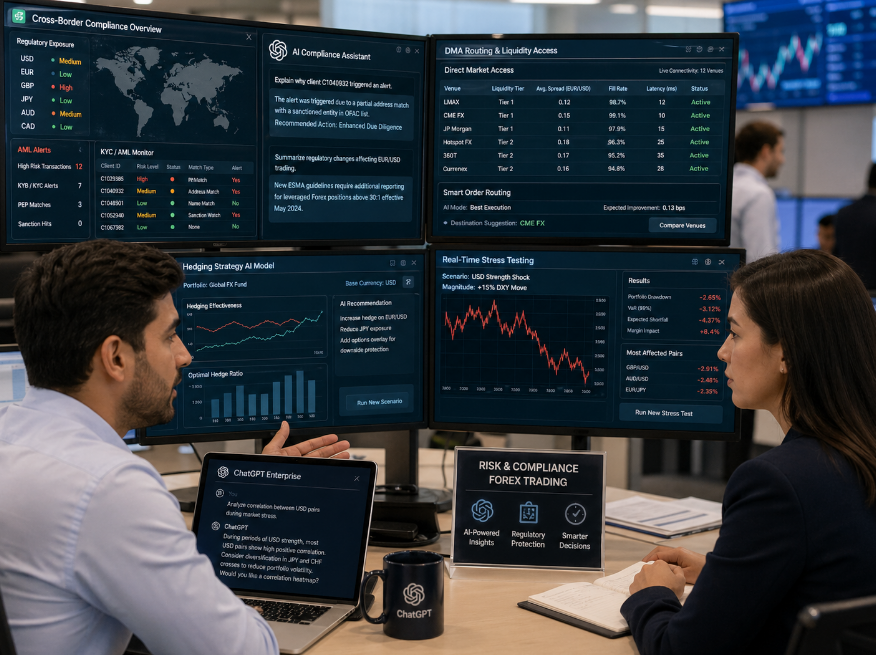
Speed matters in Forex Trading. Miss a millisecond, miss the move.
Here’s how streamlined access improves currency trading execution:
Trading platforms connect through secure API bridges.
Order routing logic selects optimal venues.
Liquidity providers are ranked by fill quality.
Technical flow inside Direct Market Access:
Client signal generated.
API validates margin parameters.
Smart routing engine evaluates:
Execution speed benchmarks
Spread differentials
Counterparty depth
Order dispatched to multilateral facility.
| Venue Type | Avg Execution Speed (ms) | Typical Spread (EUR/USD) | Liquidity Tier |
|---|---|---|---|
| Prime Broker | 12 | 0.2 pips | Tier 1 |
| ECN | 18 | 0.3 pips | Tier 1–2 |
| MTF | 25 | 0.4 pips | Tier 2 |
| Retail Aggregator | 35 | 0.6 pips | Tier 3 |
With tighter system integration and better user experience, Forex Trading feels smoother. FXBee simplifies connectivity so traders focus on strategy instead of tech headaches.
Stress Testing Scenarios with Real-Time Market Data
Forex Trading stress tests keep risk from sneaking up on you.
Inside structured scenario modeling:
Simulation models replay 2008-style liquidity squeezes.
Market fluctuations are amplified by volatility multipliers.
Economic indicators such as CPI shocks and rate pivots are layered into projections.
Stress design typically unfolds as:
Select baseline exposure in Forex positions.
Apply volatility shock (e.g., +30%).
Recalculate counterparty exposure using data analytics.
Compare capital buffer against projected drawdown.
Nested evaluation layers include:
Counterparty Review
Credit rating drift
Settlement cycle delays
Liquidity Mapping
Spread widening
Depth contraction
This structured risk assessment builds long-term financial resilience. In serious Forex Trading, stress testing is not dramatic—it’s routine. And when scenarios update in real time, traders react early instead of reacting late.
References
OTC foreign exchange turnover in April 2022 - https://www.bis.org/statistics/rpfx22_fx.htm
FX execution algorithms and market functioning - https://www.bis.org/publ/mktc13.pdf
Monitoring of fast-paced electronic markets - https://www.bis.org/publ/mktc10.pdf
ChatGPT Search - https://help.openai.com/en/articles/9237897-chatgpt-search
Introducing ChatGPT search - https://openai.com/index/introducing-chatgpt-search/
FAQ
How can technology improve accuracy in Forex Trading?
Speed and judgment now sit side by side. Modern desks combine human instinct with:
Real-time market data & historical tick data to read Major currency pairs and Exotic currency pairs under shifting volatility indices.
Algorithmic trading systems connected through API integration to Execution Management Systems for tighter pricing.
Low-latency connectivity and co-location services near liquidity providers, reducing slippage across Electronic Communication Networks and the interbank market.
Behind every signal stands risk control—Value at Risk thresholds, liquidity risk checks, and order book depth analysis—so institutional investors and hedge funds act with precision, not impulse.
What makes spot, forward, and derivatives analysis different in practice?
Price is immediate in Spot contracts, negotiated in the interbank market.
Obligation is defined in Forward contracts, shaped by interest rate gaps and macro trading views.
Structured protection appears in Futures contracts and Currency options, often used by multinational corporations and asset managers.
In daily trading:
Economic indicators and news feeds drive short-term sentiment analysis.
Quantitative strategies test carry trade or arbitrage strategies across Minor currency pairs.
Execution flows through Order Management Systems using the FIX Protocol for clean confirmation.
Each instrument carries its own rhythm of market risk and counterparty risk.
Why is low-latency execution critical for institutional participants?
Milliseconds can decide profit or regret.
High-frequency trading desks rely on Direct Market Access and cross-matching networks.
Hedge funds deploy algorithmic execution through Multilateral Trading Facilities and dark pools.
Commercial banks monitor order book depth across prime brokerage channels.
Low-latency connectivity reduces pricing gaps, while stress testing guards against operational risk during volatility spikes. In fast markets, hesitation is expensive.
How do compliance and risk management shape cross-border Forex Trading?
Cross-border flow brings scrutiny and pressure. Compliance officers track:
Anti-Money Laundering and Know Your Customer duties
Reporting requirements across jurisdictions
Market abuse regulations under strict regulatory oversight
At the same time, risk desks conduct stress testing against central bank shocks, measuring market risk and liquidity risk in Major and Exotic currency pairs.
Hedging strategies with Currency options or Futures contracts help multinational corporations and commercial banks steady cash flow when central banks shift policy. In Forex Trading, discipline protects reputation as much as capital.