
A forex profit calculator can make the arithmetic quicker, but it cannot make a trade predictable. The useful result is an estimate you can inspect: how a stated price move, position size, account currency, and set of costs could affect your balance. This guide explains the calculation for intraday and multi-day scenarios, including when the currency in which the pair is quoted differs from the currency in your account.
The examples are illustrative and use rounded rates. They are educational information, not investment, tax, or legal advice. Forex and leveraged OTC products can involve substantial loss; for U.S. retail traders, the CFTC’s forex advisory recommends checking a dealer’s registration and disclosures before funding an account.

Quick answer: the core forex profit formula
For a position measured in units of the base currency, calculate the gross result in the pair’s quote currency first:
Long position gross P/L = (exit price − entry price) × units traded
Short position gross P/L = (entry price − exit price) × units traded
Then convert the result to the account currency if necessary. A practical net estimate is:
Estimated net P/L = gross P/L − spread cost − commissions − financing/swap − conversion costs − other applicable charges.
Pips are simply a convenient way to express the price move. For many non-JPY pairs, one pip is 0.0001; for many JPY-quoted pairs, it is 0.01. A calculator should show its pip convention, contract size, and conversion rate, because those inputs often explain a mismatch with an account statement. For a companion explanation of the formula, see FXBee’s guide to forex profit calculation formulas.
Start with the inputs—not the headline profit number
Before calculating, confirm the exact instrument and the terms for the account you intend to use. A figure that looks precise can still be misleading when it was built with the wrong lot convention, side of the quote, or account currency.
| Input | Why it changes the estimate | What to verify |
|---|---|---|
| Pair and direction | They determine which move is favorable and the quote currency in which gross P/L begins. | Exact symbol, buy/long or sell/short, and pip convention. |
| Entry and exit assumptions | They define the price difference; a planned fill may not equal an executed fill. | Relevant bid/ask side, stop or target, and a realistic slippage allowance. |
| Units or lots | They determine the cash value of each pip. | Whether the platform input is units, standard lots, mini lots, or a product-specific contract. |
| Account currency | A quote-currency result may need a second exchange-rate conversion. | The rate source and timing used by the provider for conversion. |
| Costs and holding period | They turn gross P/L into a more complete net estimate. | Spread, commission schedule, financing/rollover policy, and conversion charges. |
FXBee’s forex profit calculator checklist is a useful second pass for these inputs. Compare the calculator output with the order preview and the provider’s current instrument specification; if they differ materially, investigate before placing the order.
Worked example: EUR/USD in a USD account
Assume a long EUR/USD position of 0.50 standard lots, or 50,000 euros. The entry is 1.0800 and the illustrative exit is 1.0860. The price move is 0.0060, or 60 pips.
Gross P/L in USD: (1.0860 − 1.0800) × 50,000 = $300.
Pip cross-check: for this size, one EUR/USD pip is approximately $5; 60 pips × $5 = $300.
Estimate net P/L: if the assumed round-trip spread cost is $6 and the assumed round-trip commission is $7, the estimate becomes $287 before any other applicable adjustment.
This is a clean case because the quote currency (USD) matches the account currency. It does not mean every 0.50-lot trade has a $5 pip value: the pair, trade size, and account denomination all matter.

When the account currency is different: convert deliberately
A cross-currency calculation has two stages: calculate the trade result in the pair’s quote currency, then convert that amount into the account currency. The conversion rate can move while the trade is open, so a planning estimate and a final statement entry may not match exactly.
Illustrative USD/JPY short with a USD account
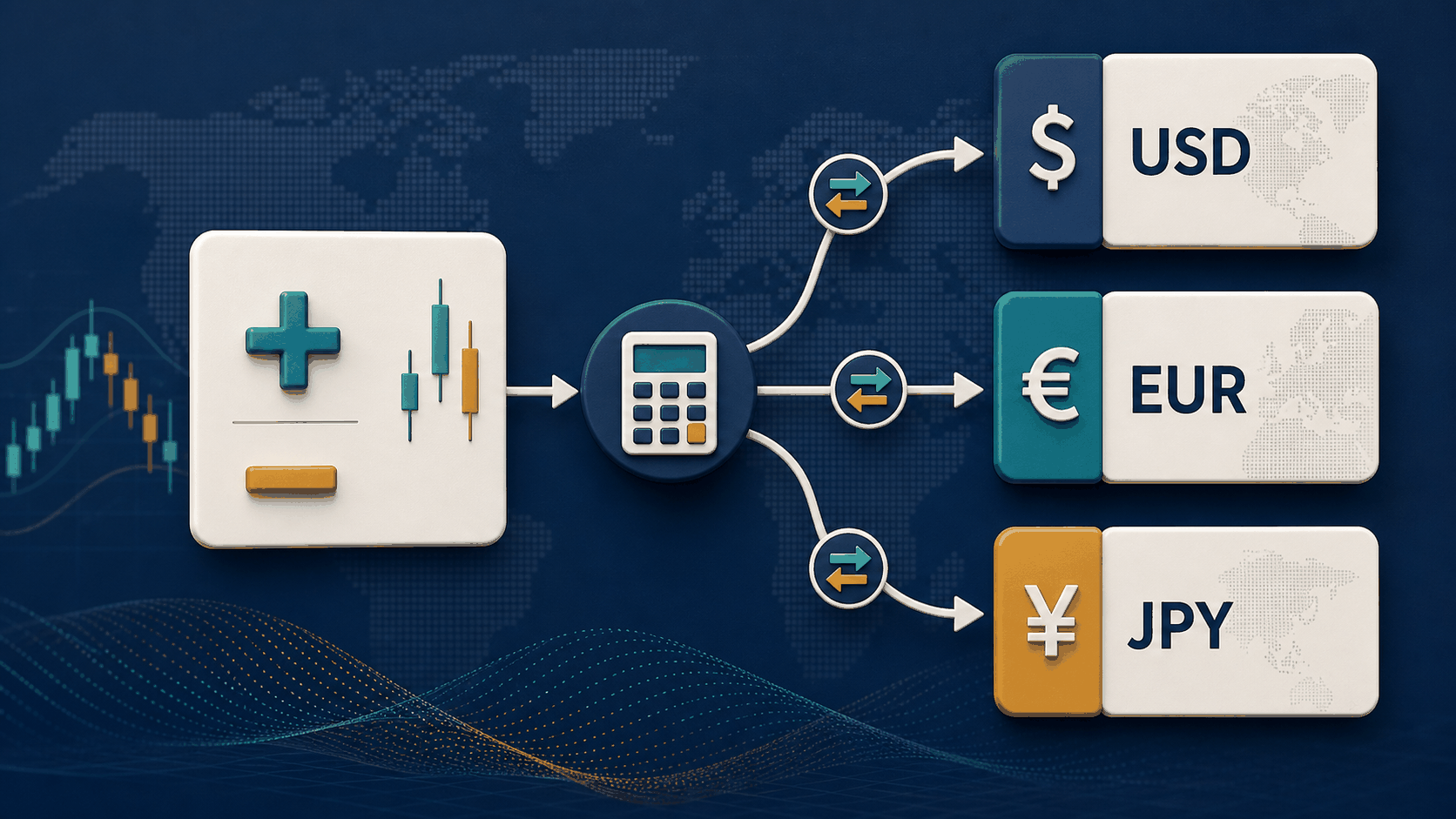
Suppose a trader sells 100,000 USD/JPY at 150.20 and closes at 149.40. Because this is a short, the favorable move is 150.20 − 149.40 = 0.80 yen per dollar. The gross result is 0.80 × 100,000 = 80,000 JPY.
To express that result in a USD account using the illustrative closing rate of 149.40 JPY per USD, divide 80,000 by 149.40. The gross result is approximately $535.48 before costs. A provider may use a different conversion rate or timing under its account agreement, so treat this as a formula check rather than a statement forecast.
What changes in an EUR account?
The same 80,000 JPY first becomes USD using the USD/JPY conversion, then USD becomes EUR using the applicable EUR/USD or USD/EUR rate. If EUR/USD is illustratively 1.0900, $535.48 is about €491.27 before costs. In practice, use the conversion rate and method specified by the provider—not a rate copied from an unrelated chart.
How timeframes change the calculation
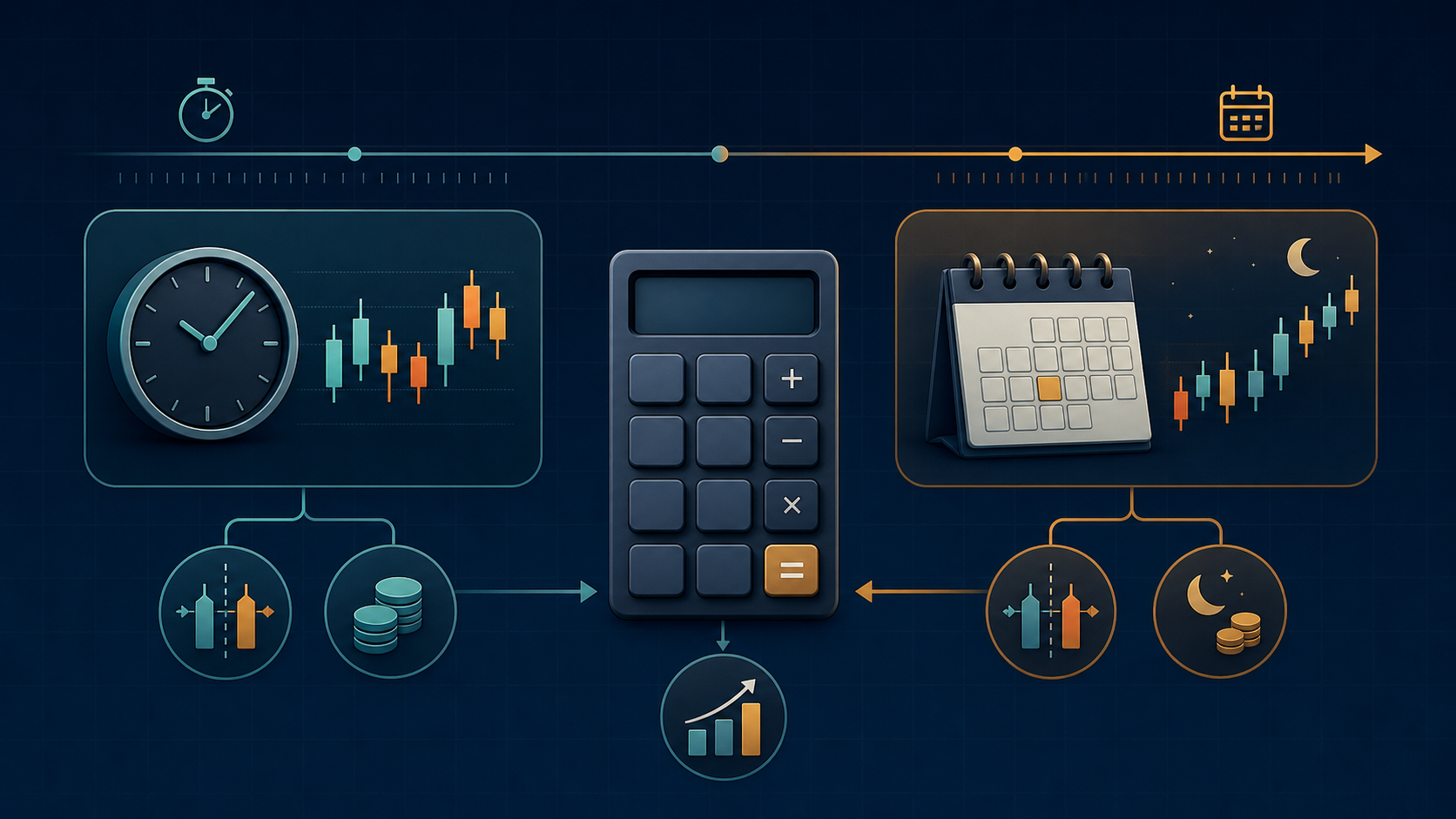
The basic price-move formula does not change merely because a chart is set to five minutes, one hour, or one day. What changes is the set of costs and risks that should be included in the estimate.
| Scenario | Calculation focus | Common omission |
|---|---|---|
| Intraday trade | Entry/exit sides, spread, commission, and a realistic execution buffer. | Assuming a displayed mid-price is an executable price. |
| Held past rollover | All intraday inputs plus financing/swap and the broker’s rollover timing. | Using the same net P/L estimate after a financing event. |
| Multi-day or swing trade | Repeated financing, weekend/gap risk, evolving conversion rates, and wider uncertainty around stops. | Treating a target calculation as fixed while costs and conversion rates change. |
For an open position, calculate unrealized P/L from the price that could close the position at that moment, then separately review accumulated costs. For a long position, that often means using the bid-side close price; for a short position, it often means using the ask-side close price. The exact treatment depends on the instrument and provider.
Use the calculator before the order, then reconcile after it closes
The most useful workflow is risk-first. Choose the price level that would invalidate the trade idea, decide the maximum amount you are prepared to lose, and size the position from those inputs. A target can then show a possible reward scenario, but it should not decide the size on its own.
Select the exact pair, direction, account currency, and contract size.
Enter a planned entry, protective stop, and intended exit scenario.
Check the pip value in the account currency—not just in the quote currency.
Add known spread, commission, and holding-cost assumptions; leave room for execution differences.
Review margin and free equity separately from P/L.
After closing, compare the estimate with the statement and identify whether the difference came from fills, conversion, financing, or fees.

For more ways to catch input errors, read common calculation mistakes in forex trading. If you use educational material or compare providers through fxbee.com, independently confirm the relevant firm’s availability, registration, costs, and terms for your location. The SEC’s Investor.gov forex bulletin also notes that leverage can magnify losses and that transaction costs can change a seemingly profitable trade into a loss.
Practical guardrails for U.S. readers
Do not treat a forex profit calculator as a promise of a fill, a future exchange rate, or a withdrawal outcome. Retail forex products, leverage limits, registration status, and account protections can differ by provider and jurisdiction. Before depositing funds or sharing sensitive information, review the firm’s risk disclosure and account agreement, verify the relevant registration and disciplinary history, and be cautious of unsolicited offers or claimed guaranteed returns. The CFTC specifically advises U.S. customers to research OTC forex dealers before making an initial deposit.