
A trade can be right about direction and still produce a smaller-than-expected account result. The gap usually comes from one of four inputs: the size of the position, the currency pair’s pip convention, the account currency, or trading costs. A forex profit calculator automates the arithmetic, but knowing the formula helps you check the result before you enter and after you exit.
This guide explains how to calculate gross and net forex profit or loss for major, minor, and JPY currency pairs. The examples use a USD-denominated account because that is common for U.S. readers. They are educational examples, not trading recommendations or a promise of results.
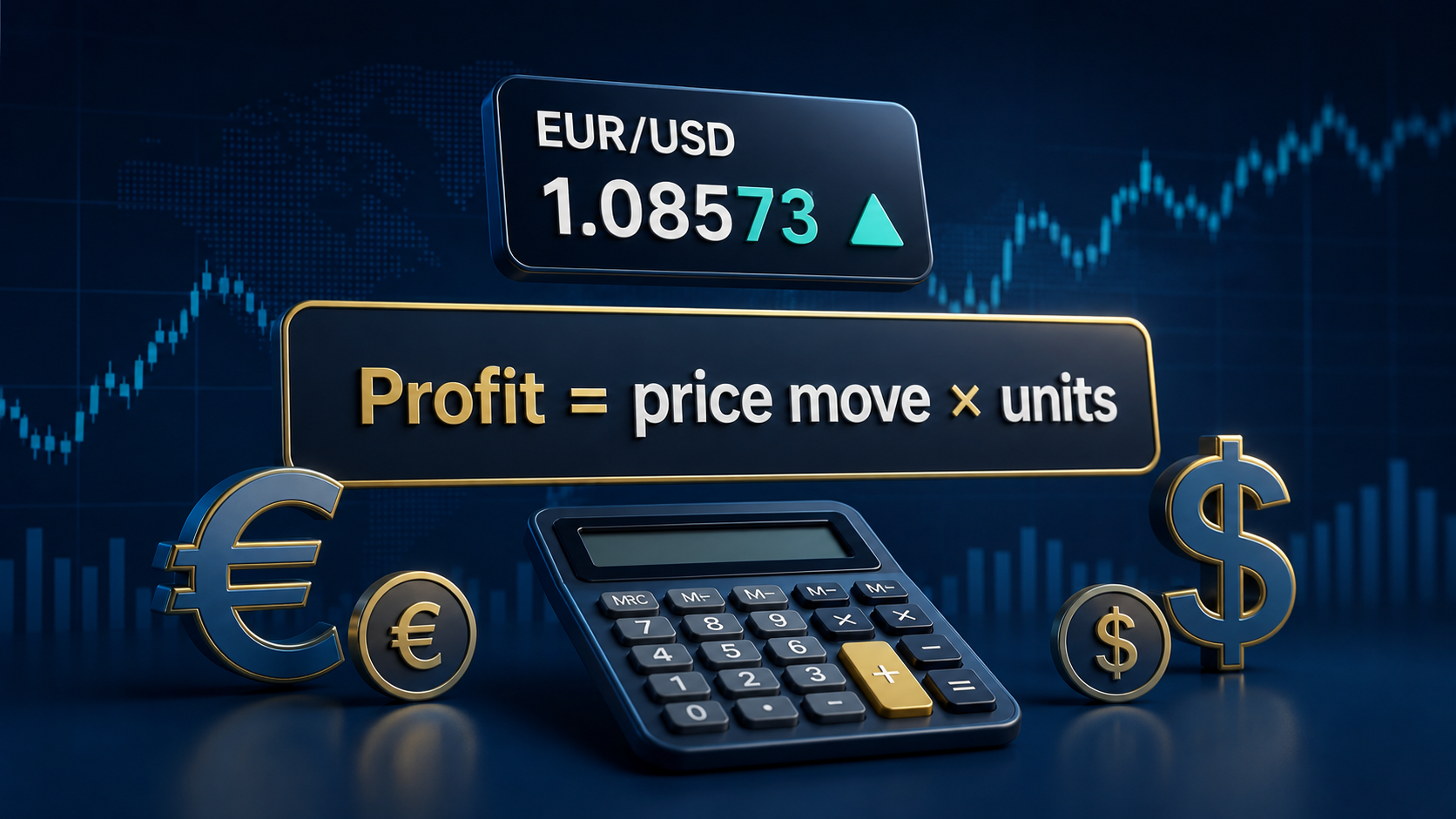
Quick answer: the forex profit formula
For a position measured in units of the base currency, calculate the gross result in the pair’s quote currency first:
Long position P&L = (exit price − entry price) × units traded
Short position P&L = (entry price − exit price) × units traded
Then convert that result to the currency of your account if necessary. Finally, subtract costs such as spread, commission, financing (swap), and any conversion charge:
Net P&L = gross P&L − spread cost − commission − financing ± rebate − conversion or other charges
The sign matters. A positive number is a profit and a negative number is a loss. A calculator should show both, but it is worth confirming which costs it includes and whether it uses entry, exit, bid, ask, or mid-market prices.
Read the currency pair before doing the math
In EUR/USD, EUR is the base currency and USD is the quote currency. A quote of 1.0800 means one euro is priced at 1.0800 U.S. dollars. When you buy EUR/USD, you buy euros and sell U.S. dollars. When the quote rises, a long position gains in USD before costs; when it falls, it loses.
The same structure applies to every pair, but the account-currency conversion can be different. In USD/JPY, the immediate P&L is in Japanese yen because JPY is the quote currency. A USD account needs a yen-to-dollar conversion before the platform can display the final amount.
| Term | What it means | Why it affects profit |
|---|---|---|
| Base currency | The first currency in the pair, such as EUR in EUR/USD. | Position size is normally expressed in units of this currency. |
| Quote currency | The second currency, such as USD in EUR/USD. | The first gross P&L calculation is expressed in this currency. |
| Pip | Usually 0.0001 for non-JPY pairs and 0.01 for JPY pairs. | It standardizes price distance for comparing trades and estimating cost. |
| Lot size | A contract-size convention: standard 100,000, mini 10,000, micro 1,000 units. | More units make each pip worth more; confirm the broker’s contract specification. |
Calculate pips and pip value
Step 1: find the price movement in pips
For most pairs quoted to four decimal places, one pip is 0.0001. For JPY pairs, one pip is usually 0.01. Fractional-pip quotes are common, but the pip remains the conventional larger unit.
Pips moved = (exit price − entry price) ÷ pip size for a long trade. Reverse the subtraction for a short trade if you want the result stated as a positive number when the short wins.
Step 2: find pip value in the quote currency
Pip value in quote currency = units traded × pip size
A 100,000-unit EUR/USD position has a pip value of 100,000 × 0.0001 = $10 when the account is in USD. A 10,000-unit position has a $1 pip value, and a 1,000-unit position has a $0.10 pip value. That shortcut works because USD is the quote currency.
For a JPY-quoted pair, the quote-currency pip value is still easy: 100,000 × 0.01 = ¥1,000 per pip. The conversion to dollars comes afterward.
Worked example: EUR/USD profit in a USD account
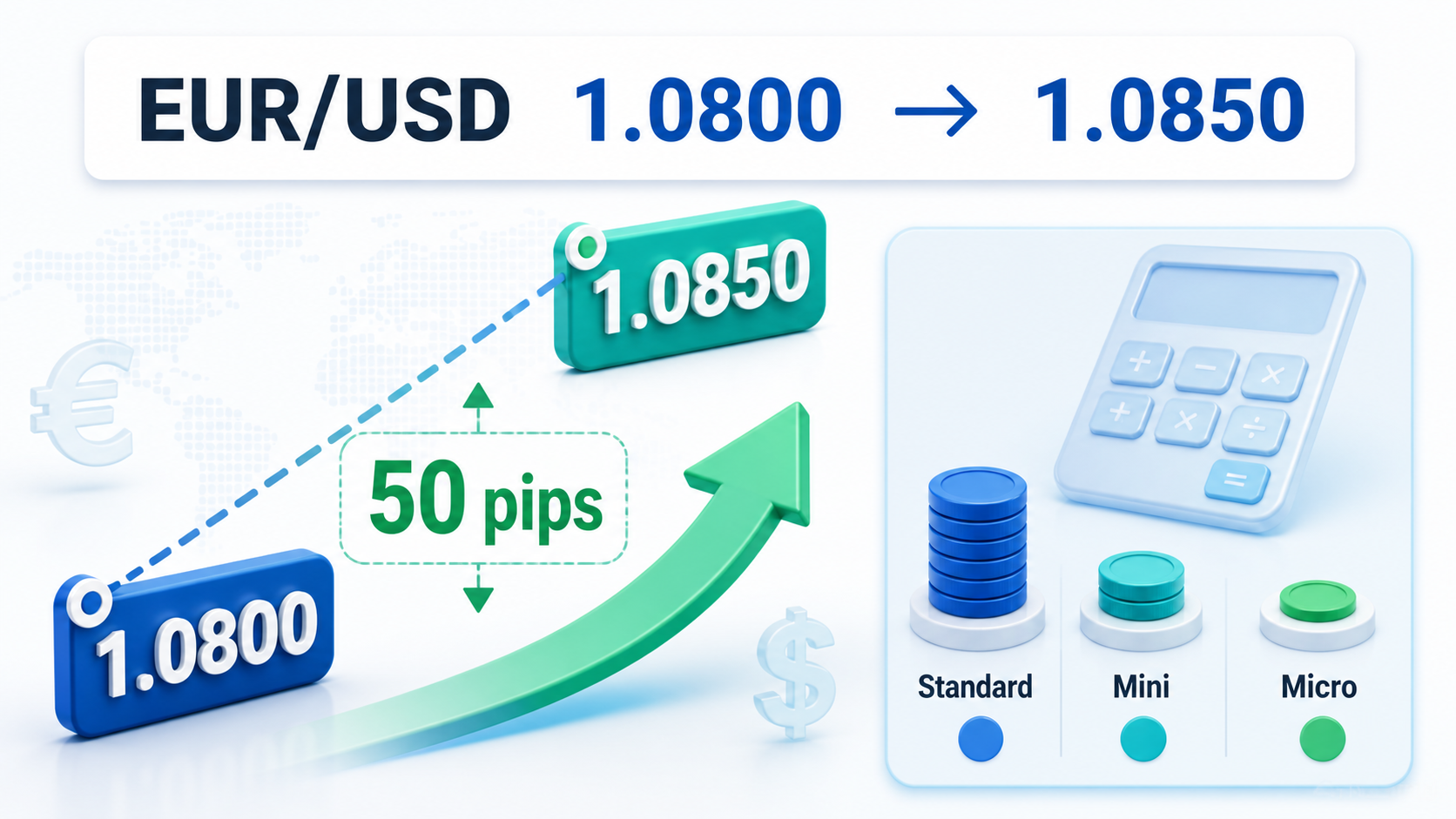
Assume a trader buys one standard lot of EUR/USD, or 100,000 EUR, at 1.0800 and closes at 1.0850.
Price movement: 1.0850 − 1.0800 = 0.0050.
Pips moved: 0.0050 ÷ 0.0001 = 50 pips.
Pip value: 100,000 × 0.0001 = $10 per pip.
Gross profit: 50 × $10 = $500.
The same answer comes directly from the price formula: (1.0850 − 1.0800) × 100,000 = $500.
Turn the gross result into a net result
Suppose the trade had an estimated 1.2-pip spread cost ($12 on one standard EUR/USD lot), a $7 round-turn commission, and a $2 overnight financing debit. The estimated net result would be $500 − $12 − $7 − $2 = $479. Actual costs and execution can differ from a pre-trade estimate.
If the trade had been a 0.10-lot position instead, all else equal, the gross result would be $50 rather than $500. Position size changes the dollar value of the move; it does not change the number of pips.
Worked example: USD/JPY profit and account-currency conversion
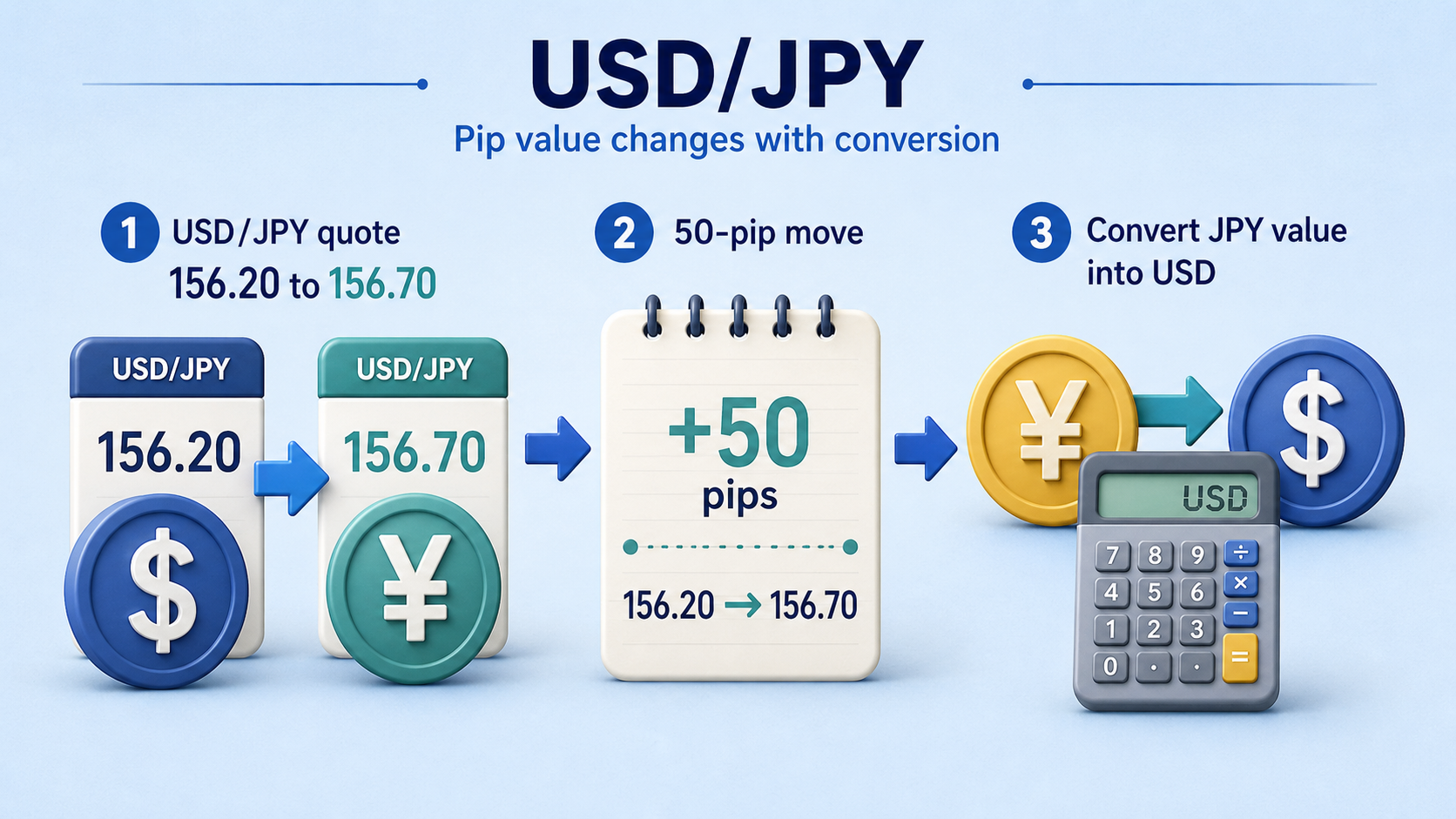
Now assume a USD account buys 100,000 USD of USD/JPY at 156.20 and exits at 156.70.
Price movement: 156.70 − 156.20 = 0.50, or 50 pips because the pip size is 0.01.
Gross P&L in JPY: 0.50 × 100,000 = ¥50,000.
Convert to USD at the illustrative exit rate: ¥50,000 ÷ 156.70 = approximately $319.08.
Equivalently, the approximate dollar pip value at 156.70 is (100,000 × 0.01) ÷ 156.70 = $6.38. Fifty pips × $6.38 is approximately $319.08. The dollar pip value changes as USD/JPY changes, which is why a fixed “$10 per pip” assumption is unsuitable for every pair.
When your account currency is not the quote currency
The general approach is always the same: calculate P&L in the quote currency, then multiply by the value of one unit of the quote currency in your account currency.
Account-currency P&L = quote-currency P&L × conversion rate
For example, a EUR/GBP trade produces a result in GBP. In a USD account, convert the GBP amount into USD using the relevant GBP/USD rate available to the account. A platform may apply its own conversion convention and rate, so a manual calculation is a check, not a substitute for the broker’s transaction record.
This is also why a forex profit calculator asks for the account currency. Two traders can take the same pair, size, and price movement and see slightly different final P&L after conversion and account-specific charges.
Short-sale example: GBP/USD
Assume a trader sells 10,000 GBP of GBP/USD at 1.2700 and buys it back at 1.2655. The price declined 0.0045, or 45 pips. Because the short benefited from a fall:
Gross profit = (1.2700 − 1.2655) × 10,000 = $45
Since USD is the quote currency, no further currency conversion is needed for a USD account. Deduct the position’s spread, commission, and any applicable financing to get the net result. If the price had risen to 1.2745 instead, the same formula would produce a −$45 gross loss.
What a forex profit calculator should include
A useful calculator is more than a pip counter. Enter the following inputs before relying on an estimate:
Currency pair and whether the trade is long or short.
Entry price, take-profit or exit price, and current price when evaluating an open trade.
Position size in lots or base-currency units.
Account currency.
Expected spread and commission schedule.
Financing or swap estimate if the position may remain open past the broker’s rollover time.
Any conversion charge, rebate, or account-specific adjustment that is relevant to the trade.
A calculator cannot predict fills. In fast conditions, slippage can make the actual entry or exit different from the requested price. Stop orders can also execute away from their trigger price. Treat the result as a planning estimate until the trade is closed and the account statement posts the final values.
Costs that change gross profit into net profit
| Cost or adjustment | How it affects the calculation | What to check |
|---|---|---|
| Spread | Creates an immediate difference between executable bid and ask prices. | Use the side of the quote you can actually trade, not only a chart’s mid-price. |
| Commission | Usually a cash amount per lot, side, or round turn. | Confirm whether the published amount is one-way or round turn. |
| Financing / swap | Can debit or credit an overnight position. | Check the instrument, direction, rollover time, and broker policy. |
| Conversion | Applies when profit currency and account currency differ. | Check the platform’s conversion rate and any stated markup. |
| Rebate | May offset eligible trading costs, but is separate from the trading P&L. | Review eligibility, account type, rate, timing, and exclusions. |
| Slippage | Changes the realized fill price. | Compare requested, triggered, and filled prices after execution. |
FXBee describes itself as a third-party rebate and trade-tracking platform rather than a trade-execution or investment-advice provider. Its broker rebate comparison, support and platform information, and terms of use are relevant starting points for checking current eligibility, rate variations, and exclusions. Do not treat a rebate as a reason to increase position size or accept a trade that does not meet your risk plan.
Use the formula for risk planning, not just profit targets
Before opening a trade, run the same calculation to estimate the loss at your stop price. For a USD-quoted pair in a USD account:
Estimated stop loss = stop distance in pips × pip value + expected costs
If a 10,000-unit EUR/USD position has a $1 pip value and the stop is 35 pips away, the price-risk component is about $35 before costs. That figure can help you decide whether the planned size fits the amount you are prepared to lose. It does not limit loss automatically: volatile pricing, gaps, and execution conditions can lead to a different realized result.

U.S. retail forex participants should also independently check the regulatory status and disclosures of any firm they are considering. The CFTC’s fraud-warning guidance cautions against claims of little or no risk and high-pressure sales tactics. Federal retail-forex disclosure rules also state that leverage can magnify loss and may lead to losses beyond the margin posted in some arrangements; see the Federal Reserve’s retail forex disclosure text.
A pre-trade checklist for accurate estimates
Write down the pair, direction, account currency, entry, stop, target, and units.
Use the correct pip size: normally 0.0001, or 0.01 for JPY pairs.
Calculate the pip distance to both target and stop.
Calculate pip value in the quote currency, then convert it if needed.
Estimate spread, commissions, and financing separately instead of assuming gross profit is net profit.
Check that the estimated loss at the stop fits your own risk limit.
After closing, reconcile the estimate with the broker’s fills and statement so the next estimate improves.
That workflow is deliberately simple. It makes the assumptions visible, which is more useful than a precise-looking output built on the wrong lot size, wrong pip convention, or incomplete cost input.
Bottom line
The core forex profit formula is price movement multiplied by position size. Pips make the movement easier to read, but they are only one part of the result. Convert quote-currency P&L into the account currency when required, then account for spread, commissions, financing, and execution. A forex profit calculator is most helpful when it reflects those inputs—and when you use it to estimate downside as carefully as upside.
Forex profit calculator FAQ
What is the basic forex profit formula?
For a long position, subtract entry from exit and multiply by the number of base-currency units. For a short position, subtract exit from entry and multiply by units. This gives gross P&L in the pair’s quote currency. Convert it to the account currency when needed, then subtract trading costs.
How does a forex profit calculator work?
It combines pair, direction, prices, pip size, position size, and account currency to estimate gross P&L. Better calculators also allow for spread, commission, financing, and conversion. The output remains an estimate until actual orders are filled and the account records all charges.
How much is one pip worth on EUR/USD?
With USD as the account currency and quote currency, a standard 100,000-unit EUR/USD position is conventionally $10 per pip, a 10,000-unit position is $1 per pip, and a 1,000-unit position is $0.10 per pip. Contract specifications and costs still need confirmation with the broker.
Why is USD/JPY pip value different in a USD account?
USD/JPY’s gross P&L is first stated in yen. To show it in dollars, the yen amount must be converted using a relevant USD/JPY rate. As that exchange rate changes, the dollar value of a yen-denominated pip changes too.
Do JPY pairs use a different pip size?
Usually, yes. A pip is commonly 0.01 for JPY-quoted pairs such as USD/JPY and GBP/JPY, while it is commonly 0.0001 for pairs such as EUR/USD. Platforms may show an additional fractional digit, but that does not change the conventional pip definition.
Is gross profit the same as net profit?
No. Gross profit reflects the price movement before costs. Net profit reflects the amount after spread, commissions, financing, conversion, and other applicable charges or credits. Comparing a target with net profit is more realistic than looking at pips alone.
How do I calculate profit on a short forex trade?
For a short, use entry price minus exit price, then multiply by units. A lower exit price creates a positive gross result. Convert the quote-currency result if your account uses another currency, and then include costs.
Does leverage change forex profit?
Leverage does not change the P&L formula for a given number of units. It changes how much margin is required to control those units. Because it can make a large position possible with less deposited margin, it can magnify the impact of small price moves on account equity and risk.
Should I include spread in a forex profit estimate?
Yes. Spread affects the executable entry and exit prices and is a meaningful cost, especially for short-term trading. Use the bid and ask relevant to your trade rather than relying solely on a displayed midpoint. Add commissions and financing separately where applicable.
Can a forex rebate be added to trade profit?
A rebate may be a separate account credit tied to eligible volume or other stated conditions. It can affect your overall net trading cost, but it does not change the market P&L from price movement. Verify eligibility, account type, exclusions, payment timing, and current terms before including an estimated rebate.
Why does my platform result differ from my manual calculation?
Common reasons include bid-ask pricing, slippage, commission timing, overnight financing, conversion rates, fractional-pip rounding, and different contract sizes. Compare your order history and account statement with each input in the formula rather than assuming the platform is using a mid-price estimate.
Is forex trading suitable for every U.S. investor?
No. Retail forex is leveraged and involves substantial risk. Consider your objectives, financial circumstances, and ability to bear losses; review a provider’s disclosures and registration status. Educational calculations can clarify trade mechanics but cannot remove market, counterparty, or execution risk.