
If you’re serious about Forex Trading, the best AI isn’t hype—it’s the edge that keeps your spreads tight and your risk in check.
Markets move fast, and gut instinct just can’t babysit millions of price ticks. You need systems that read momentum, sync with live feeds, and flag trouble before it bites.
Bank for International Settlements reports OTC FX markets reached $9.6 trillion per day in April 2025.
Strategy Alignment
Match AI to algorithmic trading, momentum setups, arbitrage, carry logic, and real trading behavior.
Data Integration
Use trusted historical data, real-time feeds, API connectivity, FIX, and normalized data processing.
Risk And Compliance
Control drawdowns, protect capital, monitor AML workflows, and support regulatory reporting.
3 Key Factors In Choosing AI For Forex
Quick heads-up: picking AI for Forex Trading isn’t about shiny dashboards. It’s about fit, data flow, and guardrails, so your forex trading doesn’t melt down when markets get jumpy.
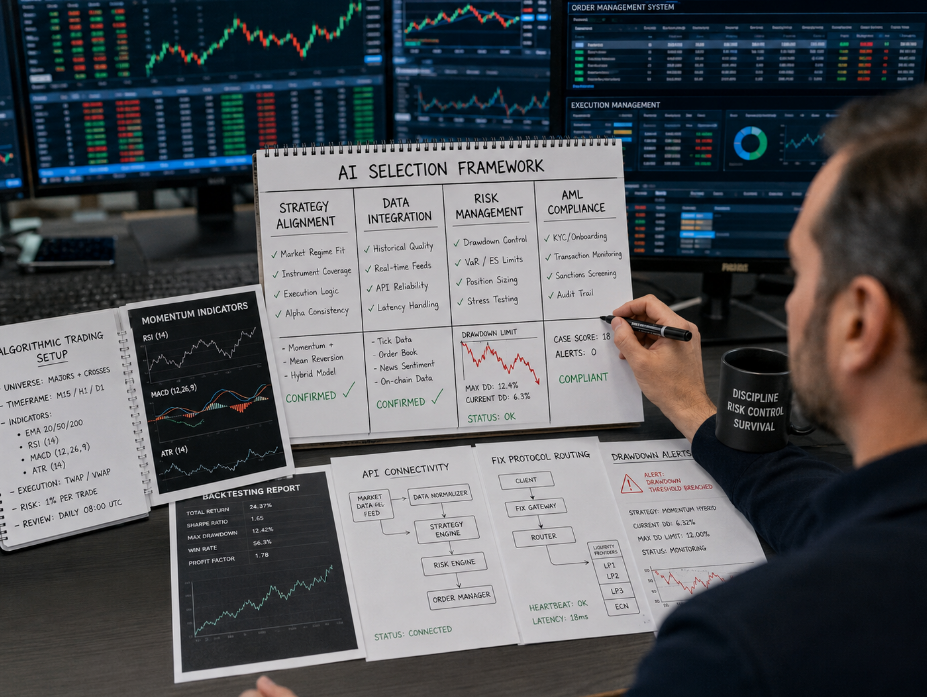
Strategy Alignment with Algorithmic Trading and Momentum Setups
A good fit starts with your Trading strategy, not the vendor pitch, because Forex Trading lives and dies by timing.
Match the model to how you actually trade FX:
Arbitrage logic that assumes realistic slippage and queue priority
Carry setups that respect rollovers and funding costs
Algorithmic trading tuned to Momentum indicators that react to real Market trends
Clear Entry/exit points that don’t “repaint” after the fact
Momentum-heavy flow:
Faster styles:
Prove it before money hits the market:
Backtesting across majors/minors with ugly weeks included
Optimization that avoids curve-fit wins and focuses on repeatable behavior
If you’re using Fxbee, push for execution settings that reflect your broker’s routing, so Forex Trading results don’t look great only on paper.
Seamless Integration of Historical Data and Real-Time Market Data Feeds
If your Forex Trading brain runs on stale inputs, it’ll make stale calls. Keep the plumbing clean, then keep it fast.
Start with Historical data you can trust, then map it to your Data sources brokers, venues, vendors.
Add Real-time data—true tick flow, not watered-down snapshots—through strong API connectivity or FIX, so Market data feeds don’t choke during news.
Normalize everything during Data processing time zones, missing ticks, symbol mapping.
Sanity-check: does your Data integration layer let you replay the same market tape for audits and backtests, then swap straight into live execution without rewiring?
That’s what keeps forex trades consistent from test to live.
Robust Risk Management and AML Compliance Capabilities
No one brags about controls—until the day they save the account. In Forex Trading, this is the difference between a bad day and a blown month.
Trading risk that’s always on:
Risk assessment with drawdown alarms and Drawdown control that can actually cut exposure
Capital protection via VaR-style limits and stress runs, plus liquidity checks during thin sessions
Hedging rules that don’t fight your core signal
Compliance that doesn’t feel like a tax:
Anti-money laundering flow baked in: Transaction monitoring, Fraud detection, and clear Compliance policies
Regulatory compliance outputs aligned to MiFID II, Dodd-Frank, ESMA, and CFTC expectations, so reporting isn’t a scramble
If Fxbee is on your shortlist, ask how alerts, approvals, and audit logs are handled end-to-end, because “we support compliance” is not a feature—it's a workflow.
Neural Networks Vs. Genetic Algorithms
Forex Trading moves fast, and smart tech makes a real difference. In Forex Trading, tools like Neural Networks and Genetic Algorithms help traders read market trends, test ideas, and stay sharp in currency trading.
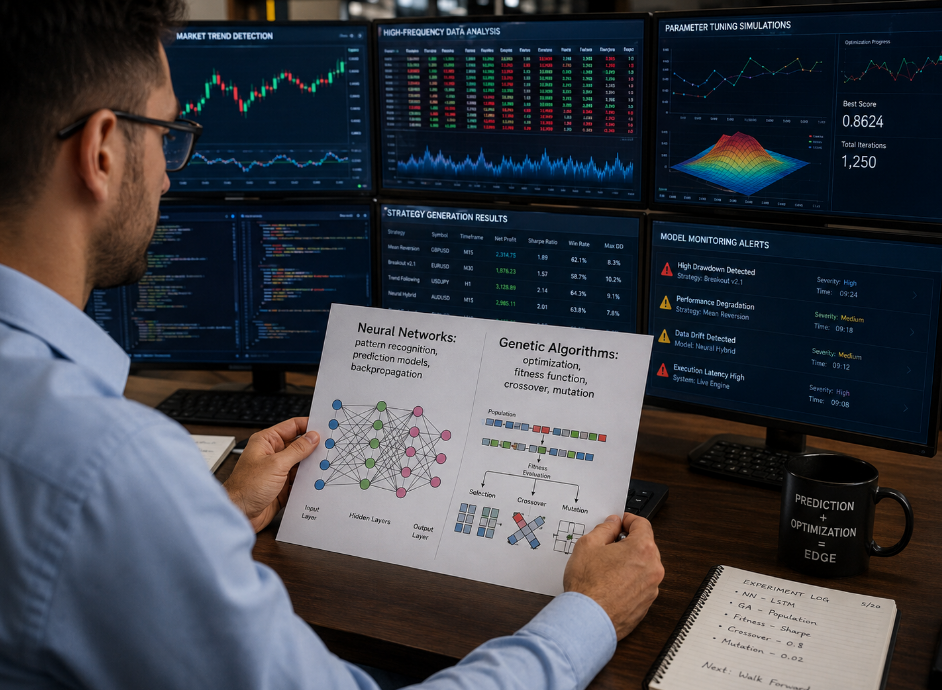
Neural Networks
In Forex Trading, Neural Networks sit inside the wider world of Machine Learning and Deep Learning, powering advanced Prediction Models for trading forex and currency markets.
Core Function in Forex Trading
Builds Prediction Models trained through Backpropagation.
Adapts to shifting Market Trends in live currency trading.
Uses Pattern Recognition to scan price action in forex markets.
Detects hidden structures in high-frequency Data Analysis streams.
Pattern Discovery
Market Forecasting
Application Layers
Blends news into Algorithmic Trading systems.
Extracts depth signals for short-term forex trading setups.
Processes tick-by-tick data for Forex Trading decisions.
Spot Forex
Futures & Order Books
Sentiment Feeds
Risk Controls
Continuous recalibration when volatility spikes.
Cross-validation across trading forex cycles.
Overfitting Checks
Model Monitoring
BIS research on FX execution algorithms notes rising use of execution algorithms in increasingly fragmented and automated FX markets.
That’s why platforms like Fxbee integrate Neural Networks into Forex Trading dashboards—giving traders practical AI without the headache.
Genetic Algorithms
While Neural Networks predict, Genetic Algorithms focus on Optimization in Forex Trading.
At the core sits Evolutionary Computation. Strategies evolve. Weak rules drop out. Strong ones survive.
Start with a pool of rule-based systems for trading forex.
Score each setup using a Fitness Function tied to return and drawdown.
Apply Crossover and Mutation to create new parameter mixes.
Repeat until the best Strategy Generation appears.
Key uses in Forex Trading include:
Parameter Tuning for entry and exit logic.
Portfolio weight balancing in currency trading.
Execution rule refinement under slippage limits.
Unlike static models, Genetic Algorithms keep adapting. In fast-moving forex markets, that flexibility matters. Fxbee applies this approach to help Forex Trading systems search thousands of combinations quickly, cutting guesswork and keeping trading forex grounded in data instead of gut feeling.
In short, Neural Networks read the market. Genetic Algorithms reshape the playbook. Smart Forex Trading often blends both.
Which AI Predictions Really Beat The Market?
Forex Trading isn’t just charts and gut feelings anymore. In today’s forex market, Trading decisions often mix data science with old-school instincts. From currency pairs to options desks, serious traders want proof that AI-driven models actually outperform live market noise.
Forecasting Major Currency Pair Trends with Quantitative Models
In Forex Trading, currency pairs like EUR/USD or USD/JPY react fast to rate gaps and macro shifts. Strong quantitative modeling blends time series data, statistical analysis, and central bank signals.
Core Model Inputs
1.1 Macro Layer
1.2 Market Layer
Market dynamics in spot flows
Liquidity depth
Volatility clustering
Interest rate differentials
Inflation spreads
GDP momentum
Validation Framework
2.1 Walk-forward testing
2.2 Transaction-cost modeling
2.3 Slippage impact review
| Pair | Rate Diff (%) | 6M Trend Signal | Walk-Forward Sharpe |
|---|---|---|---|
| EUR/USD | 1.25 | Bullish | 1.18 |
| USD/JPY | 2.10 | Bearish | 1.05 |
| GBP/USD | 0.85 | Neutral | 0.92 |
| AUD/USD | 1.40 | Bullish | 1.11 |
Consistent trend prediction in Forex Trading depends less on hype and more on disciplined algorithmic forecasting.
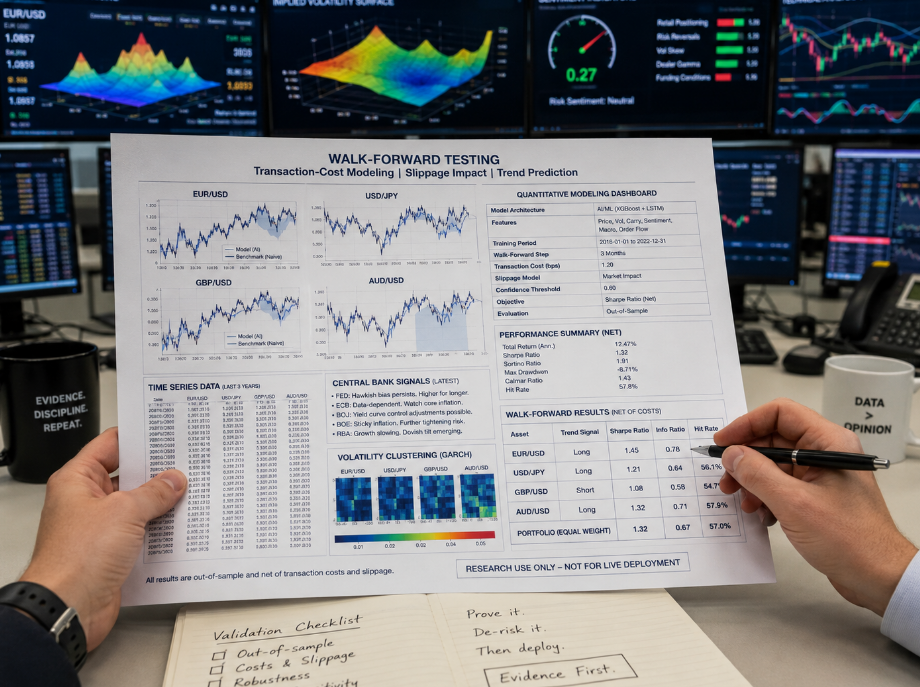
Spot Forex Volatility Signals from Sentiment Analysis
Short-term forex trading lives on volatility spikes. Here’s how sentiment indicators extracted through text mining improve volatility detection in the spot market.
Data Capture
1.1 News analysis from central bank headlines
1.2 Social feeds tracking risk tone
Signal Construction
2.1 NLP scoring of policy language
2.2 Event clustering for geopolitical shocks
Trading Use
3.1 Position sizing shifts
3.2 Stop placement tightening
3.3 Intraday hedge overlays
This mix of market psychology and structured Trading logic helps Forex Trading desks adjust before volatility explodes.
Currency Options Price Targets via Technical Analysis Algorithms
Currency derivatives desks in Forex Trading rely on structured layers:
Implied Volatility Mapping
1.1 Surface fitting across strikes
1.2 Skew shifts during macro events
Technical Alignment
2.1 Support resistance zones
2.2 Trend lines and momentum analysis
2.3 Pattern confirmation from chart patterns
Pricing Adjustment
3.1 Spread vs liquidity providers
3.2 Microstructure slippage
3.3 Scenario stress paths
Blending forex options logic with disciplined technical indicators keeps currency options targets grounded in real Trading flows, not wishful thinking.
Data Overload? AI Filters Noise
Forex Trading gets messy fast: ticks flying in, headlines shouting, calendars sneaking up, and the book flipping in a blink. This cluster shows how to keep the good stuff and ditch the junk, without losing speed. Fxbee frames practical filters for FX trading, from microstructure noise to macro shocks, so your trades feel less like guesswork.
Tick Data Prioritization through Deep Learning
In Forex Trading, raw tick data is loud, so deep learning acts like a bouncer.
Signal goals inside market microstructure:
Price stress: volatility pops, spread jumps, and bursts in trade intensity.
Context tags via feature extraction from time series: rolling range, quote-to-trade ratios, and latency hints.
Model behavior with neural networks:
Rank “what matters now” and push the rest into data filtering.
Trigger event detection when spread widens and prints accelerate together.
Execution impact for Forex trading on co-lo:
Less queue-chasing, fewer stale updates, cleaner decisions for FX trading.
Fxbee can route the ranked feed so your strategy isn’t chewing glass.
Economic Calendar Event Classification with NLP
Forex Trading around macro releases isn’t about being brave; it’s about being ready. Economic calendar text gets scrubbed with natural language processing, then sorted into “move markets” versus “just noise.”
Quick filters:
Bullet list: flag central bank items, inflation, jobs, and growth financial indicators.
1. Event classification by surprise risk, 2) text analysis for hawkish/dovish tone, 3) pair sensitivity mapping for FX trading.
※ Add named entity recognition to catch agencies, speakers, and regions.
| Release Type | Surprise z-score | Macro Sensitivity (0-100) | Typical FX Spread Widening (pips) |
|---|---|---|---|
| CPI (YoY) | 2.1 | 92 | 1.8 |
| NFP/Jobs | 1.7 | 95 | 2.4 |
| PMI Flash | 0.9 | 63 | 0.8 |
Fxbee can keep your Forex trading filter honest by tying this to live spreads, not vibes, while document embedding helps cluster similar releases across countries.
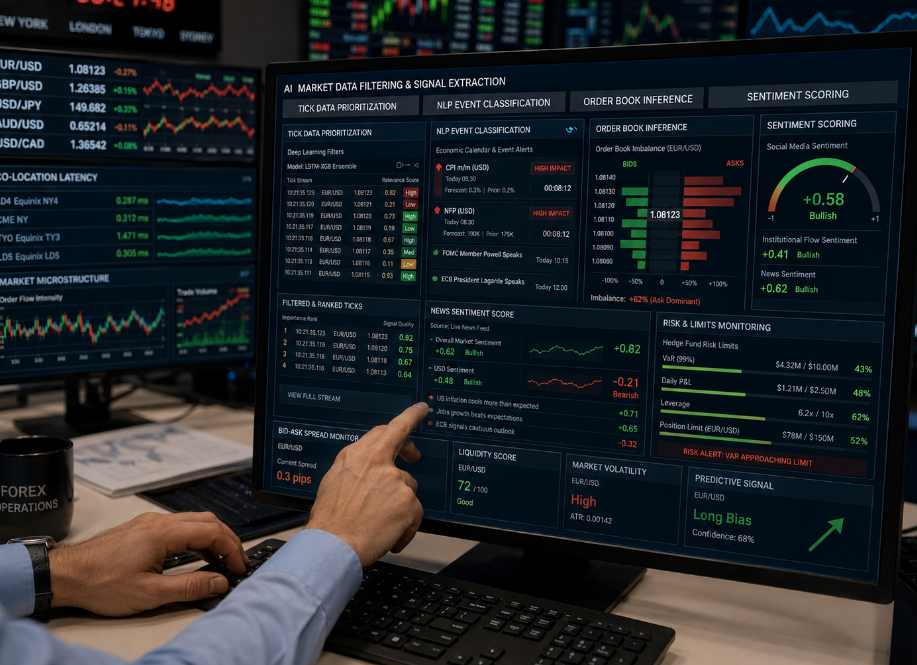
Order Book Data Inference for Liquidity Providers
FX trading for liquidity providers lives inside the order book, not on a pretty chart.
Inputs from market depth and bid-ask spread:
Level-by-level size changes, cancel velocity, and refill patterns.
Short-lived walls that vanish right before impact.
What the inference aims to surface using an inference engine:
Hidden interest: “iceberg-ish” behavior, hinted by repeated replenishment.
Imbalance that predicts short-term drift in supply-demand fights.
Spoofing risk: aggressive adds then rapid pulls near touch.
How it helps Forex Trading operations:
Inventory control for liquidity provision, pricing tweaks in fast market microstructure moments.
Fewer bad fills, less adverse selection, calmer hedging when the tape turns nasty.
News Feeds Sentiment Scoring for Hedge Funds
In Forex Trading, headlines can fake you out, especially during geopolitics. News feeds get turned into numbers through sentiment analysis, but only after strict labeling so “good for X” doesn’t get misread as “good for Y.”
Scoring logic on textual data:
Entity split: country, central bank, minister, company; each gets its own polarity.
Currency lens: what hits USD may not hit JPY the same way.
Topic lens: inflation, sanctions, supply chains, elections—kept separate for cleaner event correlation.
Portfolio use for hedge funds:
Combine market sentiment with techs for alpha generation, then cap it with risk limits so one scary headline doesn’t wreck the day.
Fxbee can pipe these scores into predictive analytics so FX trading signals get filtered before they reach execution.
References
[OTC foreign exchange turnover in April 2025 - https://www.bis.org/statistics/rpfx25_fx.htm]
[Global FX trading hits $9.6 trillion per day in April 2025 - https://www.bis.org/press/p250930.htm]
[FX execution algorithms and market functioning - https://www.bis.org/publ/mktc13.htm]
[FX execution algorithms contribute to market functioning but bring new challenges - https://www.bis.org/press/p201030.htm]
[Rise of the Machines: Algorithmic Trading in the Foreign Exchange Market - https://www.federalreserve.gov/econres/ifdp/rise-of-the-machines-algorithmic-trading-in-the-foreign-exchange-market.htm]
[The Financial Information eXchange FIX Protocol - https://www.fixtrading.org/what-is-fix/]
[Fraud Advisory: Foreign Currency Forex Fraud - https://www.cftc.gov/LearnAndProtect/AdvisoriesAndArticles/fraudadv_forex.html]
[Forex Transactions: Regulatory Guide - https://www.nfa.futures.org/members/member-resources/files/forex-regulatory-guide.html]
[ESMA reminds firms of their obligations under CFD product intervention measures - https://www.esma.europa.eu/press-news/esma-news/esma-reminds-firms-their-obligations-under-cfd-product-intervention-measures]
[Artificial Intelligence in Capital Markets: Use Cases, Risks, and Challenges - https://www.iosco.org/library/pubdocs/pdf/IOSCOPD788.pdf]
FAQ
How can AI strengthen algorithmic and momentum Forex Trading strategies?
AI sharpens decision-making where seconds decide profit or loss.
1) Strategy alignment
Supports algorithmic trading, momentum trading, and arbitrage across major currency pairs and minor currency pairs.
Adapts carry trade and macro trading models using interest rate differentials and economic indicators.
2) Infrastructure edge
Connects trading platforms with execution management systems and order management systems.
Uses FIX protocol + low-latency connectivity + co-location services for high-frequency trading.
3) Risk discipline
Real-time Value at Risk and stress testing.
Controls market risk and liquidity risk during volatile spot forex sessions.
Behind every fast model stands human judgment—asset managers and hedge funds still decide when to scale, hedge, or step back.
Why is integrated market data critical for large-scale Forex Trading operations?
Markets move on fragments of information; integration turns fragments into clarity.
Data foundation:
Historical data + real-time data
Tick data + order book data
Economic calendars + news feeds
Application across participants:
| Area | Practical Impact |
|---|---|
| Institutional investors | Backtest quantitative strategies before live deployment |
| Investment banks | Execute futures contracts and forward contracts with tighter spreads |
| Liquidity providers | Adjust pricing on exotic currency pairs instantly |
| Multinational corporations | Hedge currency options exposure |
When market data feeds sync with API integration and FIX protocol pipelines, execution becomes disciplined rather than reactive.
How do compliance and risk controls shape modern Forex Trading brokerage models?
Growth without control invites collapse. Strong brokers build on structure.
A. Regulatory spine
AML and KYC checks embedded in onboarding
Alignment with CFTC regulations, ESMA guidelines, MiFID II, and the Dodd-Frank Act
Automated regulatory reporting across jurisdictions
B. Risk containment
Monitor counterparty risk from hedge funds and central banks
Apply hedging strategies to manage currency options and futures contracts exposure
Continuous stress testing under geopolitical events and central bank announcements
C. Human oversight
Compliance teams and risk officers interpret signals beyond technical analysis or sentiment analysis.
Forex Trading is fast and global—but trust, capital protection, and disciplined oversight keep it alive.