
The Indian forex market is heating up—and not just for casual traders. More and more wholesale buyers and brokers are eyeing India as the next big thing in global currency exchange. The demand's picking up, and folks want in before the window gets too crowded.
But let’s be real—getting started here can feel like walking into a maze blindfolded. Between RBI rules, limited platform access, and a pile of unclear policies, most people just throw up their hands and walk away.
It’s like trying to join a high-stakes poker game without knowing the rules—or even the currency being used.
“One of the biggest hurdles we hear from clients is regulatory confusion,” says a senior product manager at Fxbee. “They’re ready to scale, but don’t know what’s legal.”
This guide breaks it all down. What’s moving the market, what risks to watch, and what tools make it all easier. If you're thinking about getting serious in forex on the B2B side, you're in the right place.

Why Is the Indian Forex Market Booming?
India’s forex market is heating up fast—and there’s a whole bunch of reasons fueling that fire. Let’s break it down across the key macro forces behind the surge.
Macroeconomic Drivers: Trade Balance and Foreign Exchange Reserves
The Reserve Bank of India (RBI) plays it smart with how it manages forex reserves, giving the market a lot more stability.
A shrinking Current Account Deficit has made India's global trading game a whole lot stronger.
Rising Export-Import activity, especially in tech and pharma, is pumping liquidity into forex channels.
Inflation has stayed in a manageable range recently, which means more investor confidence.
Stronger GDP growth means more foreign interest, especially from big investors watching India’s trade metrics.
Rise of Authorized Dealer Category-I Banks in Currency Settlement
RBI gave AD Category-I banks the green light to handle a wider range of forex transactions under FEMA, which means businesses now have fewer hoops to jump through.
These banks now settle trades in both Nostro and Vostro accounts, making it easier for clients to pay and get paid across borders.
Interbank Market liquidity is also smoother now since these banks play a key role in Currency Swaps and direct settlements.
"We’ve seen settlement times drop and client trust increase significantly since AD Category-I banks became more empowered by RBI’s latest reforms."
— Arun Menon, Senior Ops Manager, Fxbee
Impact of Foreign Direct Investment on Forex Growth
Capital Inflows: More FDI and Foreign Portfolio Investment (FPI) is landing in India’s financial system than ever before. This boosts forex reserves directly.
Sectoral Caps: Loosened FDI caps in retail, aviation, and defense are opening new doors for foreign capital.
Automatic Route: Investors are loving how simplified India’s automatic route has become—no more endless paperwork or waiting for government nods.
Equity Demand: Global funds keep buying into Indian equity, which indirectly strengthens the rupee by raising the demand for INR.
Ease of Doing Business: When setting up shop is easy, capital flows increase. And that means more forex demand, especially for big corporate hedging.
Digital Infrastructure and Settlement Cycle Improvements
India’s trading tech has gone through a serious glow-up. Fast processing, real-time settlements, and API-powered platforms make forex trading slicker than ever.
| System/Tech | Functionality | Impact on Forex | Entity Reference |
|---|---|---|---|
| T+1 Settlement | Trade settled the next day | Faster capital rotation | SEBI, Clearing Corporation of India |
| RTGS | Real-time gross settlement system | Instant large payments | RBI, Fintech Firms |
| Blockchain Pilots | Transparent, tamper-proof records | Lower fraud risk | Digital Rupee, Fintech |
| API Banking | Plug-and-play finance operations | Easy broker access | Banks, Forex Platforms |
Long gone are the days of paperwork and three-day waits. Today, forex is near-instant, and Fintech tools are making life easier for brokers and businesses alike.
3 Factors That Drive the Indian Forex Market
Here’s why the forex scene in India is heating up—and who’s really calling the shots behind the rupee’s moves.

Role of the Reserve Bank of India in Forex Operations
The Central bank doesn't just watch the market—it steps in to manage rupee volatility.
Through intervention, it buys or sells dollars to smooth out sharp exchange rate swings.
Liquidity management tools help balance forex flows and keep the system stable.
It also maintains foreign exchange reserves to guard against economic shocks.
The RBI's monetary policy stance directly affects currency inflow and outflow patterns.
????️ "We operate with one goal—balance stability with flexibility," said a senior policy advisor at Fxbee.
How Repo Rate and Consumer Price Index Shape Currency Demand
The Monetary Policy Committee tweaks the repo rate based on inflation data.
Lower interest rates make borrowing cheaper, boosting economic growth but weakening the rupee.
A high Consumer Price Index (CPI) erodes purchasing power, reducing demand for INR.
Rising rates? It attracts foreign investors seeking better yield—strengthening the currency.
That’s why the rupee's demand seesaws every time rates shift or CPI jumps.
Foreign Portfolio Investors and Their Market-Moving Power
Ever seen the market go nuts after a global event? Yeah, that’s often the FPIs pulling out or pouring in.
FPIs love emerging markets like India for quick capital flows and high returns.
Big moves in the equity market can cause currency volatility overnight.
Under SEBI’s watch, their portfolio investment shapes both stock and forex sentiment.
When institutional investors sell, it hits INR hard—brokers must hedge fast.
| FPI Inflows (USD Billion) | Year | INR/USD Average | Impact on INR |
|---|---|---|---|
| 23.1 | 2020 | 74.85 | Positive |
| -4.7 | 2022 | 78.95 | Negative |
| 12.9 | 2023 | 82.10 | Mixed |
Contribution of Non-Resident Indians to Forex Liquidity
NRI money? It's the quiet beast keeping INR afloat during tough times.
Remittances are steady—India tops global charts, thanks to a huge diaspora.
Funds flow through NRI accounts like NRE deposits or FCNR schemes.
That foreign currency inflow boosts liquidity, keeping exchange rates stable.
These are critical cushions for the inward flow of dollars—especially during capital flight.
Influence of Market Volatility on Wholesale Pricing
When things get shaky, pricing gets wild—and spreads can kill profits.
Exchange rate fluctuations jack up the bid-ask spread, making wholesale deals tricky.
Spot rate swings force brokers to hedge hard using swaps and forwards.
In the interbank market, traders use arbitrage and risk management tactics to stay sane.
This volatility affects final quotes for institutional clients, who expect tight execution.
Standard Forex and Indian Forex Market Regulations
Let’s break down what separates doing forex globally from doing it by the Indian playbook. Whether you're a broker or a wholesale buyer, the rules change everything here.
Overview of SEBI and FEMA Guidelines
The Securities and Exchange Board of India (SEBI) regulates all forex-linked instruments traded on Indian exchanges—like currency derivatives.
The Foreign Exchange Management Act (FEMA) is India’s primary legal framework for handling foreign currency across capital account and current account transactions.
SEBI ensures market integrity. FEMA ensures you don’t cross legal red lines with your INR trades.
The RBI keeps it all stitched together. Brokers and institutions need to stay well within these guardrails.
Enforcement Directorate: Monitoring Compliance in Cross-Border Deals
The Enforcement Directorate (ED) enforces PMLA and investigates foreign exchange violations under FEMA.
It’s not just about illegal money—cross-border remittances are tracked to ensure everything’s clean and legit.
Any sign of money laundering in forex trades? The ED dives in.
Adjudication? That’s when things get formal. Fines, license issues, or even bans can happen.
ED’s job is to keep financial crimes out of the Indian forex ecosystem. You don’t want them knocking.
CCIL’s Role in Clearing and Risk Management
The Clearing Corporation of India Limited (CCIL) plays a low-key but powerful role in forex market stability.
• Think of CCIL as the central counterparty for trades—it guarantees settlements even if one party flops.
• It uses net settlement systems to reduce transaction volumes and risk.
• Its trade repository stores deal data for transparency and monitoring.
• Risk management? Spot on. CCIL helps lower systemic risks in inter-bank transactions with tools like settlement guarantees.
Here’s a snapshot of key CCIL services:
| Feature | Description | Benefit to Brokers | Applies To |
|---|---|---|---|
| Central Counterparty | Acts between buyer & seller | Default protection | Inter-bank FX deals |
| Net Settlement | Aggregates payments per party | Lower transaction costs | INR/USD, EUR/INR pairs |
| Trade Repository | Stores deal data | Regulatory compliance support | Currency derivatives |
| Risk Mitigation Tools | Stress testing, exposure control | Better capital efficiency | Large trades, corporates |
FEDA: Supporting Inter-bank Dealers and Brokers
The Foreign Exchange Dealers' Association of India (FEDA) sets market conduct rules for authorized dealers.
FEDA ensures that brokers and inter-bank players maintain fair pricing on exchange rates.
It’s also known for building best practices in brokerage services and rate quoting.
As one Fxbee brokerage manager said:
“FEDA’s code of conduct isn’t just good ethics—it’s what keeps the whole forex engine running smooth.”Want to trade like a pro in India’s inter-bank market? Follow FEDA’s rules or risk being iced out.
How the Ministry of Finance Influences Forex Policy
India’s Ministry of Finance—specifically the Department of Economic Affairs—steers the macro ship that shapes forex strategy.
It sets fiscal policy, which influences everything from inflation to INR strength.
Policy around external debt and foreign investment is crafted here.
Sovereign credit ratings? These folks manage the messaging that global investors read.
Even budget announcements can nudge forex expectations one way or the other.
They don’t execute trades, but they make decisions that can shake the INR from top to bottom.
Differences in Compliance for Cross-Currency Swaps vs. Currency Futures
Currency futures are traded on exchanges, with standardized contracts and margin requirements. Perfectly legal under SEBI.
Cross-currency swaps, on the other hand, are typically over-the-counter (OTC) and require RBI permission in many use cases.
Futures are great for retail and brokerage platforms, while swaps are mostly used by banks and institutional hedgers for managing interest rate differentials and underlying exposure.
Compliance varies big time. One is regulated and clean. The other is powerful, but a bit spicy if you skip the permissions.
Multi-Currency Platforms: Easier Access to Indian Forex Market
Multi-currency platforms have made forex trading in India smoother and smarter, especially for wholesale players and brokerages.
Trading USD/INR, EUR/INR, and GBP/INR on Local Platforms
NSE and BSE dominate the action for currency pairs like USD/INR, EUR/INR, and GBP/INR.
Supported by SEBI regulations and RBI approvals.
Platforms offer fixed lot sizes and tick sizes to ensure fair play.
Exchange-traded derivatives simplify access for bulk orders.
???? Platforms today don’t just offer access—they offer consistency, transparency, and control, all crucial for wholesale execution.
Availability of Currency Futures and Options for Wholesale Clients
Futures help with hedging long-term exposures—think importers locking in USD/INR rates.
Options allow protection using strike prices, but cost a premium upfront.
Institutional investors prefer these tools to manage margin requirements more efficiently.
Higher open interest means deeper liquidity for large players.
Expiry dates can be used to time large cash flow events.
Futures = predictability. Options = flexibility. Wholesale = both.

How Interest Rate Swaps Serve Corporate Hedgers
Corporate treasuries aren't sleeping on this one.
Interest rate swaps (IRS) allow companies to exchange cash flows—often fixed-to-floating—based on benchmarks like MIBOR.
The notional principal never changes hands; it's all about the difference in interest.
This gives corporate hedgers control over future borrowing costs.
These are over-the-counter derivative contracts, so you’ll need expert handling.
Perfect for CFOs looking to sleep at night while rates fluctuate.
Simplifying Mark-to-Market Calculations for Brokerage Platforms
Let’s be real—nobody wants to mess up MTM calculations.
A daily settlement price determines unrealized profits or losses.
Broker platforms must constantly update the P&L statement.
Margin calls may be triggered, especially with high volatility.
Clearing corporations help reduce this manual overhead.
| Metric | Value Type | Relevance | Trigger Frequency |
|---|---|---|---|
| Unrealized Profit | Float (INR) | Risk Monitoring | Intraday/Daily |
| Margin Requirement | Percentage (%) | Capital Efficiency | Daily |
| Settlement Price | Float (INR) | Position Valuation | Daily |
| MTM Value | Float (INR) | P&L Management | Real-time |
Getting MTM wrong? That’s how brokerages bleed.
Real Effective Exchange Rate and Wholesale Trading Strategies
The REER isn't just a fancy number economists throw around.
It adjusts for inflation differentials, making it a better macro guide.
NEER compares nominal value across currencies, but REER goes deeper.
It’s calculated using a trade-weighted index—great for cross-border pricing.
Central bank interventions often aim to stabilize REER fluctuations.
???? Smart brokerages track REER for bulk quoting and timing entries. It’s the cheat code for those who know how to use it.
Role of Currency Arbitrageurs in Multi-Currency Environments
"We don’t trade noise—we trade price gaps."
— Rohit Sharma, Senior Arbitrage Desk Lead at Fxbee
Currency arbitrageurs are the quiet engine of forex liquidity.
They exploit price discrepancies across platforms.
Common methods include triangular arbitrage or spot-future parity.
The goal? Market efficiency through rapid, high-frequency moves.
These players thrive in cross-currency pairs with shallow depth.
In bulk trading, they often uncover pricing blind spots even big platforms miss.
Integration of Bid-Ask Spread Data for Better Execution
Tighter spreads = lower transaction costs for every INR moved.
Deep market depth reduces slippage, especially during news spikes.
Monitoring order book movements helps predict execution lag.
Wholesale brokers use limit orders to achieve precision.
Better execution speed and spread compression = more client satisfaction.
Bid-ask isn’t just data. It’s edge, efficiency, and profit control.
Legal or Not? RBI Rules You Must Know
Is Forex Trading Even Legal in India?
Let’s keep it real: Yes, forex trading is legal in India, but with a big asterisk. You can’t just fire up any global platform and start trading whatever currency pair you want.
The Reserve Bank of India (RBI) and SEBI (Securities and Exchange Board of India) are super strict about what’s allowed. Step out of line, and you're looking at fines or worse.
Here's what’s cool—and what’s definitely not:
✅ Legal Forex Trading:
Only approved currency pairs like USD/INR, EUR/INR, GBP/INR, JPY/INR and select exchange-listed cross-currency pairs such as EUR/USD, GBP/USD, and USD/JPY
Trades must happen through Authorized Dealer Category-I banks or regulated brokers
Only exchange-traded currency futures and options are allowed
???? Illegal Forex Activity (Under FEMA):
Trading currency pairs like EUR/USD or USD/JPY on global platforms from India
Using margin/leverage on international forex brokers
Participating in binary options or unregulated derivatives contracts
Transacting through apps or websites that don’t have an Indian regulatory license
3 Quick Things That Trip People Up
Using Offshore Brokers?
If you’re Indian and trading forex on global platforms with USD base pairs—you’re violating FEMA. Even if they’re legit in other countries, RBI says “Nope.”Liberalized Remittance Scheme (LRS) Confusion
Folks often think LRS lets them send up to $250K abroad for anything. Nah. RBI strictly says no LRS for overseas forex or crypto speculation.Derivatives ≠ All Derivatives
You can trade exchange-traded currency futures on the NSE and BSE. But if you’re messing with offshore forward contracts or unlisted derivatives, you’re in hot water.
What’s the RBI Actually Saying?
| Rule Area | Legal Status in India | Who Regulates It | Key Conditions |
|---|---|---|---|
| USD/INR trading on NSE | ✅ Legal | RBI + SEBI | Must be exchange-traded only |
| EUR/USD via foreign broker | ❌ Not Allowed | RBI (under FEMA) | Offshore speculation is banned |
| Use of leverage on forex apps | ❌ Not Allowed | RBI + Enforcement Teams | Leverage must be RBI-approved |
| INR/JPY currency futures | ✅ Legal | NSE/BSE under SEBI rules | Must go through Indian exchanges |
What Should You Actually Do?
Use RBI-licensed brokers only
Stick to listed forex derivatives on Indian exchanges
Focus on currency pairs that include INR—because anything else is off-limits unless specifically allowed on Indian exchanges
Don’t use your LRS limit for speculative trading—it’s meant for education, travel, etc.
The Indian forex market is open for business—but with guardrails. You can absolutely trade forex and even offer brokerage services, as long as you stay inside RBI’s and SEBI’s lane. Getting this wrong can tank your business before it even gets off the ground.
If you're in the wholesale game, you don’t just need a license—you need a clear compliance roadmap. Because in this business, “I didn’t know” won’t cut it.
Indian Forex: Risks and Rewards Explained
Trading currencies in bulk sounds exciting, but the deeper you go, the more you realize: it's not just about reward—it’s about risk control, too.
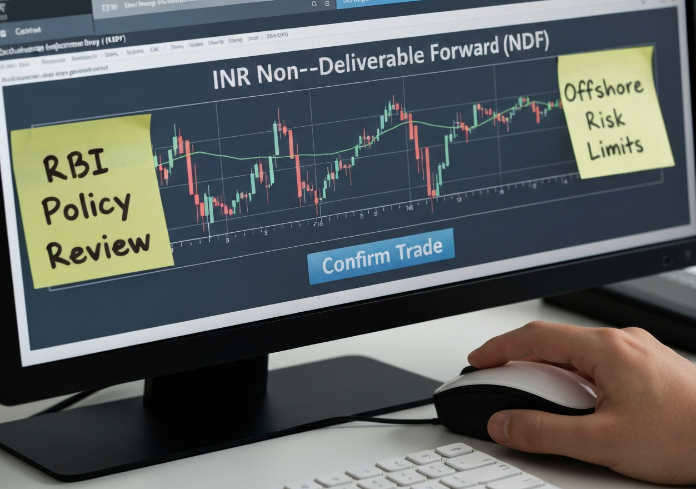
Risk Management with Forward Contracts and Non-Deliverable Forwards
Spot rates can be a total rollercoaster, and if you’re a corporate hedger or wholesale dealer, locking in rates early is a smart move.
Forward Contracts help you fix your currency exchange in advance—no surprise bills!
NDFs are your go-to when dealing with restricted currencies like the Rupee in offshore markets.
Be wary of counterparty risk though—always check who’s on the other end.
RBI-regulated currency derivatives can help you stay above board while still hedging smartly.
Fiscal Deficit and Current Account Deficit: Reward or Risk?
A growing CAD may hint at rising imports—but it can also freak out investors.
A ballooning fiscal deficit often pushes up inflation and dents India’s sovereign rating.
For forex players, this means more volatility and fewer stable hedging opportunities.
On the flip side, Foreign Direct Investment sometimes picks up when GDP growth is strong—offsetting some macroeconomic pain.
Stay tuned to the Balance of Payments reports to time your entries right.
"Fxbee’s Senior Macro Analyst Anirudh Vyas says: 'Ignoring CAD trends is like trading blindfolded—macroeconomics always tells the first part of the story.'
Impact of Settlement Cycle Delays on Large Transactions
India's forex trading used to be slower than your favorite courier. Thanks to T+2 cycles and RTGS, that’s changing—but not without snags.
Operational risk spikes during delays, especially for high-volume players like Authorized Dealer Banks.
The Clearing Corporation of India has cleaned up a lot, but errors in nostro accounts still happen.
Longer cycles increase transaction costs, which eats into broker margins.
Liquidity problems show up fast if RTGS isn’t running smoothly.
| Delay Factor | Affects Liquidity | Raises Risk | Impacts Cost |
|---|---|---|---|
| T+2 Holdovers | Yes | Yes | Medium |
| Nostro Errors | No | High | High |
| RTGS Downtime | Yes | High | Very High |
Using Nominal Effective Exchange Rate to Forecast Value
If you're in the B2B game and quoting prices across multiple countries, NEER is your secret weapon.
NEER gives you a weighted average of the Rupee’s strength across a trade basket of currencies.
Want to know if INR will appreciate or tank? NEER tells you in numbers.
Keep an eye on REER in the RBI Bulletin—it hints at export competitiveness.
When the Rupee’s NEER drops, your USD/INR clients may ask for tighter spreads. Be ready.
This helps brokers forecast market direction while tweaking pricing models in real-time. It's not magic—just math.
Conclusion
Let’s face it—navigating the Indian forex market isn’t exactly a walk in the park. Between RBI rules, currency pair options, and all the moving parts behind the scenes, it can feel like trying to fly a plane without knowing the dashboard. But here’s the thing: once you get the lay of the land, opportunities start to pop up like wildflowers after a summer rain. For brokers, corporate buyers, or anyone with skin in the wholesale game, understanding how India’s forex space ticks is half the battle.
To make your life easier, here’s a cheat sheet to keep in your back pocket:
Watch RBI and SEBI
Watch RBI and SEBI like a hawk—compliance isn’t optional
Focus on liquid pairs
Focus on liquid pairs: USD/INR, EUR/INR, GBP/INR
Use futures and NDFs
Don’t sleep on futures and NDFs for hedging big volumes
Leverage data
Use REER and CPI data to time your entries better
Choose smart platforms
Look for platforms that simplify mark-to-market and multi-currency trading
Stick with it. The complexity might feel like noise at first, but once it clicks, the rhythm of the market becomes pretty intuitive—and worth your time.
References
RBI FAQ on Foreign Exchange Transactions (LRS and margin trading) - https://www.rbi.org.in/commonman/english/scripts/FAQs.aspx?Id=3347
RBI FAQs on Liberalised Remittance Scheme (LRS) - https://www.rbi.org.in/commonman/english/scripts/FAQs.aspx?Id=1834
NSE – Contract Specifications: Currency Derivatives on INR Pairs - https://www.nseindia.com/static/products-services/currency-derivatives-contract-specification-inr
NSE Clearing – Currency Derivatives Margin Parameters (including cross-currency pairs) - https://www.nseclearing.in/risk-management/currency-derivatives/parameters
Kotak Securities – RBI Guidelines for Forex Trading in India (Forex Trading Challenges in India) - https://www.kotaksecurities.com/investing-guide/currency/forex-trading-challenges-in-india/
Share India – What are the Forex Trading Challenges in India? - https://www.shareindia.com/knowledge-center/currency-trading/forex-trading-challenges
CoinDCX – Is Forex Trading Legal in India? Complete Guide - https://coindcx.com/blog/cryptocurrency/is-forex-trading-legal-in-india/
Clearing Corporation of India Limited (CCIL) – Official Website - https://www.ccilindia.com
Foreign Exchange Dealers' Association of India (FEDAI) – About FEDAI - https://fedai.org.in/InnerPageContent.aspx?Cid=1&SCid=0&SSCid=0
SEBI – Introduction of T+1 Rolling Settlement on an Optional Basis - https://www.sebi.gov.in/legal/circulars/sep-2021/introduction-of-t-1-rolling-settlement-on-an-optional-basis_52462.html
Investopedia – Real Effective Exchange Rate (REER) - https://www.investopedia.com/terms/r/reer.asp
Testbook – NEER and REER: Definition, Formula, Differences - https://testbook.com/ias-preparation/reer-and-neer
Directorate of Enforcement (Enforcement Directorate) – Official Website - https://enforcementdirectorate.gov.in/
Department of Economic Affairs, Ministry of Finance – Foreign Exchange Management Notifications and Policy - https://dea.gov.in/
Ministry of Statistics and Programme Implementation – NEER and REER in Statistical Year Book of India - https://mospi.gov.in/sites/default/files/Statistical_year_book_india_chapters/ch40.pdf
Indian Forex Market – FAQ
Why is the Indian forex market growing so fast?
The Indian forex market has expanded rapidly because of a mix of macro strength and active participants:
Strong foreign exchange reserves closely monitored by the Reserve Bank of India (RBI)
Heavy use of USD/INR by banks and large corporates for trade and financing
Rising demand from Foreign Portfolio Investors (FPIs) in Indian assets
Active participation from Authorized Dealer Category-I Banks providing liquidity and pricing
Is forex trading legal in the Indian forex market?
Yes, but with strict conditions. Forex trading in India is legal only when:
It happens on SEBI-approved exchanges (like NSE/BSE)
Trading is mainly in INR-based pairs such as USD/INR, EUR/INR, GBP/INR, and JPY/INR
Offshore / unregulated platforms are avoided—these are monitored by the Enforcement Directorate (ED)
Which currency pairs matter most in the Indian forex market?
A few INR-based pairs dominate trading and risk management:
USD/INR – the primary pair for liquidity, pricing, and hedging
EUR/INR – widely used for exposure to European trade and investments
GBP/INR – important for UK-linked businesses and services exports
JPY/INR – often used for long-term hedging, especially against yen-denominated loans
How does the Reserve Bank of India control forex activity?
The Reserve Bank of India (RBI) actively manages forex activity through:
Issuing rules and guidelines under FEMA (Foreign Exchange Management Act)
Managing exchange rate volatility through market interventions
Setting and revising remittance limits for individuals and corporates
Stepping in when the spot exchange rate moves too sharply in a short time
What risks do wholesale buyers face in the Indian forex market?
Wholesale buyers—like large corporates and banks—typically face:
Sudden market volatility affecting import/export costs
Delays or errors in the settlement cycle
Pricing gaps caused by wide bid-ask spreads in stressed markets
Compliance risks linked to evolving SEBI and RBI regulations
Can brokers offer derivatives like swaps and futures in India?
Yes. A range of derivatives is permitted in India when offered through regulated channels, including:
Currency futures on approved exchanges
Currency options for hedging and trading
Interest rate swaps (IRS) and other over-the-counter products
Products must be offered by regulated entities and cleared through approved systems such as CCIL
Why do brokers prefer multi-currency platforms for the Indian forex market?
Multi-currency platforms give brokers and their clients more flexibility and control, for example:
Easy access to major INR pairs like USD/INR and EUR/INR
Faster mark-to-market (MTM) updates on open positions
Better pricing control for wholesale clients through tighter spreads and depth
Support for currency arbitrageurs who exploit price differences across markets
How do inflation and interest rates affect forex trading in India?
Changes in inflation and interest rates have a direct impact on INR demand:
Adjustments in the repo rate influence capital flows and carry trades
Movements in the Consumer Price Index (CPI) affect real returns for investors
Brokers track these signals closely when advising large corporate and bank clients on hedging strategies
Which authorities regulate the Indian forex market?
Several key authorities oversee different parts of the Indian forex ecosystem:
Reserve Bank of India (RBI) – currency management and FEMA rules
Securities and Exchange Board of India (SEBI) – regulation of forex derivatives and brokers
Foreign Exchange Dealers’ Association of India (FEDAI) – market and dealer practices
Ministry of Finance – overall policy direction and legislative framework
How do wholesale traders manage risk in Indian forex deals?
Wholesale traders typically use a blend of products and analytics to manage large exposures:
Forward contracts to lock-in exchange rates for future payments and receipts
Non-deliverable forwards (NDFs) for offshore or restricted currency exposures
Close tracking of the Nominal Effective Exchange Rate (NEER) to monitor overall INR competitiveness