
Forex Trading ads scream free funded accounts, like Wall Street handing out candy. Sounds sweet, but your gut knows nothing in finance is free.
Zero upfront cost often hides strict rules, tight risk caps, and payout hoops.
FXBee’s forex trading support materials emphasize transparency around partner and broker relationships.
Free Funding Isn’t Risk-Free
Leverage Is Tightly Controlled
Proprietary firms impose drawdown caps, VaR limits, and margin rules.
Hidden Costs Abound
Wider spreads, ECN markups, slippage, and volume limits often replace upfront fees.
3 Myths About Free Funded Accounts Debunked
Free funded accounts sound like a cheat code in Forex Trading, but hype and hard facts rarely match. In currency trading and online forex markets, smart traders question the fine print before risking time and skill.
Myth 1: “Zero Deposit, Zero Risk” and Counterparty Risk
In Forex Trading, a funded account without a deposit still carries risk. The absence of upfront cash does not remove exposure tied to the counterparty holding your trading capital.
Counterparty exposure in forex trading
i. Access to liquidity pools
ii. Stability during volatility
i. Revenue model sustainability
ii. Capital reserves vs trader payouts
a. Firm solvency
b. Prime broker relationships
c. Regulatory alignment
Hidden layers of liability
Contract clauses limiting withdrawals
Sudden rule changes impacting payout ratios
Platform-side execution control
Practical security checks
Verify registration
Review audit transparency
Track payout consistency
The Bank for International Settlements reported that outstanding FX derivatives grew 10% year over year to $130 trillion at end-June 2024.
In short, free capital in Forex Trading is still tied to someone else’s balance sheet. That matters.
Myth 2 Momentum Trading Unlimited? Debunking Leverage Claims
“Unlimited” momentum trading in forex trading sounds bold. Real risk desks cap everything.
Internal control layers
a. Margin thresholds
b. Daily drawdown caps
c. Max open capital exposure
Risk modeling tools
VaR ceilings
Stress-test shock ranges
Slippage assumptions
Illustrative reality check in numbers
| Pair | Max Margin % | Daily Drawdown % | Max Leverage Ratio | Avg Spread (pips) |
|---|---|---|---|---|
| EUR/USD | 3.33% | 5% | 1:30 | 0.8 |
| GBP/USD | 3.33% | 5% | 1:30 | 1.2 |
| USD/JPY | 3.33% | 4% | 1:30 | 0.9 |
| XAU/USD | 5% | 6% | 1:20 | 2.5 |
| AUD/USD | 3.33% | 5% | 1:30 | 1.1 |
Even aggressive trading strategy setups face limits on profit and loss swings driven by market movement. That’s standard in serious Forex Trading environments, including platforms like Fxbee that align risk with real market access.

Myth 3: Unreal? Tradable Exotic Currency Pairs without Fees
In currency trading, “no trading fees” on exotic currency pairs usually means cost shifts elsewhere.
Cost layers inside the currency market
ECN pass-through pricing
Broker-dealer internalization
Thin liquidity
Fewer counterparties
a. Wider spread
b. Routing markups
Transaction reality
Embedded transaction cost
Overnight swap adjustments
Volatility premiums in forex
Smart access checklist
Compare raw vs marked-up quotes
Review execution speed
Measure real slippage
Clean pricing in Forex Trading is rarely free; it’s just structured differently. On Fxbee, transparency around forex spread and market access helps traders see what’s actually baked into each trade.
Is There a Catch in “Free” Funding?
“Free” funding in Forex Trading sounds like a sweet deal. But in forex trading, nothing runs on magic. From spot contracts to algorithmic trading, small rules and hidden fees can shape your real profit. Let’s break down what’s actually going on behind the curtain.
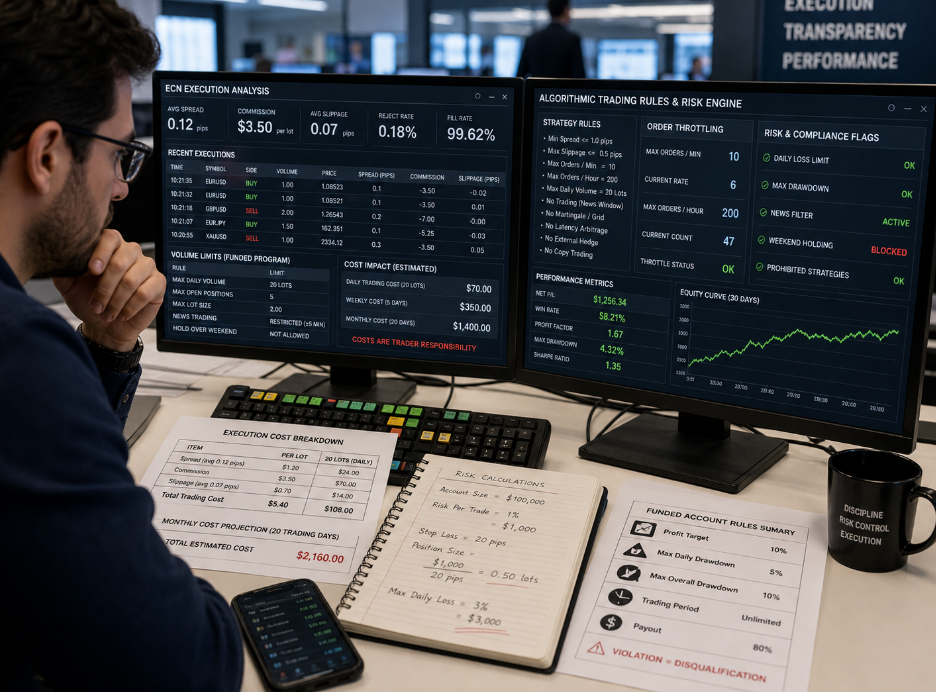
Hidden Costs: Spot Contracts Routed via ECNs
In Forex Trading, many funded accounts route spot contracts through ECNs. That sounds pro-level, and it is—but here’s how costs stack up inside the routing and execution process:
Execution Layer
i. News spikes
ii. Large lot routing
i. Depth variations during London/New York overlap
ii. Thin books during rollover
a. Liquidity pools
b. Slippage factors
Brokerage Layer
a. Spread markups
b. Commission fees per million traded
c. Overnight swaps on leveraged positions
Below is a simplified comparison often seen in live forex trading environments:
| Execution Venue | Avg Spread (pips) | Commission ($/lot) | Slippage (pips) | Total Est. Cost ($/lot) |
|---|---|---|---|---|
| Raw ECN | 0.2 | 7 | 0.1 | 9.00 |
| Marked-up ECN | 0.8 | 0 | 0.2 | 10.00 |
| Hybrid Model | 0.5 | 4 | 0.3 | 9.50 |
| Internalized | 1.2 | 0 | 0.0 | 12.00 |
In currency trading, those tiny differences eat into funded performance targets fast.
Do Proprietary Trading Firms Impose Volume Limits?
Short answer? Yes.
In Forex Trading, proprietary firms apply volume limits to control risk management exposure and protect capital.
Here’s how it usually plays out:
Daily lot caps tied to account size
Restrictions during high-impact news
Max open positions across correlated pairs
Capital protection
Regulatory reporting
Internal performance evaluation
The BIS Triennial Survey 2025 shows that average daily OTC FX turnover reached $9.6 trillion in April 2025, even as trading conditions were shaped by elevated volatility and policy-driven market stress.
The Bank for International Settlements reported that global OTC FX turnover averaged $9.6 trillion per day in April 2025.
For retail traders in Forex Trading programs, that means trading activity isn’t just about skill. It’s about staying inside firm restrictions while keeping returns steady. Platforms like Fxbee help traders track lot exposure in real time so volume rules don’t catch you off guard.
Can Algorithmic Trading Survive Free-Funded Rules?
Algorithmic trading in free funding models works—but only if your strategy respects strict trading rules.
Infrastructure Compliance
a. FIX protocol alignment
b. Latency thresholds
c. Order throttling
Execution Controls
a. Max orders per minute
b. Daily loss auto-cut
c. Risk filter validation
Profitability Balance
a. Spread sensitivity
b. Commission drag
c. Slippage tolerance
In automated Forex Trading systems, small frictions change everything. High-frequency logic may hit order caps. Scalpers feel execution delays. Swing models usually adapt better.
Serious forex trading automation needs ongoing compliance checks, clean data, and realistic backtesting. Fxbee integrates rule monitoring directly into dashboard metrics, helping automated traders keep profitability aligned with funded account terms.
So yes, free funding works in Forex Trading—but only when you read the fine print and trade smart, not just fast.
Traders Keep Watching Brokers Offering Free Funded Accounts
In today’s Forex Trading space, traders want more than hype. Free funded accounts are pulling serious attention across the Forex market, especially among active forex traders chasing tighter spreads and cleaner execution. The shift reflects real Market analysis, not guesswork.

Data Proves: Major Currency Pairs Drive Account Demand
Demand in Trading accounts is strongly tied to activity in key Currency pairs.
Core driver: liquidity inside the Forex market.
Tight spreads
Deep interbank books
Transparent Data
EUR/USD
GBP/USD
USD/JPY
Institutional flow concentrates on:
Reasons behind this concentration:
From a Market analysis angle:
Higher liquidity reduces slippage.
Predictable volatility supports structured Forex Trading plans.
Clear pricing feeds stronger Trader preferences.
Account growth pattern:
New funded users often start with majors.
Scaling traders expand only after stable returns.
Demand rises when brokers offer funded access tied to major-pair trading.
In short, serious forex trading activity sticks to pairs where volume talks.
Real-Time Data and Sentiment Analysis for Funded Traders
Funded traders live on speed. Real-time data feeds shape quick Trading decisions, especially in fast-moving Forex Trading sessions.
Live economic calendars guide entry timing.
Sentiment analysis tracks Market sentiment shifts.
Clean Information flow cuts emotional noise.
Strong Market psychology separates random trades from structured forex trading. A funded trader watches price, volume, and sentiment together. That combo sharpens conviction.
Fxbee supports this rhythm by integrating stable feeds into its trading environment, helping funded users react without lag. In online currency trading, seconds matter. No fluff—just execution backed by current numbers.
How Execution Management Systems Influence Broker Choice
Behind every solid forex trade sits an Execution system.
Technology layer:
Smart order routing across liquidity venues.
Reduced rejection rates.
Transparent System performance tracking.
Broker evaluation logic:
Compare Order execution speed.
Review slippage statistics.
Assess Market access depth.
Test Trading platforms stability.
Decision outcome:
Traders favor brokers where execution matches strategy style.
Clean fills build trust.
Reliable Trading technology directly impacts Broker selection.
For many active in Forex Trading, that’s the deal-breaker. Fxbee positions itself around efficient routing and stable infrastructure, which keeps funded accounts competitive in a fast forex market.
Part-time Traders: Access Free Trading Funds
Balancing a day job while getting into Forex Trading sounds wild, yet plenty of part-time traders are quietly building steady gains. Smart systems, clean risk control, and the right tools make Forex Trading fit real life.

Part-time Arbitrage: Balancing Day Job and FX
Running a solid arbitrage strategy in the forex market while holding a day job is less about hustle and more about structure. In Forex Trading, timing and automation do the heavy lifting.
Core Setup for Part-Time Currency Trading
Focus on temporary mispricing between correlated pairs.
Stick to liquid sessions to reduce execution lag.
Use reliable electronic trading platforms connected to major financial markets.
Activate price alerts on cross pairs.
Platform Foundation
Opportunity Scanning
Daily Workflow with Work-Life Balance
Close gaps and log outcomes.
Monitor alerts only. No random trades.
Review overnight spreads.
Set conditional orders.
Pre-Work Routine
During Office Hours
After Work
Risk Boundaries
Cap exposure per pair.
Avoid overlapping arbitrage loops.
Respect margin rules in Forex Trading.
With platforms like Fxbee, part-time trading feels manageable, not chaotic. That’s how Forex Trading becomes sustainable alongside a 9–5.
API Integration for After-Hours Momentum Strategies
Momentum moves don’t wait for your commute. Through API integration, traders connect automated trading systems directly to broker servers for cleaner execution in the after-hours market.
Here’s how this fits into algorithmic trading within Forex Trading:
Connect Infrastructure
Link your system via FIX or REST API.
Sync real-time data feeds with your trading platforms.
Strategy Logic
Define momentum thresholds.
Trigger entries based on volatility bursts.
Control slippage using execution speed filters.
Monitoring
Use dashboards to track latency.
Audit filled orders daily.
Short bursts. Clear rules. No emotional clicks.
Fxbee supports smooth API connectivity, which helps traders stay active in foreign exchange markets even while off the clock. In modern FX trading, automation keeps Forex Trading running while you sleep.
Managing Liquidity Risk with Exotic Currency Pairs
Exotic currency pairs can look tempting in Forex Trading, yet liquidity risk hits fast when spreads widen. Smart risk management keeps small accounts alive.
Understanding Market Depth in Foreign Exchange
Central bank comments.
Political headlines in emerging markets.
Wider spreads during low-volume hours.
Spread Behavior
Volatility Triggers
Position Structuring
Offset exposure with correlated major pairs.
Trade smaller lots than majors.
Size Control
Hedge Overlay
Active Protection Plan
Pre-set stop levels.
Avoid stacking correlated exotics.
Review exposure across all currency markets weekly.
Exotics can pay, but only when managed with discipline. In Forex Trading, survival beats hype. With the right structure and tools like Fxbee, part-time traders gain access to smarter funding paths while keeping risk in check.
FAQ
How do free funded accounts reshape risk in Forex Trading?
Free funded accounts from proprietary trading firms look attractive, yet risk never disappears—it shifts.
Counterparty risk depends on the firm’s prime brokerage and broker-dealer networks.
Market risk is capped through lot limits on Major currency pairs like EUR/USD.
Internal controls align with Value at Risk (VaR) models and stress testing.
Under MiFID II, Basel III, and Regulatory reporting rules, capital buffers and liquidity ratios quietly dictate how much freedom a trader truly has. The drama lies in scale: access feels large, but exposure is tightly engineered.
Are Exotic currency pairs suitable for institutional-scale Forex Trading?
Exotic currency pairs promise sharp moves, yet execution tells another story.
Wider spreads increase liquidity risk on Spot contracts.
Slippage on ECNs or Single-dealer platforms reduces pricing efficiency.
Credit risk rises when trading outside deep Interbank market flows.
Institutional investors, Commercial banks, and Multinational corporations often prefer Major currency pairs or Cross currency pairs for consistent fill quality. For Hedge funds running Arbitrage strategies or Carry trade models, predictability beats excitement.
What operational costs hide behind large-scale Forex Trading infrastructure?
Access to scale demands more than capital.
Co-location services near Interbank market hubs.
Low-latency connectivity for High-frequency trading.
Execution management systems and Order management systems linked via FIX protocol.
Even then, Operational risk remains—Regulatory reporting under the Dodd-Frank Act, AML, and KYC obligations continue ticking in the background. Technology reduces friction; compliance preserves survival.
How do execution management systems influence trading performance?
Execution management systems sit between strategy and market reality.
Component Practical Impact on Forex Trading Electronic trading platforms Route Spot contracts, Futures contracts, and Currency options across ECNs and MTFs API integration Connects Algorithmic trading models to live order flow Market data feeds Deliver Real-time data and Economic indicators for timing Market surveillance tools Support compliance with MiFID II and Basel III For Asset managers and Hedge funds, the system decides where orders meet liquidity—Dark pools, Prime brokerage channels, or Single-dealer platforms—often shaping performance more than the strategy itself.
Can algorithmic strategies thrive inside funded account limits?
Algorithmic trading survives only when structure and speed align.
Order caps restrict Momentum trading bursts.
Throttling rules affect Mean reversion precision.
Hedging strategies across Forward contracts or Futures contracts must respect internal VaR thresholds.
Historical data, Technical analysis, and Sentiment analysis fuel the models; Real-time data keeps them alive. Yet in funded environments, discipline outweighs aggression. The algorithm may be fast—but risk control is faster.