
Forex Trading isn’t a casino spin; it’s a pressure cooker where risk either behaves or blows up. The 3-5-7 rule cuts through the noise with strict exposure caps and timing discipline.
Big desks don’t wing it; they box risk into clear tiers, measure heat with hard data, and pick entry windows like seasoned street vendors picking prime corners. That structure keeps capital alive when markets snap.
How Does The 3-5-7 Rule Work?
Forex Trading sounds fast and flashy, but smart money keeps it structured. The 3-5-7 idea brings order to currency trading by setting clear limits on risk, exposure, and targets. In Forex trading and FX trading alike, discipline beats hype. Let’s break down how this Framework actually runs in real trading markets.
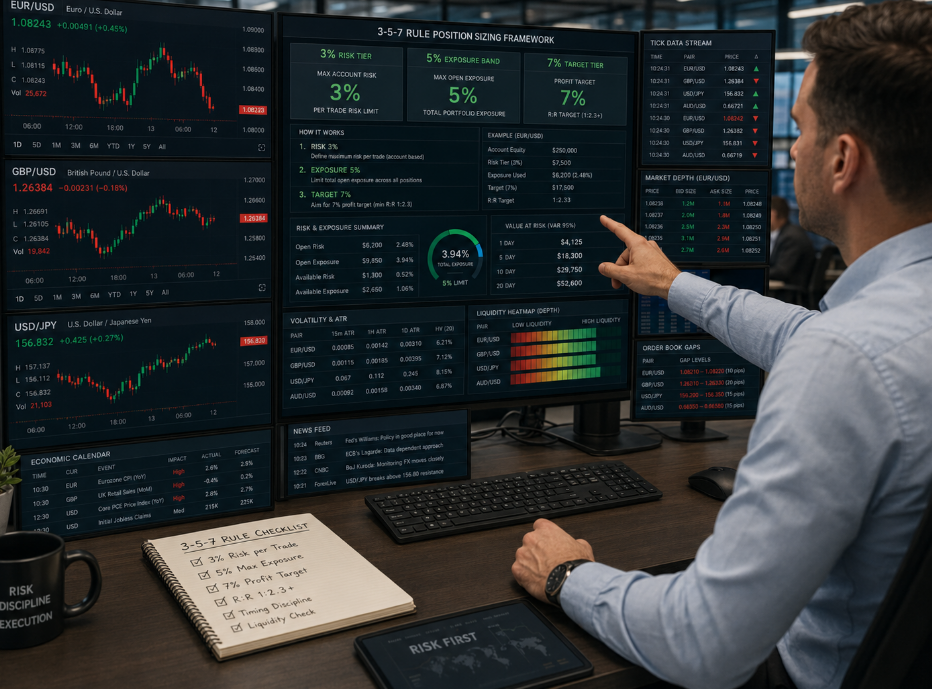
Origins and Core Principles Behind the 3-5-7 Framework
At its core, the Framework stands on a solid Foundation built around risk tiers.
3% Risk Tier
Capital at risk per idea stays capped.
Protects long-term Strategy stability.
5% Exposure Band
Controls portfolio-level Exposure.
Aligns with institutional Principles on capital preservation.
7% Target Logic
Sets structured reward expectations.
Anchors the trading Methodology to measurable outcomes.
In Forex Trading, this Concept grew from hedge fund risk desks where survival mattered more than hype. The Genesis of the rule links to strict drawdown control in FX trading portfolios.
Nested inside the structure:
Capital Allocation
Trade-level control
Portfolio balance
Behavioral Discipline
Pre-set exits
No emotional overrides
For Forex trading desks using Fxbee analytics tools, the rule keeps currency trading grounded instead of reactive.
Calculating Position Sizes with Value at Risk and Volatility Data
Position sizing in Forex Trading blends math with street smarts.
Key elements:
Position sizing
Volatility
Exposure
Metrics
Typical inputs in FX trading models:
| Pair | Daily Volatility (%) | 1-Day VaR (95%) | Suggested Risk % |
|---|---|---|---|
| EUR/USD | 0.65 | 1.2 | 2.5 |
| GBP/USD | 0.90 | 1.8 | 2.0 |
| USD/JPY | 0.55 | 1.0 | 3.0 |
| AUD/USD | 0.75 | 1.5 | 2.2 |
Process in currency trading:
Measure Volatility from recent data.
Calculate VaR using defined confidence levels.
Adjust Exposure so total account risk respects the 3-5-7 Strategy.
Risk management in Forex trading becomes less guesswork, more structured Calculation. Fxbee integrates these Data analysis workflows so traders can size positions without blowing past limits.
Timing Entries Using Historical Tick Data and Economic Calendars
Entry timing in Forex Trading lives at the intersection of speed and patience.
Entry timing
Micro-level: Tick data
Macro-level: Economic events
Inside professional FX trading desks:
Data Layer
Spread behavior
Liquidity shifts
Historical data
Event Layer
CPI
Central bank decisions
Calendar
Signal Layer
Technical Indicators
Volatility filters
Traders track the Schedule tightly. If nonfarm payrolls hit, currency trading spreads widen fast. The 3-5-7 Methodology reduces size before high-impact releases and restores it once noise fades.
Forex Trading platforms like Fxbee sync news feeds with tick-level analytics, helping trading decisions stay rule-based, not impulsive.
Adapting to Liquidity Risk for Institutional Investors
Liquidity can make or break Forex Trading results.
Core focus areas:
Liquidity
Market depth
Execution
Capital
Management
In institutional FX trading:
Monitor order book gaps.
Adjust ticket size to avoid slippage.
Split orders across venues.
Under the 3-5-7 Risk adaptation lens:
Assess real-time Market depth.
Scale entries for smoother Execution.
Protect institutional Capital through layered fills.
For large Investor type profiles, liquidity planning is not optional. It’s survival. Forex trading at scale demands structured Management, and Fxbee supports that with execution analytics tailored to institutional trading flows.
4 Steps To Apply The 3-5-7 Rule
Forex Trading sounds flashy, but in real life it’s about discipline, timing, and smart risk control. In currency trading, small mistakes snowball fast. These four actions shape how traders apply the 3-5-7 rule in Forex trading while keeping risk tight and execution sharp.
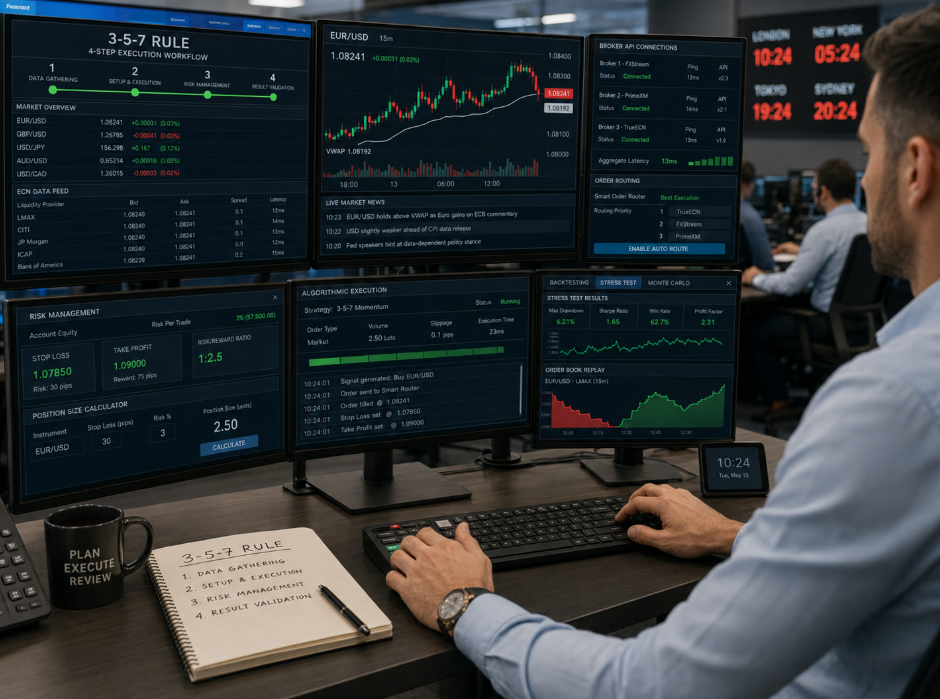
Step 1: Gathering Real-time Market Data via API Connectivity
In Forex Trading, data is oxygen. Without clean Real-time data and steady Financial data streams, trading forex turns into guesswork.
Core inputs:
Market information from ECNs
Direct API integration with brokers
Stable Connectivity protocols for low latency
Inside a professional setup:
Data acquisition
Price ticks
Depth of market
Cross-asset signals
Data feed validation
Latency checks
Gap detection
Redundancy routing
The BIS Triennial Central Bank Survey reported global FX turnover at $7.5 trillion per day in April 2022, while Reuters later reported that BIS 2025 survey data showed global currency trading rising toward $10 trillion a day. That reinforces how critical high-quality real-time feeds are in Forex trading.
With tools from Fxbee, traders plug into structured Data feeds that keep trading decisions grounded, not emotional.
Step 2: Defining Stop-loss and Take-profit on Major Currency Pairs
Risk control keeps Forex Trading alive. No exit plan? That’s gambling.
Identify Major currency pairs liquidity zones.
Calculate Stop-loss levels using volatility bands.
Set Take-profit targets based on realistic Trade parameters.
Nested risk logic matters:
Risk management
Value at Risk thresholds
Correlation exposure
Event-driven adjustments
Position management
Partial scaling
Hedge overlays
Dynamic Exit strategy shifts
In forex trading, tight spreads don’t protect poor planning. Smart structure does.
Step 3: Executing Orders on Algorithmic Trading Platforms
Execution speed defines modern Forex trading performance.
Algorithmic trading
Pre-coded Execution algorithms
Slippage control logic
Liquidity routing
Order execution stack
Trading platforms interface
Trade automation rules
Broker bridge stability
At Fxbee, Platform interface tools sync with institutional-style engines, helping optimize entries toward VWAP benchmarks. In active Forex Trading, even a few milliseconds shift results.
Step 4: Stress Testing Results with Order Book Data
Forex Trading without testing is like driving blind.
Core validation layers:
Stress testing
Spread widening
Flash volatility
Liquidity drain
Backtesting
Multi-year Market simulation
Historical Order book data replay
Tick-level revalidation
Performance analysis
Drawdown tracking
Sharpe ratios
Tail-risk scans
Solid Result validation backed by Liquidity analysis shows if a forex strategy survives real shocks. Forex Trading rewards preparation. Trading forex punishes shortcuts.
Day Trading: Implementing The 3-5-7 Rule
Forex Trading moves fast, and day traders feel every tick. In spot forex and currency trading, timing is cash. The 3-5-7 rule adds rhythm to trading decisions, especially in online Forex Trading where seconds matter. This guide ties high-speed execution, carry trade tweaks, and risk control together so your FX trading game stays sharp, not reckless.
High-Frequency Trading Strategies Meets 3-5-7 Timing
In Forex Trading, speed shapes outcomes. When high-frequency trading meets strict timing rules, structure replaces guesswork.
Core engine
Algorithmic execution processes split-second entries.
Timing signals align with the 3-5-7 rule windows.
Order flow tracking spots liquidity gaps.
Market layer
Micro breakout capture
Reversion inside 3-minute bands
Bid-ask spread shifts
Hidden liquidity pockets
Market microstructure
Trading strategies
Rule application in live FX trading
3-minute momentum scan
5-minute validation through volume
7-minute exit discipline
Platforms like Fxbee support low-latency routing, helping Forex traders apply this framework without lag killing the edge.
Carry Trade Adjustments for Intraday Scalping
Short-term carry trade logic still works in Forex Trading, but it needs trimming.
Yield focus
Interest rate differential between major currency pairs
Swap sensitivity during intraday trading
Scalping control
Ignore wide spikes
Respect session overlaps
Quick spread capture
Tight position management
Scalping techniques
Volatility filter
Execution checklist
Scan rate expectations.
Match pair volatility.
Scale down during news bursts.
Fxbee tools help monitor swaps and price swings in real time, which keeps currency trading practical, not emotional.
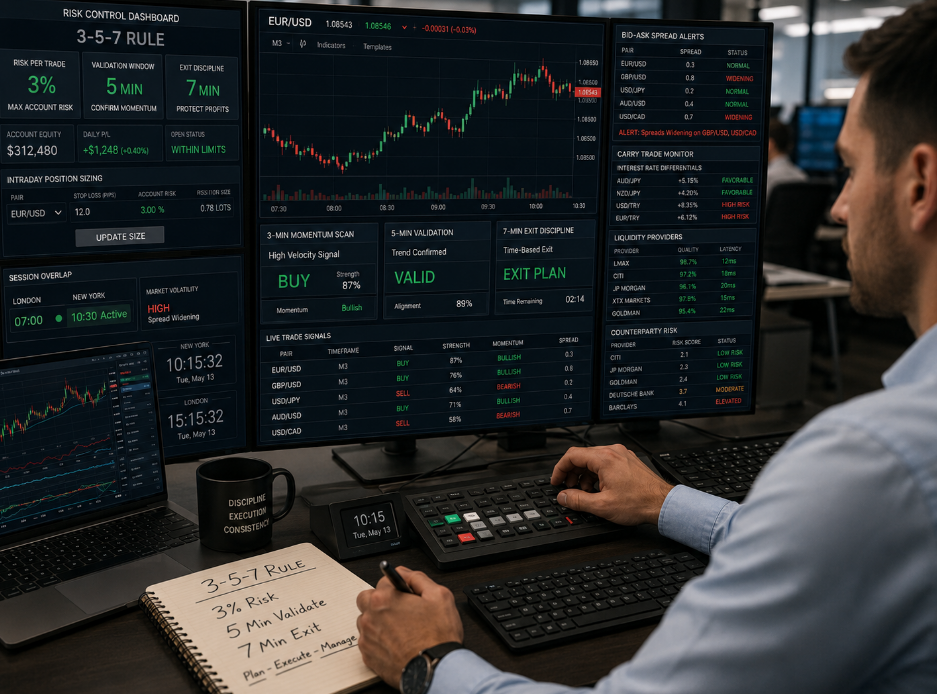
Managing Counterparty Risk During Fast-paced Sessions
Fast markets expose weak links in Forex Trading.
Broker and venue review
Counterparty risk scoring
Compare liquidity providers
Assess execution venues
Risk management stack
Internal risk management limits
Spread alerts during market volatility
Session-based exposure caps
Trading session discipline
London open: tighter spreads, higher speed
New York overlap: heavier volume
Smart broker selection reduces friction. In online Forex Trading and broader foreign exchange trading, clean execution and solid credit backing keep FX trading sustainable.
3-5-7 Rule Vs. Traditional Money Management
Forex Trading sounds exciting, but without structure it can wreck your account fast. In the Forex market, discipline beats hype. Let’s break down how the 3-5-7 Rule stacks up against traditional money habits in currency trading.
3-5-7 Rule
In Forex Trading, the 3-5-7 Rule builds control into every move. It revolves around strict risk management and controlled position sizing, keeping traders from going all-in on emotion.
Exposure Framework
1.1 Capital Layer
1.2 Position Layer
Apply tiered position sizing per setup.
Align size with predefined profit targets.
Cap total exposure to protect capital preservation.
Define clear loss limits before trade entry.
Execution Discipline
2.1 Entry Logic
2.2 Exit Logic
Pre-set trade exit rules lock gains or cut losses fast.
Quant triggers guide trade entry, not gut feeling.
Protection Core
Dynamic hedging supports risk management.
Structured loss limits reduce drawdown shock.
This tiered strategy fits active Forex traders who want numbers, not vibes. On platforms like Fxbee, traders plug these controls directly into their Trading systems, keeping Forex Trading sharp and consistent.
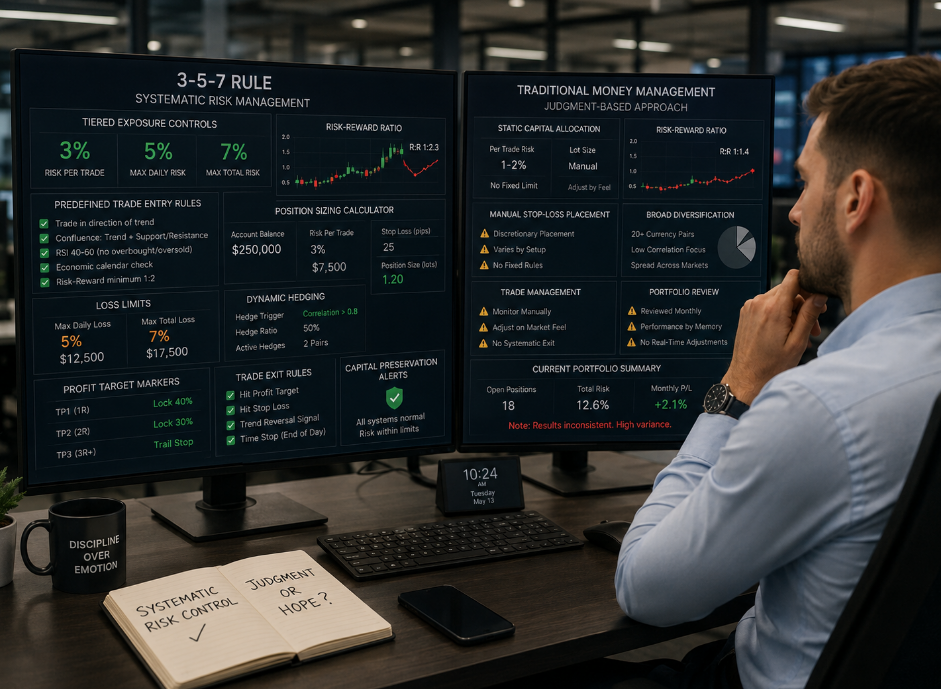
Traditional Money Management
Traditional money habits in the forex market feel more relaxed. Some traders like that.
Static capital allocation across pairs.
Broad diversification to smooth swings.
Manual stop-loss and take-profit placement.
Core idea: balance the risk-reward ratio.
Adjust position sizing based on comfort.
Review overall portfolio management monthly.
This style leans on personal judgment. In currency trading, that can work—if discipline stays tight. But without systematic risk control, emotions creep in.
Many Forex Trading beginners start here. Later, after a few tough lessons, they shift toward rule-based models. Fxbee supports both styles, yet serious Forex traders often blend structure with experience to survive long term.
References
[2022 Triennial Central Bank Survey - [https://www.bis.org/statistics/rpfx22.htm](https://www.bis.org/statistics/rpfx22.htm)]
[OTC Foreign Exchange Turnover in April 2022 - [https://www.bis.org/statistics/rpfx22_fx.pdf](https://www.bis.org/statistics/rpfx22_fx.pdf)]
[Global Currency Trading Closing in on $10 Trillion a Day - https://www.reuters.com]
[Minimum Capital Requirements for Market Risk - [https://www.bis.org/bcbs/publ/d352.htm](https://www.bis.org/bcbs/publ/d352.htm)]
[Dodd-Frank Act - [https://www.cftc.gov/LawRegulation/DoddFrankAct/index.htm](https://www.cftc.gov/LawRegulation/DoddFrankAct/index.htm)]
[Foreign Currency Retail Off-Exchange Rules - [https://www.cftc.gov/LawRegulation/DoddFrankAct/Rulemakings/DF_20_FXSwaps/index.htm](https://www.cftc.gov/LawRegulation/DoddFrankAct/Rulemakings/DF_20_FXSwaps/index.htm)]
[Foreign Currency Exchange Forex Trading For Individual Investors - https://www.investor.gov]
[MiFID II Article 17 Algorithmic Trading - [https://www.esma.europa.eu/publications-and-data/interactive-single-rulebook/mifid-ii/article-17-algorithmic-trading](https://www.esma.europa.eu/publications-and-data/interactive-single-rulebook/mifid-ii/article-17-algorithmic-trading)]
[FXBee Official Website - [https://www.fxbee.com/](https://www.fxbee.com/)]
[FXBee Broker Page - https://www.fxbee.com/broker.html]
FAQ
How does the 3-5-7 Rule strengthen risk control in Forex Trading?
In active Forex Trading desks, discipline protects capital when markets turn violent. The 3-5-7 structure sets tiered exposure limits monitored across Major Currency Pairs and correlated positions.
3% base tier – standard allocation measured through Value at Risk and live Volatility Data.
5% expansion tier – applied when Liquidity Risk remains stable across Electronic Communication Networks.
7% maximum tier – reserved for high-conviction setups, stress-tested against Historical Tick Data.
Institutional Investors, Hedge Funds, and Proprietary Trading Firms align these limits inside Order Management Systems, while Prime Brokers supervise Counterparty Risk under Basel III. The tension lies in balance: push returns, but never surrender control.
Why is API Connectivity critical in large-scale Forex Trading operations?
Modern Forex Trading runs on speed and traceability. API Connectivity binds Algorithmic Trading Platforms to Execution Management Systems and Interbank Dealing Systems in real time.
Direct routing to Liquidity Providers reduces slippage.
Automated Reporting Requirements support MiFID II and the Dodd-Frank Act.
Trade Surveillance and Anti-Money Laundering checks operate in parallel.
Behind the screen: Low Latency Connectivity, Co-location Services, and hardened Data Centers guarded by Cybersecurity Measures. When milliseconds decide profit or loss, infrastructure becomes strategy.
How do Institutional Investors structure multi-instrument Forex Trading portfolios?
Professional desks rarely rely on a single instrument. Risk is distributed, hedged, and recalibrated continuously.
| Instrument Type | Core Purpose | Typical Users |
|---|---|---|
| Spot Contracts | Immediate exposure to Major Currency Pairs | Hedge Funds, Investment Banks |
| Forward Contracts / Non-Deliverable Forwards | Lock future rates, manage Market Risk | Central Banks, Corporates |
| Futures Contracts | Exchange-traded transparency | Proprietary Trading Firms |
| Currency Options / Cross Currency Swaps | Structured Hedging Strategies | Institutional Investors |
Positions are modeled through Quantitative Strategies, Arbitrage Strategies, or Macro Trading views. Credit Risk and Liquidity Risk remain under daily Stress Testing. Every allocation carries weight; every hedge carries cost.
How does low-latency technology shape High-Frequency Forex Trading performance?
In High-Frequency Trading, delay equals danger. Prices shift between ticks; spreads widen without warning.
Real-time Market Data and Order Book Data stream into High Performance Computing clusters.
Volume Weighted Average Price and Algorithmic Execution models react instantly.
Network Redundancy and Cloud Computing maintain uptime during volatility spikes.
The result is precision under pressure. Investment Banks and Liquidity Providers compete in microseconds, guided by data, constrained by Risk Management, and watched closely through Know Your Customer and Trade Surveillance controls. In this arena, speed is discipline—and hesitation is expensive.