
A trade chart is not a crystal ball. It is a compact record of price, time, participation, and uncertainty. For a U.S.-based forex trader, the useful question is rarely “Where will price go?” It is “What would make this idea valid, what would prove it wrong, and is the risk acceptable before I place the order?”
This guide explains a repeatable way to read a forex trade chart, turn observations into a plan, and keep broker research separate from trade analysis. It is educational information, not investment, tax, or legal advice.

Read a trade chart in the right order
Many weak trades begin with an indicator signal and work backward from there. A more durable process starts with context. First establish the timeframe and the market condition; then locate the levels that could change the decision; only then look for a trigger. This sequence reduces the temptation to turn every candle into a prediction.
On a candlestick chart, each candle summarizes the open, high, low, and close for one period. The body shows the distance between open and close, while the wicks show where price traveled but did not finish. A long wick is not automatically a reversal signal. It becomes useful only when it appears at a meaningful location and fits the broader structure.
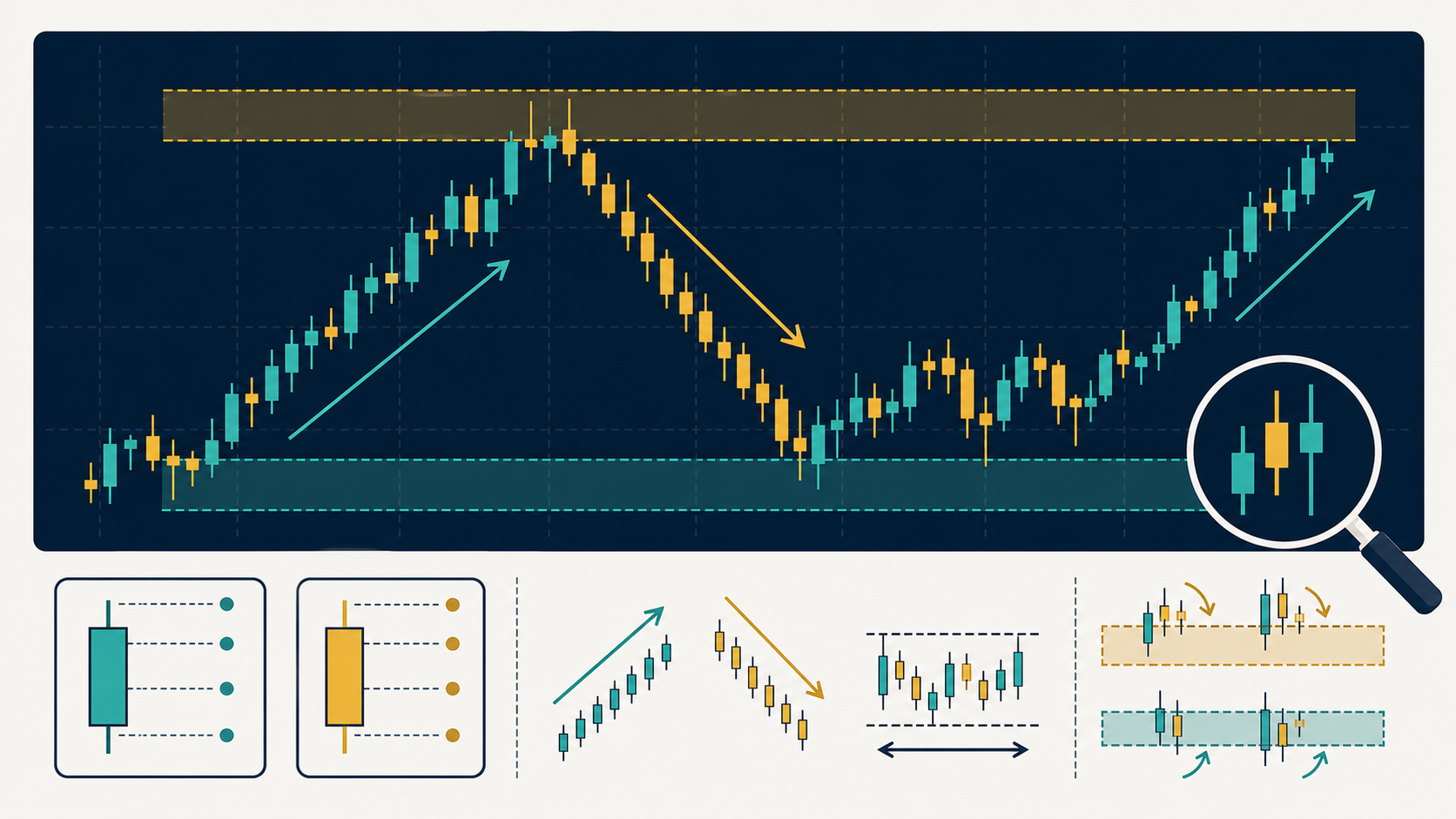
| Chart question | What to examine | Why it matters |
|---|---|---|
| What is the timeframe? | Match the chart to the intended holding period. | A five-minute entry can conflict with a daily-chart trend without either chart being “wrong.” |
| Is price trending or ranging? | Higher highs and lows, lower highs and lows, or repeated rotation between boundaries. | Breakout and mean-reversion ideas require different invalidation logic. |
| Where are decisions likely to cluster? | Prior swing points, repeated reaction zones, session highs/lows, and obvious range edges. | These areas help define where an idea is confirmed or disproved. |
| What changed? | Structure break, failed breakout, strong close, or volatility expansion. | A trade needs a reason to exist now, not merely an interesting level. |
Keep the display simple enough that every mark has a job. A handful of clear levels and one optional momentum or volatility tool are usually easier to audit than a screen full of overlapping signals. The goal is not to make the trade chart look sophisticated; it is to make the next decision unambiguous.
Build a trade thesis before looking for an entry
An analyst-style trade thesis is conditional. It describes the setup, the evidence required, the point of failure, and the risk—not a certainty about the next move. Write it in plain language before using the order ticket.
Define the backdrop. Note the currency pair, chart timeframe, trading session, upcoming high-impact events, and whether price is trending or rotating in a range.
Mark the decision zone. Choose a level or zone that matters because price has reacted there, not because it happens to sit near the current price.
Specify the trigger. Examples include a close beyond a boundary, a retest that holds, or a rejection that returns inside a range. “It looks ready” is not a trigger.
Place the invalidation point. Ask where the original idea no longer makes sense. A stop should protect the thesis, not simply sit at a convenient dollar amount.
Calculate size from the stop. Decide the maximum loss first, then derive position size from the distance to invalidation and the pair’s value per pip.
Plan the review. State what will cause an exit, a reduction, or no action. Include a rule for scheduled news if that is relevant to the setup.

A hypothetical chart walkthrough
Suppose a currency pair has spent several sessions rotating between two well-tested boundaries. Price briefly moves above the upper boundary but closes back inside the range. That observation alone does not command a trade. A short thesis would still need a defined entry condition, a clear invalidation beyond the failed-move area, and a position size that keeps the loss within the trader’s preset limit. If price instead accepts above the range, the original short thesis is invalid; standing aside is a valid outcome.
This is intentionally a framework rather than a signal. A chart pattern can fail, spreads can change, and fast market conditions can produce fills far from the intended level. Keeping the plan conditional makes those realities visible early.
Put risk before prediction
Leverage makes a small price movement matter more, in both directions. The U.S. Commodity Futures Trading Commission (CFTC) advises prospective retail forex customers to research a dealer and its registration and disciplinary history before depositing funds. Its forex customer advisory also explains that retail OTC forex involves the dealer as counterparty and that losses, fees, financing charges, and other costs matter to outcomes.

A practical risk checklist
Set a maximum loss per trade that is small enough to survive a sequence of losses.
Use a stop or other predefined exit process that reflects the thesis and the platform’s order behavior.
Check spread, commission, overnight financing, and any other account-specific cost before treating a chart level as tradeable.
Reduce size or stay out when a scheduled event could make a normal stop distance unrealistic.
Do not average down merely because a chart is moving against the original idea.
For U.S. residents, verify a prospective counterparty’s status and background through the NFA BASIC database and review the CFTC’s guidance. Registration and disclosures do not eliminate market risk, but verification is a sensible first screen. Do not treat social-media claims, copied trade histories, or a polished chart image as proof of suitability.
Keep trade-chart analysis separate from provider and rebate research
A well-drawn trade chart does not answer whether a broker, rebate program, or copy-trading feature is available or appropriate for a particular customer. Those are separate due-diligence questions. FXBee describes itself as a third-party platform for forex rebate services, trading-task rewards, copy-trading insights, and a trader community; its support information says it does not offer trade execution or investment advice. Readers can review FXBee’s broker and rebate comparison page alongside the site’s support information.
For a U.S. reader, treat availability, eligibility, broker status, account terms, and rebate mechanics as items to confirm directly before registering or depositing. A rebate may reduce a stated trading cost, but it does not turn a poor setup into a sound trade, remove the risk of loss, or establish that a provider may serve every location. Review the applicable terms of use and privacy policy, then compare the exact broker account conditions you would use.
| Question | What to verify |
|---|---|
| Can I legally open and use this account from my location? | Registration status, stated geographic eligibility, and the broker’s current onboarding rules. |
| What will this trade actually cost? | Spread, commission, financing, conversion costs, and the conditions attached to any rebate. |
| How is the rebate tracked? | Eligible accounts, instrument exclusions, timing, withdrawal conditions, and dispute process. |
| What happens when something goes wrong? | Order-execution policies, support channels, account documentation, and complaint options. |
Use the trade chart as a decision record
The most valuable chart annotation may be the one you revisit after the trade. Save the setup, the stated thesis, the risk amount, and the exit reason. Over a meaningful sample, this separates a workable process from a sequence of memorable outcomes. It also reveals common errors: entering before confirmation, moving invalidation after entry, increasing size after a loss, or ignoring costs during active sessions.

Mastery in 2026 is less about finding a new indicator than maintaining a process that survives uncertainty. Read context first, define the conditions that would change your mind, and verify the trading provider separately from the chart idea. That approach makes a trade chart a tool for decisions rather than a source of false confidence.
Trade chart FAQ
Risk disclosure
Forex and CFD trading can result in substantial losses and may not be appropriate for every investor. This article is general education and does not recommend a transaction, broker, or strategy. U.S. laws, provider availability, pricing, platform features, and terms can change; verify current information directly with the relevant official source and provider before acting.