
A forex profit calculator is most useful before an order is placed, when it can turn a price idea into a clear estimate of possible loss, possible gain, and trading costs. Treat the result as a planning check—not a forecast or a promise. In fast markets, your fill, spread, financing, and conversion rate may differ from the inputs.

What a forex profit calculator can—and cannot—tell you
A forex profit calculator estimates how a move between an entry price and an exit price could translate into profit or loss for a chosen position size. Depending on the tool, it may also estimate pip value, margin, spread cost, commission, swap or financing, and conversion into the account currency.
That makes it valuable for asking a more useful question than “Where could this pair go?”: “If my stop is hit, what is the likely dollar loss, and does that fit my plan?” Use the same calculation for a target, but do not let the target decide the position size. The stop and the maximum acceptable loss should do that work.
A calculator cannot know the exact execution you will receive. A stop order may fill away from its trigger in a gap or thin market; spreads can widen; commissions and overnight financing can vary by account and product; and a cross pair can introduce currency-conversion effects. Think of the output as an estimate with a margin for error.
The inputs to verify before you calculate
Good inputs matter more than a polished calculator. Confirm these details from the instrument specification and your broker’s current trading conditions.
| Input | Why it matters | Practical check |
|---|---|---|
| Currency pair and direction | They determine which price movement benefits the position and how the pip value may be converted. | Confirm whether you are buying or selling and whether the quote currency matches your account currency. |
| Entry price and stop price | The distance between them defines the planned adverse move. | Use the price you expect to enter, then allow for realistic spread and possible slippage. |
| Target price | It provides an estimated gross upside and a risk-to-reward comparison. | Calculate it after the stop-based position size is set. |
| Position size | It turns pips into money. A small sizing change can materially change the loss at the stop. | Check the contract size, minimum increment, and pip value for the exact instrument. |
| Spread, commission, and financing | These costs reduce net results and can change break-even. | Use the broker’s current schedule; do not assume another account type has the same costs. |
| Account currency and holding period | Conversion and overnight financing can affect the final amount. | Check the calculator’s account-currency setting and the rollover treatment for the intended holding time. |
Calculate downside first, then size the position
Start with a dollar amount you can afford to lose on one trade. Some traders express this as a small percentage of account equity, but there is no universal “safe” percentage. The appropriate amount depends on your financial situation, strategy, leverage, liquidity, and ability to absorb a losing streak. It should never be money needed for essential expenses.
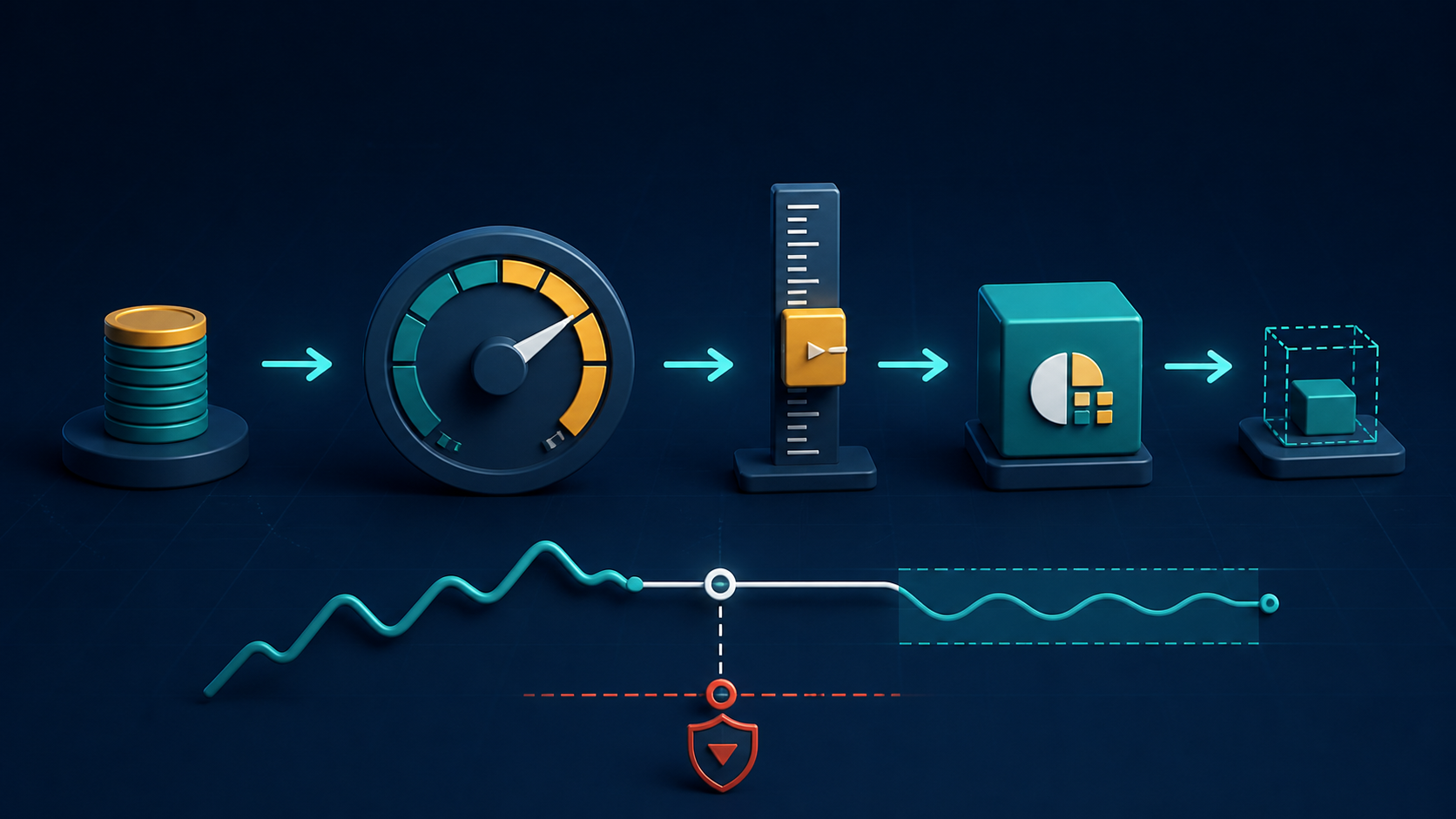
Next, translate the stop distance into a position size. A simplified planning formula is:
Position size = maximum planned loss ÷ (stop distance in pips × pip value per unit)
For example, assume a $5,000 account, a $25 maximum planned loss, and a 25-pip stop. The budget is $1 per pip ($25 ÷ 25). On a pair where 0.01 standard lot is approximately $1 per pip in a USD account, the starting calculation would be about 0.01 lot. This is only an illustration: pip value, contract size, account currency, spread, and execution can change the amount.
Why calculating after choosing a lot size is backwards
Choosing a familiar lot size first and then moving the stop to make the loss look acceptable can detach the stop from the trade idea. A stop should reflect the point at which the premise is no longer valid or the volatility makes the trade unsuitable. If that distance creates too much dollar risk, reduce the size or skip the trade.
A forex profit calculator is helpful here because it makes the trade-off visible before a live order is exposed to the market. If the broker’s minimum trade size is already too large for your risk budget, the setup may not fit that account.
Gross P/L is not net P/L
A price target can look attractive until costs are included. The calculator’s gross result generally reflects the distance from entry to exit multiplied by position size. Your net result may be lower after the spread, commission, overnight financing, and any conversion charge. The same costs also make a losing trade slightly worse than the clean price-distance calculation suggests.
| Planning item | Illustrative calculation | What to remember |
|---|---|---|
| Stop distance | 25 pips × $1 per pip = $25 gross loss at the stop | Allow for spread and slippage; a stop is not a guarantee of an exact exit price. |
| Target distance | 50 pips × $1 per pip = $50 gross profit at the target | Subtract trading costs to estimate a net outcome. |
| Risk-to-reward | $50 gross potential gain ÷ $25 gross planned loss = 2:1 gross | It is a ratio, not a probability or a reason to take the trade. |
For short holds, financing may be immaterial; for positions held through rollover, it may not be. Do not use a generic online calculator to infer your broker’s costs. Use the tool’s assumptions only after comparing them with the applicable product specification.

Keep profit, margin, and liquidation risk separate
Profit/loss and margin are related but answer different questions. Profit/loss estimates the effect of a price move at a given size. Margin is the collateral required to open and maintain that exposure. A trade can have a planned stop loss that fits your budget yet still create operational pressure if the account has limited free margin, if multiple positions are correlated, or if volatility expands.
Leverage increases the size of the exposure controlled by a smaller deposit; it does not reduce the amount the market can move against you. In the United States, the CFTC’s retail forex advisory notes that leverage can magnify losses and that retail OTC forex is traded against the dealer rather than through a live exchange. Build in a cushion rather than treating the platform’s minimum margin as a position-size recommendation.
Also consider portfolio risk. Two positions may appear separate but respond similarly to a broad U.S. dollar move. Add the possible losses across related positions before deciding whether a new trade fits the overall risk limit.
A five-minute pre-trade workflow
State the invalidation point. Write the price or market condition that would make the trade idea wrong. Put the stop there only if that distance is practical.
Set a maximum dollar loss. Choose the amount before opening the order and include related open positions in the wider account-risk view.
Enter realistic calculator inputs. Select the exact pair, account currency, trade direction, entry, stop, target, and intended size. Add current spread, commission, and expected holding period where the tool supports them.
Size from the stop. Reduce the position until the estimated loss at the stop fits the loss budget, allowing a cushion for spread and slippage.
Compare net reward with risk, then decide. If the target is too close after costs, or the required size is below the broker’s minimum, passing on the trade is a valid outcome.
This procedure is deliberately unglamorous. Its value is that it makes rejection easy before a trade becomes emotionally expensive.
Notes for U.S. retail forex traders
U.S. readers should treat broker eligibility and registration as part of risk management. Before depositing funds or sharing sensitive information, use the NFA’s BASIC database and the CFTC’s customer advisory to check registration and disciplinary history. The CFTC also cautions against offers that downplay risk or promise unusually easy returns; see its forex fraud alert.
FXBee publishes a broker comparison and rebate page and a support center. Those resources may help you organize questions about account types and costs, but they do not replace independent due diligence. Confirm that any broker, account, product, and promotion is available to U.S. residents and is appropriate for your circumstances before you act. FXBee should not be assumed to be a broker, a calculator provider, or a recommendation of a particular firm based on this article.
Forex involves a substantial risk of loss and is not suitable for everyone. This article is educational information, not individualized investment, legal, tax, or trading advice.
Pre-order checklist

My stop reflects invalidation, not the loss amount I hope to avoid.
The estimated loss at the stop fits my pre-set risk budget, with a buffer for execution differences.
I confirmed pip value, contract size, account currency, and the broker’s minimum size.
I reviewed spread, commission, and potential overnight financing.
I checked free margin and combined exposure with correlated positions.
I verified the broker’s eligibility and registration for my location.
Frequently asked questions
What is a forex profit calculator?
A forex profit calculator estimates the potential profit or loss from a planned entry, exit, and position size. Many tools also estimate pip value, margin, and selected costs. It is a scenario-planning aid, not a prediction. Results can differ because of spread changes, slippage, financing, conversion, and the actual price at which an order fills.
Should I use a forex profit calculator before every trade?
Using one before every new position can create a useful pause. At a minimum, calculate the estimated loss at the stop, position size, target outcome, and likely costs. Recheck when the pair, account currency, holding period, or stop distance changes. A routine is most valuable when volatility or emotion makes intuition less reliable.
How do I calculate forex position size from my stop loss?
Divide your maximum planned dollar loss by the product of the stop distance in pips and the pip value per unit. Then check the broker’s contract size and minimum increment. Because pip value can change with the currency pair and account currency, use the exact instrument and account settings rather than copying a figure from another trade.
Does the calculator include spread and commission?
Some calculators do, while others show only gross price movement. Check the tool’s assumptions and compare them with your broker’s current schedule. Spread, commission, financing, and currency-conversion charges can all affect the net result. If a calculator does not include a cost, add a conservative allowance before deciding whether a target is worthwhile.
Is a 2:1 risk-to-reward ratio enough to take a trade?
No. A 2:1 ratio only compares the estimated gross target to the estimated loss at the stop. It does not measure the probability of reaching either price, the effect of costs, or whether the stop makes sense for the market. Use it as one planning metric, alongside a defined setup and an amount you can afford to lose.
Why can my actual loss be larger than the calculator estimate?
The calculation may assume a specific entry and exit price. In live markets, spreads can widen and stop orders may fill at a worse price in fast conditions, gaps, or limited liquidity. Commission, financing, and conversion can also alter the amount. Build a buffer into the planned loss instead of treating the displayed number as exact.
What account currency should I choose in a forex calculator?
Choose the currency in which your trading account reports profit, loss, margin, and fees. That setting helps the calculator convert the trade result into the number you actually use for risk limits. For cross pairs, verify the tool’s conversion assumptions and remember that conversion rates can move between entry and exit.
Does leverage make a forex trade less risky?
No. Leverage can let a smaller deposit control a larger position, which can magnify gains and losses. Risk is driven by exposure, price movement, position size, and execution—not by how small the initial margin looks. Consider the loss at the stop and the account’s free-margin cushion before using leverage.
Can I use a forex profit calculator for trades held overnight?
Yes, but include the expected holding period and the applicable financing or rollover terms if the tool offers them. These charges or credits can matter more for longer holds and can change by instrument and broker. Check the current product specification rather than assuming a historical swap rate will apply.
How can U.S. traders check a forex broker before opening an account?
Start with the CFTC and NFA resources to verify registration and review disciplinary history. Confirm that the broker and the exact account or product are available to U.S. residents, then read the risk disclosure, costs, margin policy, and withdrawal terms. Do not rely on a calculator, referral page, or marketing claim as a substitute for this check.