
Choosing a forex cfd provider is not just about chasing the lowest spread on paper. For a brokerage buying at wholesale level, the real test is simple: can this partner help you keep costs down, fills clean, and clients happy when markets get jumpy?
A tight quote can look great at first glance, but that is only half the story. If execution drags, slippage creeps in, or liquidity dries up when volume spikes, that “cheap” pricing can turn into a money pit fast.
It is a bit like buying the cheapest fuel for a race car. Saving a little up front does not help much if the engine starts coughing when the pressure is on. Brokerages need pricing that holds up in the real world, not just in a sales deck.
“Low spreads mean nothing without stable execution,” as one Fxbee executive put it.
This article gets straight to the point: what drives real trading costs, how deeper liquidity can cut slippage, and what to check before picking a provider that can grow with your brokerage instead of slowing it down.
Lowest Spreads forex cfd provider: What really affects trading costs?
How spread, pip, and lot size shape total forex trading costs
The Bid-ask spread is the visible entry cost.
Pip value changes by pair and base currency.
Lot size scales the hit fast; a tiny spread on a big trade still stings.
Add commission, margin, and leverage impact, and the true transaction cost shows up.
A provider with “low spreads” can still be pricey when the math gets real.
Why liquidity and execution quality matter more than advertised pricing
Tight quotes mean little if order execution is messy. A strong liquidity provider setup gives better market depth, fewer requotes, and a steadier fill rate. In ECN or STP flow, speed matters too; high latency can wreck a nice-looking price before the trade lands. For brokerages buying wholesale, clean fills beat flashy ads every day. That is where real client trust starts.
Hidden costs in rollover, slippage, deposit, and withdrawal processes
A low spread is not the whole story.
Swap rates and overnight funding can quietly eat margin.
Negative slippage after a price gap can turn a good entry ugly.
Currency conversion fees add up on cross-border funding.
A clunky payment gateway may pile on withdrawal fee costs.
Some firms even sneak in an inactivity fee.
Small charges look harmless, then boom, the monthly bill gets chunky.
How wholesale brokerages compare pricing across forex, CFD, indices, and commodities
Forex pricing often tracks the spot market, while some CFD products mirror futures or internal market maker books. That changes contract size, spread behavior, and markups across asset classes like indices and commodities. Wholesale buyers usually check institutional pricing, prime brokerage access, and signs of spread compression during active sessions. Put simply: compare by product mix, execution model, and trading hours, or the “best price” can be a trap.
Tight spreads vs. stable execution
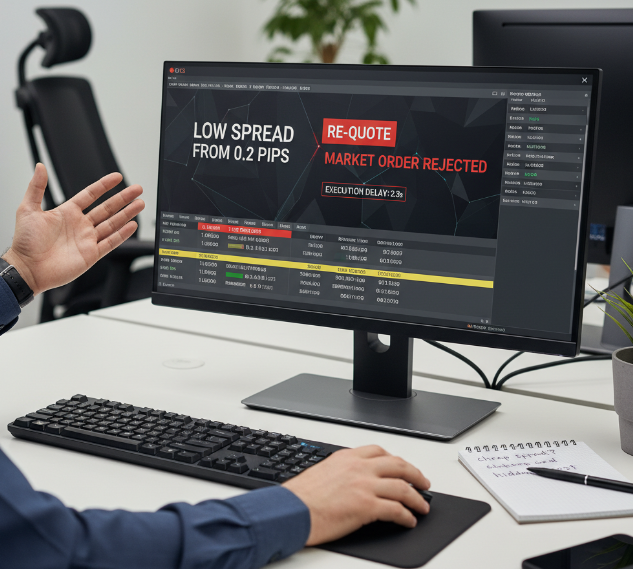
Low spreads, poor execution
Spreads grab attention. That is the easy sell.
Execution quality keeps clients. Re-quotes, latency, and order rejection make cheap pricing feel fake.
Market making can cut both ways. Good internalization may help, but weak routing can hurt fills fast.
Quick truth: if a forex cfd provider posts low Spreads but stalls orders in live trading, clients notice pretty quickly. Tight pricing without clean execution is not a win. It is just hidden cost wearing a nice outfit.
Fast fills, wider pricing
Execution speed matters when clients fire market orders during active sessions.
Fill rate tells the real story when liquidity starts thinning out.
Bid-ask spread can run wider with some ECN brokers and STP brokers, yet the actual fill may still be cleaner.
Short version: a slightly wider price is sometimes the better deal. If liquidity is deeper and price impact stays lower, broker performance often looks stronger over time. Fast fills can save more money than a flashy headline spread.
Slippage, volatility, and liquidity gaps
Slippage jumps during major news and sharp market volatility.
Liquidity gaps hit hard when market depth disappears for a few seconds.
Price spikes can trigger stop-loss orders at levels nobody likes.
That is where execution risk gets real. A provider with weak depth may turn normal trading into a mess during NFP, CPI, or surprise rate calls. For a brokerage, this is not just a trading issue. It hits trust, retention, and support workload all at once.
Too much slippage? Choose a forex cfd provider with deeper liquidity.
What causes slippage in forex, CFD, and derivatives trading
Slippage usually pops up when market volatility spikes and order execution can’t keep pace.
A wide bid-ask spread means thinner pricing
A liquidity gap leaves fewer fills at the quoted level
A price gap can hit after news or session opens
Latency slows the route
A big market order sweeps levels
A late limit order misses the price
For wholesale brokerages, this stuff adds up fast.

How liquidity pools improve execution and settlement quality
Deeper liquidity pools help trades land cleaner.
Tier 1 banks and other liquidity providers add more quotes
ECN routing improves order matching
Good aggregation pulls the best prices into one stream
Faster clearing supports smoother settlement
In plain English: more depth usually means fewer nasty fills, tighter spread behavior, and better confidence for brokerages handling serious trading flow.
Why pricing engines matter during volatility in currencies, stocks, and commodities
A strong pricing engine keeps quotes sane when currencies, stocks, and commodities get jumpy.
Short version:
Better price discovery tracks real market conditions
Low latency helps quote updates stay fresh
Smart quote generation cuts stale prices
Algorithmic trading logic reacts quicker to market data
Built-in risk management helps block bad fills and arbitrage abuse
For a brokerage, that means pricing stays usable when markets go a bit wild.
How brokerages assess provider depth across API, data feed, and trading platform infrastructure
Brokerages usually check the plumbing before signing anything.
FIX API stability for institutional flow
Real order book depth, not just pretty top-of-book quotes
Network connectivity and message throughput under stress
Solid bridge technology for MT4 and other setups
Low data latency across the feed
If the stack looks shaky, execution pain usually shows up later in slippage, rejects, or messy pricing.
5 factors to evaluate a wholesale forex cfd provider

Regulation, license, and compliance standards for broker partnerships
Not all licensing is built the same. A provider under ASIC, FCA, or CySEC usually gives stronger regulatory oversight, cleaner reporting, and clearer risk disclosure. For wholesale broker partnerships, check the compliance framework, AML/CTF process, and how MiFID II rules affect onboarding and cross-border business. If the paperwork feels messy, that is a red flag. Clean compliance saves headaches later.
Margin, leverage, and risk management controls for brokerage clients
Look at the risk stack, not just the sales pitch:
Clear leverage ratios by client type
Smart margin call alerts
Fair stop-out level logic
Built-in negative balance protection
Solid slippage control and hedging support
If a provider cannot explain how it handles risk exposure during volatility, that is a bit sketchy. Good controls protect both broker and client capital.
Trading platform strength: web terminal, mobile application, and charting tools
A decent setup usually comes down to 3 things.
Execution speed with low latency during busy market hours.
Stable platforms like MetaTrader 5 or cTrader, plus smooth mobile trading.
Useful extras: API integration, solid GUI, and enough technical indicators for serious trading.
If the platform freezes when markets get wild, low spreads will not save the day.
Funding efficiency: deposit, withdrawal, AML, KYC, and account operations
Fast money movement keeps clients happy. Slow deposit flow, clunky withdrawal handling, or painful identity verification can kill trust pretty quickly. Check the payment gateway mix, bank wire support, instant withdrawal options, and total transaction fees. Also review onboarding, AML, KYC, and how the provider coordinates with a liquidity provider on settlement. Smooth ops feel boring, and that is exactly the point.
Asset coverage across forex, cryptocurrencies, ETFs, indices, and commodities
Product range can make or break your offer. Some brokerages need only major pairs and a few CFD instruments. Others want the full menu: exotic pairs, altcoins, ETFs, stock indices, spot gold, and Brent crude. A wider shelf helps with client retention, cross-sell potential, and basket trading ideas. If asset coverage is too thin, growth hits a ceiling fast.
How can a forex cfd provider support brokerage growth?
Using API connectivity and algorithmic trading tools to scale brokerage operations
A growing brokerage needs tech that does not choke when traffic spikes.
FIX API keeps order routing fast and clean
REST API supports account, pricing, and funding functions
MetaTrader 5 adds a familiar trading platform for clients
Bridge technology connects liquidity and back-end systems
With automation, low latency, and support for HFT, the desk can handle more trading without turning into a mess.
How better execution and liquidity improve client retention and trading volume
Better order execution cuts nasty slippage.
Strong market depth keeps pricing steady in fast moves.
Access to Tier 1 liquidity, STP, and ECN flows can improve fill rate.
Cleaner fills and tighter spreads keep traders active longer.
When clients see fewer rejects and smoother fills, they stick around, trade more, and complain less. That is good for retention and even better for trading volume.
Supporting risk management with negative balance protection, margin call, and stop out logic
Good risk management is not just a safety net; it keeps the brokerage alive when volatility gets wild. Clear rules around negative balance protection, margin call, and stop out level help control exposure before losses spiral. Add smart settings for leverage, live tracking of equity and margin level, plus basic hedging tools, and the operation stays a lot more stable when markets get jumpy.
Why multi-asset access to forex, CFD, stocks, and cryptocurrencies expands revenue opportunities
Quick win: more asset classes usually mean more ways to earn.
Forex brings frequent trading flow
CFD products widen margin opportunities
Equities, commodities, and indices attract broader client groups
Crypto assets pull in high-interest traders
This kind of diversification supports cross-selling, lifts trading volume, and gives the brokerage more room to grow without betting everything on one market.
Regulation, liquidity, and pricing standards

Low spreads look great on paper, but trust comes from regulation, clean execution, and price transparency when markets get wild.
A wholesale forex cfd provider earns attention when the basics are tight and the details hold up under pressure. For a brokerage buyer, that usually comes down to three things: Compliance, Liquidity providers, and Pricing behavior. If one piece is shaky, the whole setup can get messy fast.
What serious brokerages usually check
Regulation from names the market already respects, such as FCA, ASIC, and CySEC
Clear Compliance processes for onboarding, monitoring, reporting, AML, and KYC
Relationships with Tier 1 banks and diversified Liquidity providers
An execution model built around ECN or STP routing
Visible Market depth instead of mystery fills
Consistent Bid-ask spread behavior across normal and volatile sessions
Better Price transparency on quotes, markups, and order handling
Controls that reduce ugly Slippage during fast market moves
A lot of providers talk a big game. The better ones can actually show how pricing is formed, where liquidity comes from, and how orders move from click to fill.
3 signs pricing standards are actually legit
Spreads stay believable during busy hours
A provider may advertise a tiny Bid-ask spread, but the real test comes during news releases, market open, and rollover time. If spreads blow out every time the market gets active, that “low spread” pitch does not mean much.Execution matches the quoted price often enough to build trust
Clean routing through ECN or STP channels, backed by multiple Liquidity providers, helps orders land closer to expected levels. That matters for forex, CFD, indices, commodities, and every fast-moving book.The provider explains the rules instead of hiding them
Good Price transparency means a brokerage can see how pricing is sourced, how markups work, and when Slippage is likely to increase. No smoke, no mirrors.
Quick descriptions that matter in real buying conversations
FCA
A lot of procurement teams view FCA coverage as a strong trust signal because standards around client handling and oversight are taken seriously.
ASIC
ASIC-regulated providers often appeal to brokerages that want strong operating discipline and clear compliance expectations.
CySEC
CySEC comes up often in multi-region brokerage expansion because it is familiar to many firms serving broad cross-border markets.
Tier 1 banks
Access to Tier 1 banks can support tighter pricing and more stable streams, especially when paired with non-bank liquidity.
ECN
ECN setups are often associated with deeper market access and cleaner quote formation.
STP
STP is popular with firms that want straightforward routing and operational simplicity.
Market depth
Depth shows how much volume is available across price levels. More depth can help reduce rough fills in active trading.
Slippage
Some slippage is normal in volatile conditions. The issue is not zero slippage. The issue is excessive or one-sided slippage.
Practical comparison table for brokerage buyers
| Standard Area | What a Strong Provider Shows | What a Weak Provider Shows | Why It Hits Brokerage Results |
|---|---|---|---|
| Regulation and Compliance | FCA, ASIC, or CySEC oversight, clear Compliance workflow, risk disclosure, segregated handling standards | Vague license claims, patchy paperwork, unclear legal entity | Raises trust, lowers operational risk, helps client acquisition |
| Liquidity setup | Multiple Liquidity providers, Tier 1 banks, visible Market depth, stable routing | Single-source flow, thin books, poor fill consistency | Affects execution quality, client retention, and complaint volume |
| Pricing standards | Clear Bid-ask spread policy, better Price transparency, explainable markups | “From 0.0 pips” promo talk with little proof | Helps buyers judge true cost, not just headline marketing |
| Execution behavior | ECN or STP logic, balanced slippage profile, better fill reporting | Delays, asymmetrical Slippage, frequent off-market fills | Directly shapes trader experience and brokerage reputation |
A few blunt questions smart buyers ask
How many Liquidity providers are behind your pricing?
If the answer is fuzzy, that is usually a red flag.
Do you aggregate quotes from Tier 1 banks and non-bank sources?
That mix can improve Market depth and support steadier pricing.
How do you explain Slippage to broker partners?
A serious provider talks about it plainly, with examples and controls.
Is your model ECN, STP, or a hybrid?
The right answer is less about the label and more about how execution really works.
Can you show quote stability during high-volatility events?
This gets past sales talk and into real operating standards.
Voices from Fxbee
Mason Reed, Liquidity Engineering Manager, Fxbee
“Everybody loves a tight Bid-ask spread in a sales deck. The real test is what happens when liquidity gets patchy. That’s when market depth and routing logic have to do the heavy lifting.”
Alicia Chen, Compliance Director, Fxbee
“Brokerages are not just buying access to forex and CFD trading. They are buying operational confidence. FCA, ASIC, and CySEC familiarity helps, but day-to-day Compliance discipline is what keeps the relationship healthy.”
Daniel Brooks, Executive Vice President of Institutional Solutions, Fxbee
“A wholesale buyer usually asks for low spreads at the start. A month later, the talk shifts to Slippage, price transparency, and client retention. That shift tells you what really matters.”
What sticks in memory after vendor meetings
A provider can look polished, have a slick trading platform, and still fall short when the market speeds up. Brokerages remember the stuff that hurts in real life:
Quotes that vanish when clients try to execute
Bid-ask spread spikes with no clean explanation
Thin liquidity during major forex sessions
Compliance answers that sound rehearsed but not specific
Pricing reports that make the brokerage work too hard to find the truth
The good vendors tend to be calmer and clearer. They do not overhype. They show how pricing is formed, how ECN or STP routing behaves, how Liquidity providers are stacked, and what guardrails are in place when volatility jumps.
Conclusion
Chasing the lowest spread alone is a bit like buying a car just because the sticker price looks sweet. Once the road gets rough, the real story shows up in execution, slippage, liquidity, and how clean the pricing really is. For any brokerage buyer, the smart move is to look past the flashy pitch and study the full cost of doing business.
A solid forex cfd provider should bring more than tight quotes to the table. You want steady market depth, clear price transparency, strong compliance, and reliable support when volatility hits and the wheels start wobbling. That mix helps protect client experience, keeps trading conditions fair, and saves your team from putting out fires later.
At the end of the day, the best partner is not the one with the prettiest headline. It is the one that can back up low spreads with trust, stable execution, and standards that hold up when the heat is on.
References
[FCA Handbook COBS 22.5 – Restrictions on the retail marketing, distribution and sale of CFDs - https://handbook.fca.org.uk/handbook/cobs22/cobs22s5]
[ASIC RG 227 Over-the-counter contracts for difference: Improving disclosure for retail investors - https://www.asic.gov.au/regulatory-resources/find-a-document/regulatory-guides/rg-227-over-the-counter-contracts-for-difference-improving-disclosure-for-retail-investors/]
[CySEC Home - https://www.cysec.gov.cy/en-gb/home/]
[ESMA MiFID II Rulebook - https://www.esma.europa.eu/publications-and-data/interactive-single-rulebook/mifid-ii]
[ESMA reminds firms of their obligations under CFD product intervention measures - https://www.esma.europa.eu/press-news/esma-news/esma-reminds-firms-their-obligations-under-cfd-product-intervention-measures]
[MetaTrader 5 Trading Platform - https://www.metatrader5.com/en/trading-platform]
[cTrader by Spotware - https://www.spotware.com/ctrader/]
[FIX Trading Community – What is FIX - https://www.fixtrading.org/what-is-fix/]
[Investopedia – What Is a Bid-Ask Spread - https://www.investopedia.com/terms/b/bid-askspread.asp]
[Investopedia – Slippage Definition - https://www.investopedia.com/terms/s/slippage.asp]
FAQ
How do I evaluate a forex cfd provider beyond low spreads?
Look beyond the headline price. Check regulation under FCA, ASIC, or CySEC, review Bid-ask spread stability in fast markets, ask about Liquidity providers, Market depth, and Slippage, confirm Compliance, AML, and KYC steps, and test real execution on the trading platform.
Why can a low spread still lead to high trading costs?
A tiny spread can look great, but weak execution, thin liquidity, and heavy slippage can eat into results fast. Smart brokerages look at the full pricing picture, not just the headline pip.
What makes a wholesale forex cfd provider reliable for brokerages?
Reliability usually comes from strong Compliance and clear license coverage, access to Tier 1 banks and several Liquidity providers, steady pricing and good Price transparency, stable settlement, deposit, and withdrawal flow, plus support for API, data feed, and daily trading.
How important is regulation when choosing a provider?
Regulation matters a lot because it shapes trust and client safety. A provider under FCA, ASIC, or CySEC usually gives brokerages more comfort around investor protection, segregated accounts, and risk disclosure.
What should I ask about liquidity before signing with a forex cfd provider?
Ask who the main Liquidity providers are, whether flow comes from Tier 1 banks, non-banks, or both, how Market depth is shown across forex, CFD, and indices, what happens to pricing during volatility spikes, and how often Slippage rises.
Does ECN or STP execution really make a difference?
Yes. ECN and STP setups can help with cleaner execution and fairer pricing. The real test is simple: look at fill quality, slippage, and quote stability in live trading.
How can a forex cfd provider help a brokerage grow faster?
A strong provider can support growth through access to currencies, stocks, commodities, cryptocurrencies, and ETFs, better API and algorithmic trading support, a reliable mobile application and web terminal, smoother funding, withdrawal, and settlement, plus useful risk management tools for clients.
What risk controls should a brokerage look for?
A good provider should offer risk management tools like negative balance protection, margin call, stop out, and support for position sizing. That helps protect capital when volatility picks up.
Why is price transparency so important in a forex cfd provider?
Price transparency matters because it shows how the Bid-ask spread is built, helps spot hidden markups in pricing, makes execution and slippage easier to review, supports clearer client communication, and builds trust during compliance checks.
Can one provider support forex, CFDs, and other asset classes well?
Yes, if the provider has strong liquidity, stable data feed support, and broad coverage across forex, derivatives, indices, commodities, and cryptocurrencies. Breadth still needs solid execution.