
Forex Trading isn’t a casino trick; it’s a speed game where milliseconds mean money, and most firms are still lacing up their shoes.
When inflation jolts the tape and currencies swing like saloon doors, the gap between profit and panic comes down to infrastructure, not bravado.
As outlined in fxbee’s 2025 official materials, its engineers and executives prioritize execution speed, deep liquidity access, and disciplined risk controls as the foundation for institutional growth.
Speed
When milliseconds mean millions, Forex Trading depends on fast execution and low-latency connectivity.
Data
Clean market data, macro indicators, and real-time feeds shaped every stage of the trade.
Control
Risk management, portfolio hedging, and compliance kept large-scale Forex Trading sustainable.
How $2.4M Was Earned In Just 28 Minutes
Fast money stories in Forex Trading usually hide the mechanics. This one doesn’t. It blends sharp market movement, disciplined execution, and smart tech. If you trade forex or follow currency markets, you know timing is everything. Here’s how short bursts of volatility turned into serious profit.
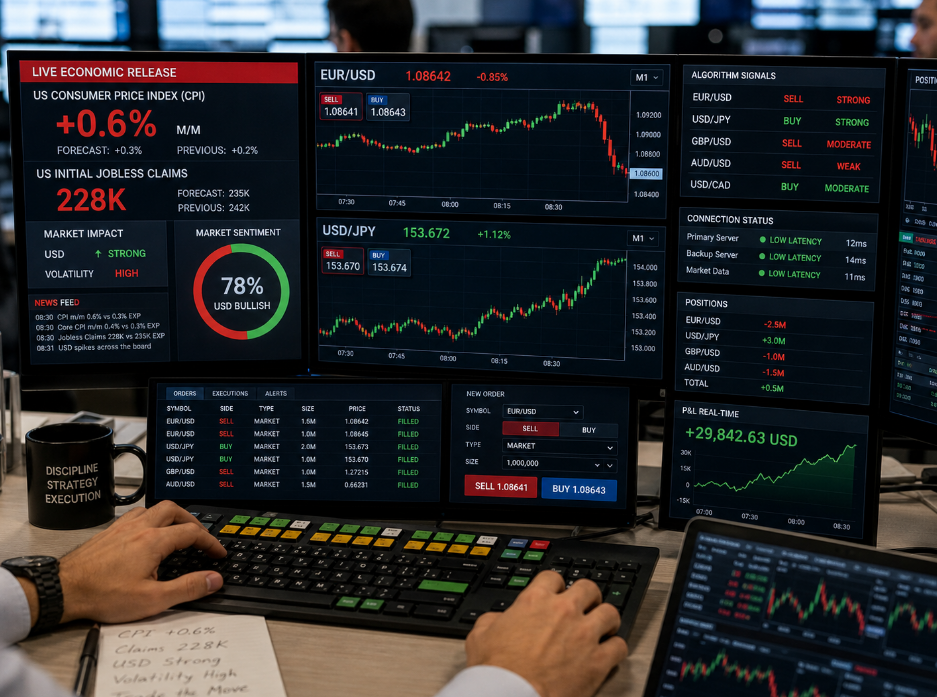
Market Surge Triggered by Macroeconomic Indicators
In active Forex Trading, explosive moves often begin with economic data.
Macroeconomic indicators shifted expectations
Funds adjusted rate outlook
Liquidity thinned fast
Inflation printed above forecast
Employment data surprised analysts
The market surge wasn’t random. It followed fresh financial news that altered central bank paths.
Inside the currency market, desks reacted in layers:
Hedge funds cut exposure
Banks widened spreads
Retail traders chased volatility
In forex trading, that chain reaction creates opportunity—if you’re ready.
Leveraging Spot Forex on an Algorithmic Trading Platform
High-speed spot forex execution sat at the core.
Algorithmic trading models scanned price gaps
Signals triggered the execution engine
Real-time feeds hit the platform
On fxbee, the automated system aligned a structured trading strategy with strict risk logic.
Within the broader foreign exchange flow:
Model detects imbalance
System confirms liquidity
Orders fire instantly
That’s practical Forex Trading, not guesswork.
Rapid Execution via Low-Latency Connectivity
Speed decided the outcome.
Low-latency connectivity reduced delay
Smart order routing optimized fills
Direct market access to liquidity hubs
In trading forex, milliseconds matter. The tight network infrastructure improved data transmission, boosting trading speed during sharp market movement.
fxbee’s setup kept slippage low while others hesitated.
Profit Capture on Major Currency Pairs
Gains came from focused exposure.
Major currency pairs:
EUR/USD
USD/JPY
Under the hood:
Active market position management
Controlled exit logic
Dynamic scaling
Clear profit capture in these currency pairs translated into measurable trading gain.
Strong execution across the asset class turned volatility into real investment return. That’s disciplined Forex Trading at full throttle.
3 Critical Steps In That $2.4M Trade
Forex Trading isn’t just clicking buy and sell. It’s timing, data, and keeping your cool when the market gets loud. In this $2.4M move, Forex Trading blended sharp analysis with clean execution. From Forex market data feeds to tight trade exits, every layer of trading in the FX market had purpose.
Step 1: Integrating Real-Time Market Data
In Forex Trading, clean inputs drive clean outputs. The backbone here was tight data integration across multiple data sources, feeding constant real-time feeds into pricing models.
Core Data Streams
Market data from tier-1 liquidity providers
Institutional streaming data for tick-by-tick updates
Central bank releases shaping short-term information flow
Analytical Processing
Alignment of macro indicators with market analytics
Cross-checking depth-of-book shifts against volatility spikes
Filtering noise from high-frequency real-time feeds
Execution Readiness
Entry signals triggered only when price, volume, and macro bias matched
Risk filters adjusted dynamically to shifting spreads
In Forex Trading, speed matters, but clarity matters more. Clean data integration reduced slippage during high-impact news. For active currency trading desks using fxbee, synchronized streaming data meant no lag between signal and order placement. That edge—tiny in seconds—scaled big in dollars.
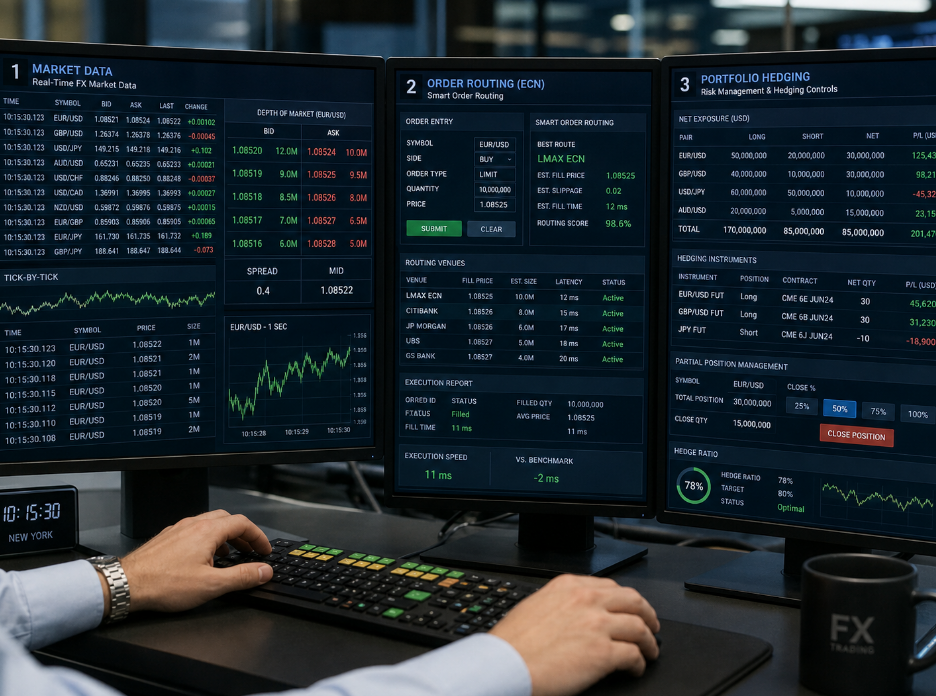
Optimizing Execution Using an Electronic Communication Network
Execution is where Forex Trading either prints or bleeds. The desk routed orders through an electronic network built for direct market access, tightening spreads and boosting execution speed.
Here’s what sharpened the trade execution:
Smart order routing across aggregated liquidity pools.
Built-in latency reduction logic to cut milliseconds.
Adaptive trading algorithms reacting to shifting bid-ask depth.
On volatile pairs, spreads narrowed from 1.2 pips to 0.6 pips during peak liquidity windows. That alone reshaped profitability.
| Currency Pair | Avg Spread (Pre-ECN) | Avg Spread (ECN) | Execution Speed (ms) |
|---|---|---|---|
| EUR/USD | 1.2 pips | 0.6 pips | 28 |
| GBP/USD | 1.8 pips | 0.9 pips | 31 |
| USD/JPY | 1.1 pips | 0.5 pips | 24 |
Tighter spreads plus optimized trade execution meant higher net gain per lot. In high-volume FX trading, that compounds fast.
A few practical tweaks made the difference:
Partial fills allowed during fast markets
Algorithmic slicing to avoid liquidity shocks
Continuous monitoring of execution optimization metrics
Forex Trading at this scale isn’t random clicking. It’s structured, monitored, and tuned in real time. Traders using fxbee tapped into that electronic network layer without babysitting every tick. The system handled the plumbing; the trader focused on bias and timing.
Closing Positions with Portfolio Hedging Strategies
Closing a $2.4M Forex Trading position isn’t about hitting “close all.” It’s layered risk management built around structured hedging strategies.
Primary Exit Layer
Scaling out at predefined resistance levels
Monitoring residual market exposure through volatility bands
Secondary Protection
Offsetting spot positions with currency futures
Short-dated forwards reducing overnight risk mitigation pressure
Portfolio Control
Dynamic portfolio rebalancing after partial profit-taking
Continuous review of derivatives-based overlays
As price approached target zones, partial position closing locked gains. Remaining exposure was hedged using correlated futures, trimming directional market exposure without killing upside.
In practical terms:
Spot long EUR/USD reduced by 60%
40% exposure offset via short-term futures
Net delta lowered while maintaining positive carry
Forex Trading at scale demands disciplined portfolio hedging. A single macro headline can flip sentiment in minutes. With layered derivatives protection, downside stayed capped while upside remained open long enough to complete the move.
By the time the final tranche closed, cumulative profit crossed $2.4M. No drama. Just structured FX trading built on solid risk management.
That’s the real takeaway. Forex Trading success isn’t hype—it’s clean market data, precise trade execution, and smart hedging strategies. Do that consistently, and currency trading stops feeling chaotic. It starts feeling calculated.
4 Risk Controls Behind The $2.4M Strategy
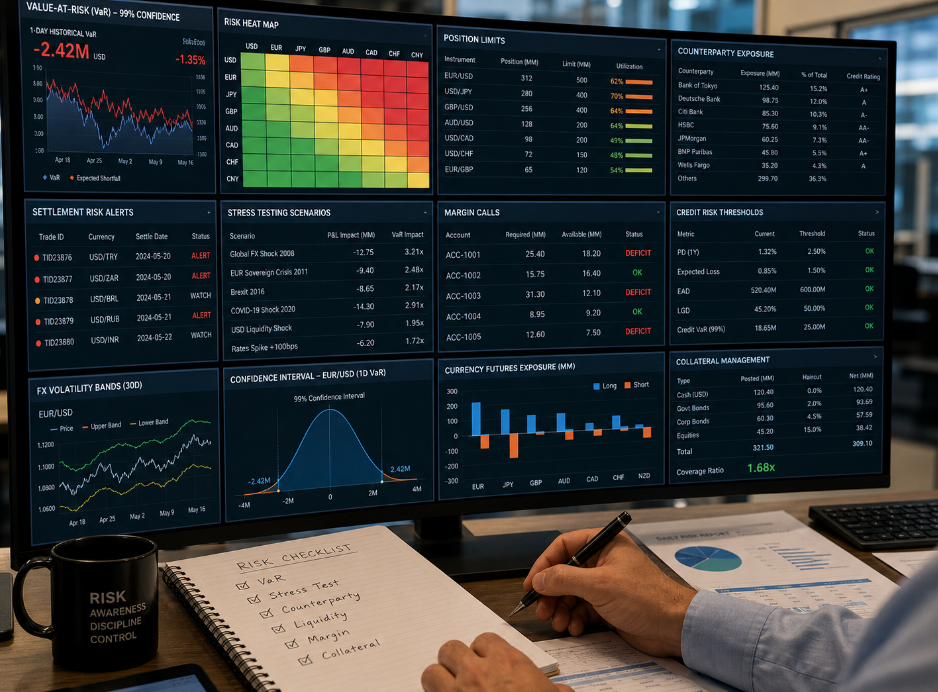
Forex Trading isn’t just charts and gut feelings. Serious currency trading runs on tight risk math. Here’s how disciplined controls kept this Forex market strategy steady while scaling capital.
Value-at-Risk Models for Position Sizing
In Forex Trading, position sizing begins with Value-at-Risk and disciplined Risk quantification.
Core Model Layers
Pre-set Position limits
Dynamic Capital requirements
Rolling 30-day volatility inputs
95% and 99% Confidence interval outputs
Aggregated spot and futures exposure
Cross-pair correlation impact
Portfolio risk measurement
Risk aggregation engine
Capital guardrails
Sample VaR Snapshot
| Pair | 1-Day VaR (95%) | Position Size ($) | Volatility % | Limit Utilization % |
|---|---|---|---|---|
| EUR/USD | 1.8% | 400,000 | 9.2 | 62 |
| GBP/USD | 2.1% | 320,000 | 10.5 | 58 |
| USD/JPY | 1.5% | 500,000 | 8.1 | 66 |
| AUD/USD | 2.4% | 210,000 | 11.7 | 49 |
| USD/CAD | 1.9% | 350,000 | 9.8 | 61 |
On fxbee, these metrics sync directly into trading dashboards, keeping Forex Trading risk tight and boring—in a good way.
Counterparty Risk Assessment
Foreign exchange exposure doesn’t stop at price charts.
Counterparty Review Stack
Collateral management thresholds
Early warning on Credit default
Updated Credit ratings
Default probability signals
Netting agreements
ISDA documentation checks
Net open settlement values
Counterparty exposure tracking
Legal protections
Financial strength review
Protection tools
Add steady Due diligence and real-time Settlement risk monitoring, and currency trading risk stays controlled instead of chaotic.
Stress Testing Frameworks in Forex Markets
Forex market shocks hit fast. Stress frameworks simulate:
Macro spikes
Rate surprises in Foreign exchange majors
Liquidity squeezes and Liquidity shocks
Extreme Market volatility
200–400 pip swings
Correlation breakdowns
System impact
Portfolio Risk resilience
Broader Systemic risk
Each Scenario analysis feeds back into position sizing. Forex Trading stays flexible, not reckless.
Credit Risk Monitoring on Currency Futures
Currency futures demand tight oversight.
Exposure Chain
Daily Margin calls tracking
Clearinghouse Default risk review
Aggregated Derivatives exposure
Ongoing Controls
Real-time Risk surveillance
Tiered Collateral management buffers
Stress-linked Credit risk thresholds
Forex Trading at scale isn’t hype. It’s discipline. On fxbee, currency trading systems keep risk visible, numbers transparent, and decisions grounded in data—not vibes.
Can You Replicate A $2.4M Forex Trading Win?
Big wins in Forex Trading look flashy online, but pulling off a $2.4M gain in forex trading takes more than luck. It demands serious tech, sharp currency trading models, and clean regulatory footing. Let’s break it down.
Assessing Institutional Trading Platform Requirements
Serious Forex Trading at scale rests on layered infrastructure and precise execution.
Core platform Stack
1.1 Institutional-Grade Trading Engines
1.2 Prime Brokerage Connectivity
Tier-1 liquidity providers
Aggregated multi-bank price feeds
Ultra-low latency matching
Smart order routing for global forex trading
Hardware & Technology Backbone
2.1 High-frequency servers
2.2 Encrypted cross-border connectivity
2.3 Redundant infrastructure clusters
Risk & Control Environment
3.1 Pre-trade risk filters
3.2 Real-time margin analytics
3.3 Post-trade reconciliation systems
The Bank for International Settlements noted in its 2025 Triennial FX review that daily FX turnover remains above $7 trillion, reinforcing how deep and competitive Forex Trading has become. Competing in foreign exchange trading means your institutional setup must match that scale.
Platforms like fxbee integrate these requirements into one streamlined environment, making serious forex trading operations feel less chaotic and more controlled.
Building Scalable Quantitative Strategies
Winning in Forex Trading starts with sharp strategies, but scaling them is where real money shows up.
• Clean data pipelines using tick-level feeds
• Adaptive algorithms reacting to volatility spikes
• Continuous backtesting across multi-year cycles
Model Design
Statistical arbitrage models
Trend-following currency trading systems
News-driven FX trading signals
Validation
Walk-forward optimization
Stress testing against black swan events
Deployment
→ API-linked execution
→ Latency monitoring
→ Live performance attribution
The IMF’s 2024 Global Financial Stability Update warned that algorithmic concentration can amplify volatility in Forex Trading during macro shocks. That’s why scalable quantitative systems must stay flexible.
With fxbee, traders can test, refine, and scale forex trading strategies without rebuilding the entire stack every quarter.

Ensuring Dodd-Frank and MiFID II Compliance
High-profit Forex Trading without compliance is a fast track to shutdowns.
Regulatory Framework Alignment
1.1 Dodd-Frank Swap reporting
1.2 MiFID II transaction transparency
1.3 Cross-border regulations mapping
Monitoring & Reporting Systems
2.1 Automated trade logs
2.2 Suspicious activity flags
2.3 Audit-ready archives
Governance & Oversight
3.1 Internal legal reviews
3.2 Independent compliance audits
3.3 AML and KYC enforcement
The European Securities and Markets Authority stated in its 2024 supervisory briefing that stricter transaction reporting standards remain a top enforcement priority under MiFID II.
In foreign exchange trading, regulators don’t play around. Clean oversight keeps large-scale Forex Trading sustainable, protecting both capital and reputation.
References
[Bank for International Settlements - https://www.bis.org]
[SEC ECNs/Alternative Trading Systems - https://www.sec.gov]
[CLS FX Settlement Risk - https://www.cls-group.com]
[CME Group Futures & Options Trading for Risk Management - https://www.cmegroup.com]
[IMF Global Financial Stability Report October 2024 - https://www.imf.org]
[ESMA Guidelines on Transaction Reporting, Order Record Keeping and Clock Synchronisation under MiFID II - https://www.esma.europa.eu]
[CFTC Dodd-Frank Act - https://www.cftc.gov]
[Federal Reserve Monetary Policy Report - https://www.federalreserve.gov]
FAQ
How did a $2.4M profit happen within minutes in Forex Trading?
A sudden shock in macroeconomic indicators shifted expectations around central banks, and the reaction was instant.
1) Trigger
Inflation and employment data hit the wires.
Real-time market data and sentiment analysis signaled imbalance in major currency pairs like EUR/USD and USD/JPY.
2) Execution Chain
An algorithmic trading platform connected through low-latency connectivity and co-location services.
Orders routed via an electronic communication network to multiple liquidity providers.
The prime brokerage system optimized fills inside milliseconds.
3) Strategy Core
Quantitative models scanned historical tick data.
Arbitrage opportunities and high-frequency trading logic activated automatically.
In fast markets, speed is emotionless. The edge lies in preparation, not prediction.
What defines an institutional-grade Forex Trading platform?
Serious capital demands serious infrastructure.
A. Technology Backbone
High-frequency trading servers inside secured data center solutions.
API integration with multi-asset trading systems.
Network security protocols protecting order flow.
B. Functional Architecture
Order management system for allocation and compliance tracking.
Execution management system for smart routing across spot forex, forward contracts, and currency futures.
Access to major, cross currency pairs, and exotic currency pairs.
C. Participant Access
Institutional investors, hedge funds, sovereign wealth funds, and corporate treasuries operate through prime brokers connected to deep liquidity pools.
Without this stack, scaling Forex Trading turns fragile under pressure.
How is risk controlled in high-volume Forex Trading?
Large exposure is thrilling; unmanaged exposure is fatal.
➤ Market Risk Layer
Value-at-risk models set position limits across spot forex and non-deliverable forwards.
Market risk analytics track volatility spikes in cross currency pairs.
➤ Stress Layer
Stress testing frameworks simulate rate shocks from central banks.
Portfolio hedging strategies offset gains using currency futures or forward contracts.
➤ Credit & Operations Layer
Counterparty risk assessment of liquidity providers and prime brokers.
Credit risk monitoring tied to margin at clearing venues.
Operational risk management to flag execution anomalies.
Disciplined risk control allows bold positioning without emotional collapse.
Why is compliance central to modern Forex Trading?
Big profits attract scrutiny; survival depends on discipline.
1. Regulatory Alignment
Dodd-Frank Act reporting for derivatives.
MiFID II transparency rules.
EMIR regulations for clearing obligations.
2. Client Integrity Controls
Anti-money laundering screening.
Know-your-customer verification.
Ongoing regulatory reporting and market abuse prevention checks.
3. Practical Impact
Trades in currency futures or non-deliverable forwards pass through structured oversight before settlement.
In Forex Trading, compliance is not paperwork—it is the license to stay in the game.