
Before placing a trade, it is useful to know what a price move could mean in account-currency terms. You can work it out by hand, and that skill helps you understand pips, lot size, quote currency, and trading costs. But when you need to compare several pairs, position sizes, or exit levels, a forex profit calculator can make the same estimate faster and easier to check.
The key word is estimate. A calculator can standardize the arithmetic; it cannot predict the market or guarantee the amount ultimately credited to an account. Spread changes, commissions, overnight financing, slippage, conversion rates, and broker-specific contract rules can all affect realized P/L.
Quick answer: calculator for speed, manual math for understanding
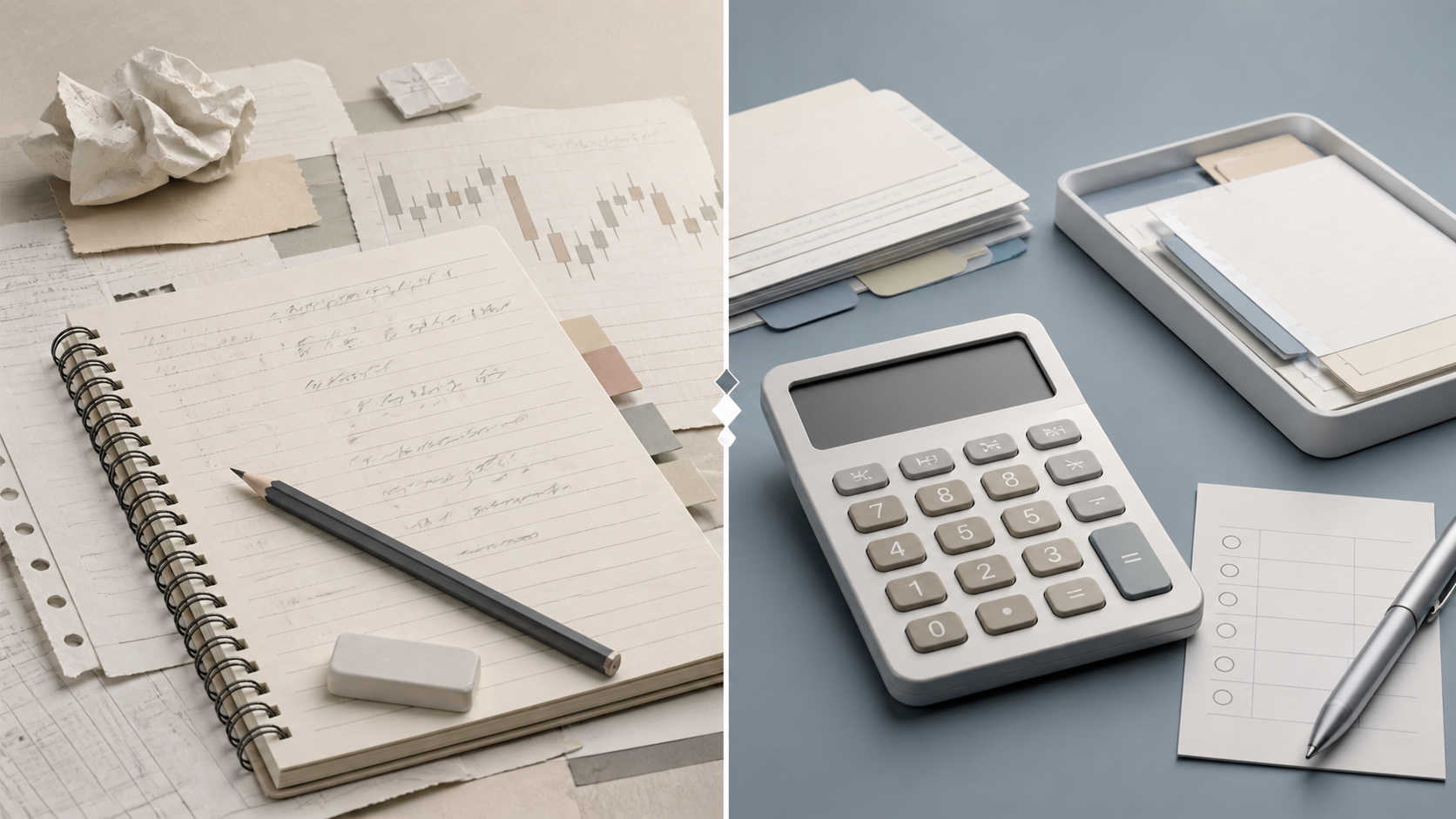
Manual calculation is valuable when learning a pair’s pip convention, verifying a quote, or checking whether a tool uses the assumptions you intended. A calculator is usually the practical choice when trade inputs change often or when you are comparing scenarios. The strongest workflow uses both: understand the math once, then use a tool to repeat it consistently.
| Question | Manual calculation | Forex profit calculator |
|---|---|---|
| Best use | Learning, spot checks, and simple one-pair examples | Repeated planning and comparing several scenarios |
| Speed | Slower as inputs multiply | Usually immediate once inputs are entered |
| Accuracy risk | Arithmetic, decimal, pip-value, and conversion mistakes | Wrong settings, stale prices, or omitted costs |
| Transparency | Every assumption is visible | Depends on whether the tool shows its inputs and assumptions |
| What it cannot do | Predict execution or future prices | Predict execution or future prices |
What a forex profit calculator is actually calculating
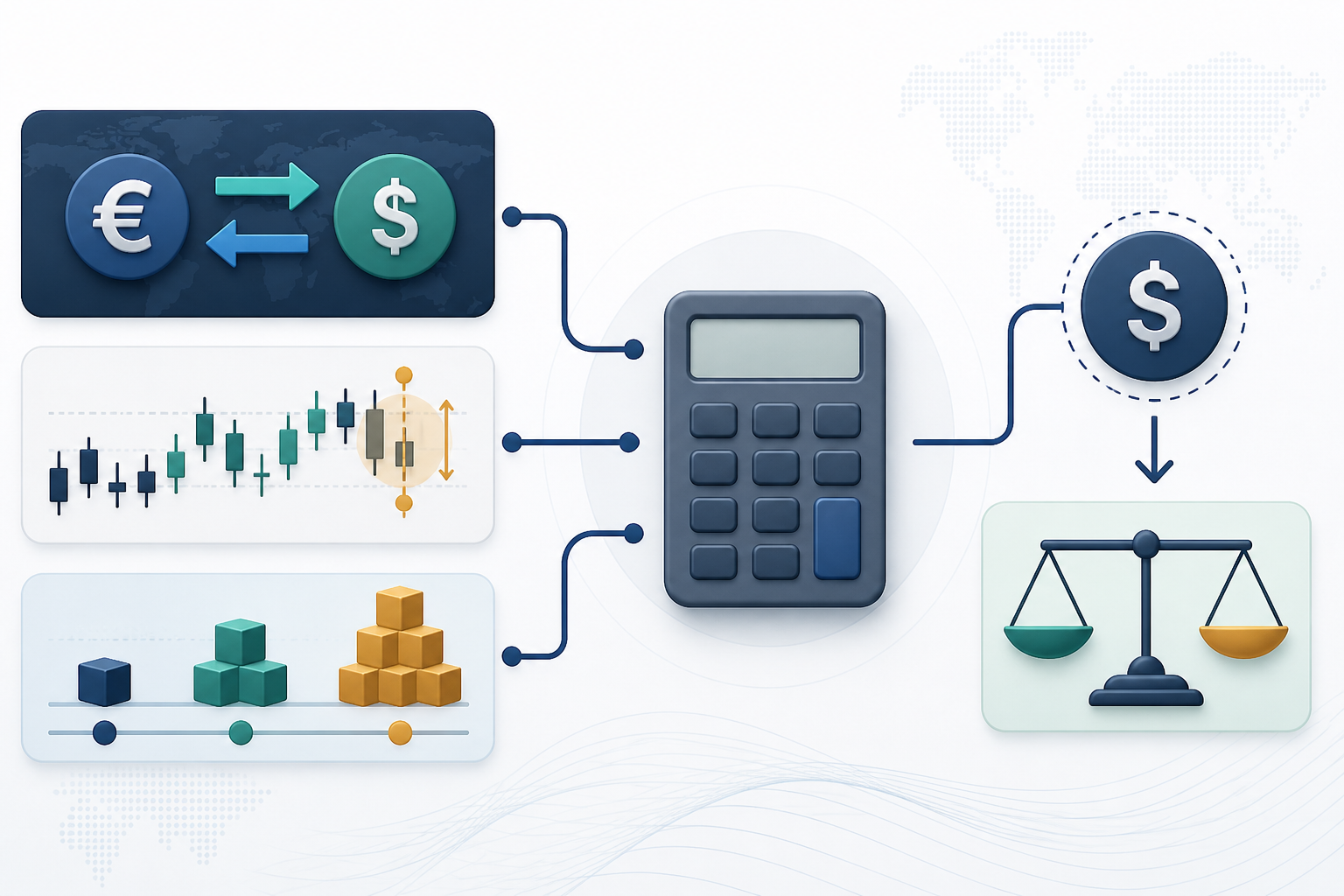
At its simplest, profit or loss comes from the price difference between entry and exit, multiplied by the size of the position. The result may then need conversion into the account currency. A useful tool asks for the currency pair, direction, entry price, exit price, trade size, and account currency. Some tools also let you model spread, commission, swaps, or other costs.
A simplified expression is:
Estimated gross P/L = price movement × units traded
For a pip-based view:
Estimated gross P/L = pip movement × pip value × number of lots
The calculation is simple in principle, but the pip value is not identical for every pair or account currency. JPY pairs commonly use a different displayed decimal convention, and cross pairs can require a currency conversion. That is why copying a convenient “$10 per pip” rule into every trade can be wrong.
How to calculate forex profit manually
Use a manual calculation when you want to inspect the assumptions rather than simply receive an output. Start with the contract specifications supplied by the broker for the exact instrument and account type.
Identify whether the position is long or short.
Find the price movement: exit minus entry for a long position, or entry minus exit for a short position.
Convert that movement into pips using the pair’s pip convention.
Confirm the pip value for the position size and account currency.
Multiply pip movement by pip value and number of lots.
Subtract applicable spread, commission, financing, and conversion costs to move from gross to a more complete estimate.
Illustrative EUR/USD example
Suppose a trader buys one standard lot of EUR/USD at 1.0800 and closes at 1.0850. The move is 50 pips. With a commonly used illustrative pip value of $10 for one standard lot when USD is the quote and account currency, the gross estimate is 50 × $10 = $500. This excludes costs. If a spread, commission, or overnight charge applies, the realized result may be lower; different account currencies or contract specifications can also change the value.
For a short trade, the directional subtraction reverses: the position benefits when the exit price is below the entry price. The position size and cost checks still apply.
Where manual calculations go wrong
Most errors are not advanced mathematics. They are small assumption errors repeated under time pressure:
Counting pipettes (one-tenth of a pip) as full pips.
Using a standard-lot pip value for a mini or micro lot.
Applying the EUR/USD convention to a JPY pair or a cross pair.
Forgetting that a trade opens at one side of the quote and closes at the other.
Comparing gross P/L with an account statement’s net P/L.
Ignoring commission, swaps, conversion charges, or the broker’s contract specification.
These errors matter because forex is commonly traded with leverage. The U.S. Commodity Futures Trading Commission (CFTC) notes that leverage can amplify gains and losses, and that retail OTC forex involves additional dealer and margin considerations. Review its customer advisory on forex trading before treating any calculated estimate as a risk limit.
Why a forex profit calculator saves time
A calculator earns its place when a plan has several moving parts. Instead of rebuilding the pip value and conversion math every time, you can change one input—such as lot size, stop level, or target—and compare the resulting estimates. That makes it easier to keep position sizing and risk planning separate from the emotional pull of a live price move.
Time savings are especially noticeable when you:
Compare the same idea across multiple currency pairs.
Test several exit targets or stop levels.
Switch among account currencies or lot sizes.
Need a quick pre-trade gross P/L estimate and a separate cost checklist.
Want to verify a platform’s displayed value with an independent calculation.
Speed is not the same as certainty. Entering 0.10 lots instead of 1.00 lots, selecting the wrong account currency, or using an outdated quote will produce a precise-looking but unhelpful number. Treat the calculator’s input fields as a pre-trade checklist.
Accuracy: the tool is only as good as its assumptions
A calculator can reduce arithmetic slips, but it does not automatically know your execution conditions. Check whether it uses live or delayed prices, how it defines a pip, whether it includes spread or commission, and whether its contract size matches your broker. For a trade held overnight, check financing separately; it may not be reflected in a basic P/L estimate.
For U.S. readers, broker eligibility and registration deserve a separate check. The CFTC advises prospective customers to research OTC forex dealers and verify registration and disciplinary information. A calculator is a planning aid, not a substitute for reviewing a broker’s disclosures, account agreement, margin rules, withdrawal terms, and current costs.

A practical calculator workflow
Confirm the exact currency pair and whether your idea is long or short.
Enter the proposed entry and exit or stop price using the same quote precision as the broker.
Set the contract size or lot size precisely.
Select the account currency and confirm any conversion assumption.
Record the gross estimate, then list spread, commission, and potential financing separately.
Compare the possible loss at the stop with the amount you have decided you can risk.
Recheck the order ticket and current broker specifications before submitting a live order.
If you use a rebate service as part of your cost review, keep that analysis separate from the trade’s gross P/L. FXBee’s broker comparison page lists rebate information by broker and account type, while its support center describes its role as a third-party platform rather than a trade-execution or investment-advice provider. Rebate rates, eligibility, and payment methods can change, so confirm the relevant current terms before relying on them in a trading-cost estimate.
When manual calculation is still the better choice
Do the math manually at least often enough to understand the result. It is useful for checking a calculator that returns an unexpected number, validating a broker statement, studying a new instrument, or learning why a cross-pair pip value changes with the account currency. Manual work is also a good defense against entering an incorrect lot size or confusing a pip with a point.
For ordinary scenario planning, however, use a calculator after you understand the setup. The gain is not just speed; it is consistency. A repeatable input process makes it easier to notice omitted costs and compare like with like.

Bottom line
Use manual math to understand the moving pieces; use a forex profit calculator to repeat the process without redoing routine arithmetic. In either case, distinguish gross from net P/L and validate the inputs against the broker’s current specifications. Calculated profit is a scenario, not a forecast, and leveraged forex trading can result in substantial losses.
Frequently asked questions
What is a forex profit calculator?
A forex profit calculator estimates the gross profit or loss of a proposed currency trade from inputs such as pair, direction, entry, exit, position size, and account currency. Its result is an estimate, not a forecast or a guarantee of realized P/L.
Is a forex profit calculator more accurate than manual calculation?
It can reduce arithmetic and conversion mistakes, but only when the inputs and contract assumptions are correct. A manual calculation using the same correct inputs can reach the same estimate. Neither method automatically captures all execution costs.
Does a calculator include spread and commission?
Some tools do and some show only gross P/L. Check the fields and documentation. If costs are not included, record spread, commission, swap or financing, and any currency-conversion charge separately before comparing the result with a statement.
How do I calculate profit for a long forex trade?
For a long position, subtract entry price from exit price, convert the movement into pips where appropriate, and multiply by the pip value and position size. Then account for applicable trading and financing costs. The pip value depends on the pair, size, and account currency.
How do I calculate profit for a short forex trade?
For a short position, subtract exit price from entry price. A lower exit than entry creates a positive gross price movement for the short. Multiply by the verified pip value and lot size, then include all applicable costs.
Why is my realized forex P/L different from my calculation?
Differences can come from bid/ask spread, slippage, commission, overnight financing, conversion rates, partial fills, or contract specifications. Compare your estimate with the broker’s trade confirmation and current fee schedule to identify the relevant item.
Are pips and pipettes the same thing?
No. A pipette is commonly one-tenth of a pip. Many platforms display fractional-pip pricing, so confirm the quote precision before counting a movement or entering an exit price into a calculator.
Why does pip value change on some currency pairs?
Pip value reflects the instrument’s quote currency, contract size, and your account currency. JPY pairs use a different pip convention, and cross pairs can require a conversion. Verify values using the broker’s current specifications for the account you use.
Can a profit calculator determine my position size?
Some calculators can model position size once you supply a risk amount and stop distance. Treat that output as a planning estimate, then confirm margin, minimum trade size, and other constraints with the broker before placing an order.
Can rebates be included in forex trade-profit calculations?
They can be assessed separately as part of a trading-cost review, but eligibility, rates, settlement timing, and account type matter. Do not treat a potential rebate as a guarantee of profit or substitute it for a complete risk calculation.
Important risk note
This article is educational and not investment, legal, or tax advice. Forex and CFDs can involve leverage and substantial risk, including loss of capital. U.S. traders should verify a dealer’s registration and disciplinary history, review applicable disclosures and account terms, and consider whether the risks are appropriate for their circumstances.