

Choosing the right Forex Trading Platforms 2026 isn’t just about checking boxes—it’s about picking the tech that’ll keep your business sharp, fast, and ahead of the pack. If you're running a brokerage or building one, the tools you use aren't just software—they're your frontline.
Thing is, there’s no shortage of platforms promising the moon. But when real money’s on the line and your clients expect lightning-speed trades, airtight security, and clean UX across devices, you can’t afford to guess.
We’ve heard it straight from Fxbee’s lead engineer: “Most firms don’t lose trades—they lose trust. Our job is to protect both.” That means getting serious about what platforms can actually deliver under pressure.
This guide filters the noise and breaks down what matters—speed, stability, security, and smart tools for brokers and serious traders.
No fluff, just what you need to know to make a call that sticks.
7 Key Factors for Choosing a Forex Trading Platform in 2026
Trading Technology Integration for Scalable Brokerage Operations
When your brokerage grows, your tech either scales with you—or breaks you.
API connectivity: Lets you plug your platform into your CRM, payment gateways, and liquidity bridge without drama.
MT5 & middleware: MT5’s flexibility plus middleware support keeps your back-end sharp and agile.
Cloud hosting: Multi-region deployment reduces latency and improves uptime.
Data standardization: Clean, normalized data between front, middle, and back office to stop reconciliation nightmares.
Event-driven architecture: Real-time processing of orders, margin changes, and risk events.
The right tech stack doesn’t just keep trades flowing—it keeps support tickets, manual fixes, and compliance headaches under control.
Regulatory Compliance Features: A Must-Have for Institutional Clients
This is where most new brokers mess up.
KYC protocols: No shortcuts here. Onboarding must be secure and compliant.
AML monitoring: Automated alerts and real-time checks help prevent shady flows.
Licensing support: Platforms with built-in licensing frameworks save time.
Reporting and audit trail: Clear logs that satisfy even the pickiest regulators.
"Compliance is more than ticking boxes—it’s the foundation of trust with clients and regulators."
— Angela B., Compliance Director at Fxbee
Advanced Risk Management Tools for Multi-Account Control
One misstep in risk, and boom—goodbye clients.
MAM & PAMM systems – Efficiently manage client funds with flexible split strategies.
Stop-loss and drawdown alerts – Triggered automatically to protect portfolios.
Hedging tools – Essential for volatile news releases and high-exposure trades.
Margin call automation – Prevents overexposure by protecting both trader and broker.
Exposure visibility – Real-time dashboards for risk managers are non-negotiable.
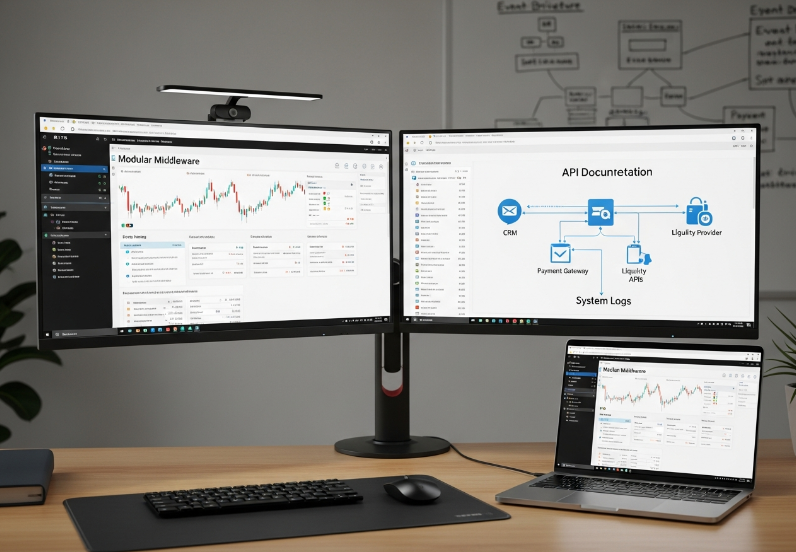
Customizable Platform Infrastructure for B2B Deployment
It’s your brand, your flow. The platform should feel like yours.
SDK access for adding unique brokerage features.
White-label branding so everything from UI/UX to login screens fits your identity.
Modular builds that adapt to growth or niche offerings.
API-first architecture to snap in extra tools without a rebuild.
Front-end tweaks for localization, theming, and regional preferences.
If you’re onboarding IBs, partners, or sub-brokers, this flexibility is what keeps everyone happy without building five different systems.
Execution Mechanisms That Support High-Frequency and Algorithmic Trading
Execution quality is your brokerage’s heartbeat.
Sub-100ms trade execution is the minimum standard for active day traders and scalpers.
STP & ECN routing: Smart routing reduces requotes and improves fill quality for fast markets.
Order types: Stop, limit, OCO, trailing stops, bracket orders, and partial fills should all be standard.
Smart liquidity aggregation: Chooses the best price from connected banks, ECNs, and LPs.
Failover systems: If one liquidity provider breaks, execution reroutes instantly—no downtime drama.
Real-Time Market Data and Sentiment Analytics for Broker Insights
Great platforms don’t just show charts—they show context.
Economic calendars baked into the terminal so traders see impact events in real time.
Multi-timeframe charts with common indicators (RSI, MACD, Bollinger Bands, Ichimoku, etc.).
Depth-of-market (Level II) view to see liquidity and order book pressure.
News & sentiment feeds from professional wires and alternative data sources.
Broker dashboards that combine order flow, client P&L trends, and risk at a glance.
You’re not just giving traders a screen—you’re giving them information that keeps them on your platform instead of jumping to third-party tools.
Scalability and White-Label Capabilities for Brokerage Growth
You might be small now—but the right platform assumes you won’t stay that way.
Multi-brand support: Run several brands or white-label offerings from one core.
Flexible fee structures: Different spreads, commissions, and swaps per group or brand.
Partner & affiliate layers: Track IBs, affiliates, CPA deals, and revenue-sharing without spreadsheets.
Regional routing: Adjust leverage, instruments, and compliance per jurisdiction.
Performance monitoring: Know which partners and segments are driving real volume, not just signups.
MT4 vs. MT5 vs. Proprietary Platforms
Execution Speed and Order Types
Legacy platforms still have their place—but 2026 isn’t forgiving to slow tech.
| Platform | Typical Latency* | Slippage Rates* | Order Type Coverage |
|---|---|---|---|
| MT4 | ~125ms | Higher | Basic but familiar |
| MetaTrader 5 (MT5) | ~90ms | Moderate | Advanced pending + netting |
| Proprietary | ~50ms or lower | Lower | Full customization possible |
*Illustrative ranges based on common broker setups.
MT4: Still loved by many retail traders, but aging in terms of speed and flexibility.
MT5: Multi-asset capable with deeper timeframes, more indicators, and better order handling for serious day traders.
Proprietary platforms: Can be optimized around your exact execution model and infrastructure.
Support for Smart Contracts and API Access
Modern brokerages don’t just need charts—they need programmable infrastructure.
REST & WebSocket APIs for high-frequency algos and trade copying.
Smart contract hooks for on-chain settlements, loyalty, or tokenized products.
Server-side strategy hosting so algos don’t die when a trader’s laptop does.
Platforms that expose secure, well-documented APIs are the ones that attract quant traders, fintech partners, and serious volume.
Multi-Asset Support and Cross-Platform Interfaces
Day traders in 2026 rarely touch just FX.
FX, indices, commodities, crypto, and equities in one login.
Cross-margin & portfolio margin across assets.
Web, desktop, and mobile that sync watchlists, layouts, and alerts.
This isn’t a luxury anymore—it’s baseline expectation for competitive brokers.
Broker Control Over Customization and Data Ownership
Owning your client data, logs, and configurations is what lets you:
Run custom analytics on order flow.
Build in-house dashboards for risk and marketing.
Avoid getting locked into one vendor forever.
Proprietary or semi-proprietary solutions shine here, especially where you control hosting and data pipelines.
Types of Forex Trading Platforms in 2026
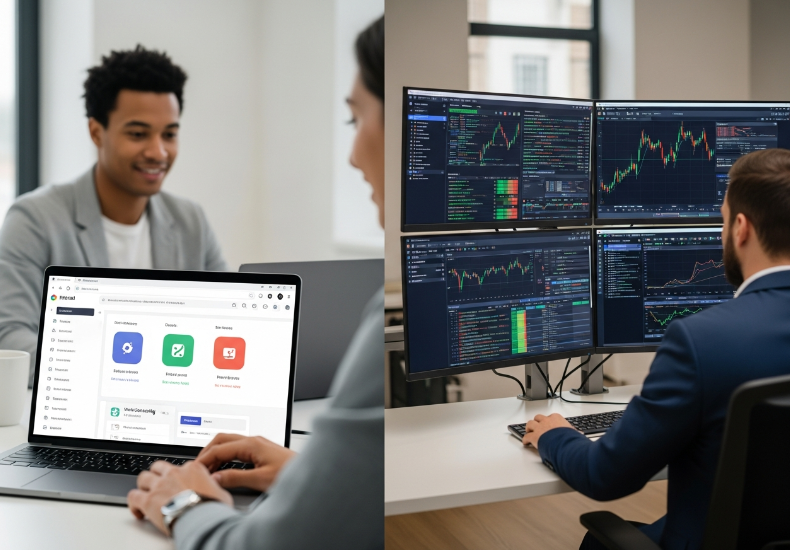
Retail-Focused vs. Institutional-Grade Interfaces
Retail-focused platforms: Smooth onboarding, simplified UI, and guardrails to avoid rookie mistakes.
Institutional-grade terminals like Bloomberg cater to banks, funds, and desks that live inside advanced analytics and multi-screen workflows.
The trick for many brokerages? Offering something that feels friendly enough for serious retail traders but doesn’t frustrate pros who expect depth.
Cloud-Based Hosting vs. On-Premise Deployment
Cloud and on-prem each have their fans:
Cloud-based platforms
Faster deployment
Easier scaling during volatility spikes
Often better uptime SLAs
On-premise setups
More control over data residency and hardware
Appealing to brokers in jurisdictions with stricter data rules
Hybrid models are increasingly common—core trading in the cloud, with regional edge servers for latency-sensitive routing.
Copy Trading Systems and Social Trading Networks
Copy trading isn’t just for beginners anymore—it’s evolved into a strategic community-driven tool for brokerages.
Mirror Trading lets clients clone real-time trades
PAMM accounts help brokers manage pooled funds
Platforms like ZuluTrade provide live Leaderboards
Users love Transparency and accessible Portfolio cloning
Builds a sense of Community among users
Copy trading can boost your client retention, especially among new entrants who’d rather follow proven traders than go solo—provided your platform supports real-time updates and vets Signal Providers to avoid chaos.
Integration with Distributed Ledger Technology
It’s not all crypto hype—Distributed Ledger Technology (DLT) is changing how brokerages manage execution and back-end operations.
“Smart Contracts cut settlement time from hours to seconds,” says Elena Myles, Senior Blockchain Developer at Fxbee.
By integrating blockchain, tokenization, and DeFi rails alongside traditional rails—and as central banks push CBDC pilots—expect DLT to become standard, not special, especially for settlement, collateral management, and programmable payouts.
Compliance Modules for Regional Regulatory Standards
| Region | Key Regulation | Licensing Required | KYC Level |
|---|---|---|---|
| EU | MiFID II, GDPR | Investment Firm License | High |
| UK | FCA Handbook (CFD/FX) | FCA Authorization | High |
| Australia | ASIC | AFSL | Medium–High |
| Middle East | DFSA/ADGM/SAMA | Local Brokerage Licensing | Medium–High |
| Offshore | Variable (FSC/IFSC) | Local Securities License | Medium |
Platforms that map settings—like leverage caps, marketing restrictions, and instrument availability—to regulatory zones give you control without spinning up separate systems for every region.
Security Features That Protect Your Forex Trades
Segregated Client Accounts and Negative Balance Protection
Smart brokers treat client funds like sacred.
Segregated accounts ensure client money is held separately from operational funds, acting as a financial firewall.
Negative balance protection ensures traders can’t lose more than they deposit, even in extreme volatility.
Automated margin calls and stop-out levels protect both broker and client from catastrophic spirals.
Stress-testing tools let you run “what if” scenarios on positions during news events.
This setup helps prove you're playing by the rules—and not gambling with customer money.

Data Encryption and Secure Socket Layers in Trading Terminals
Wanna stop hackers cold? Here’s what top forex platforms use under the hood:
| Protocol | Use Case | Strength | Deployment Scope |
|---|---|---|---|
| TLS 1.3 | Data in transit | High (supports AES-256) | Terminals & APIs |
| SSL Certificates | Server identity validation | Moderate | Public interfaces |
| HTTPS | Browser terminal access | Essential | Client-side trading |
AES-256 encryption gives bank-level protection.
Firewalls plus end-to-end security build solid client confidence.
Fxbee cybersecurity engineer Leo Kim says:
"Encryption isn’t optional—it’s your handshake with your client's trust."
Multi-Layer Authentication and Session Monitoring
2FA secures access at login using phone codes or authentication apps.
Biometric login and SMS verification give extra flexibility.
IP whitelisting limits where logins can even happen.
Session timeout prevents forgotten logins from being hijacked.
Login alerts help flag unusual behavior fast.
Together, these stack up as serious guardrails against hijacking, shared credentials, or lazy logouts. No one gets in unless they're supposed to.
Investor Compensation Schemes and KYC Protocols
FSCS & ICF style protections offer peace of mind that clients’ funds are protected if the broker fails, from UK-style compensation schemes to CySEC’s investor fund rules.
Due diligence: Brokerages need a KYC-ready platform to verify identity, proof of address, and risk level.
AML compliance: Automation of anti-money laundering checks helps pass regulatory oversight audits.
Client trust: Compensation schemes are often the last line of defense in crisis—and a strong selling point to bigger accounts.
Audit Trails and Transaction Reporting Requirements
In regulated markets, every order, quote, and confirmation needs to be traceable.
Full trade logs with timestamps down to the millisecond.
Edit histories on orders, cancellations, and modifications.
Export tools for regulators and internal audits in standardized formats.
When clients request a ledger of trades or regulators call for data, you want to deliver in minutes—not hours. This makes or breaks your credibility as a brokerage.
Too Many Choices? Top 5 Forex Platforms Ranked for 2026
Top 5 Forex Platforms at a Glance
| Platform Name | Best For | Notable Feature | Weak Spot |
|---|---|---|---|
| MetaTrader 5 (MT5) | Multi-asset day trading | Deep technical analysis tools | Interface feels outdated to some |
| cTrader | Fast execution | Built-in Level II pricing | Customization is a bit limited |
| Fxbee Pro | Brokerage scalability | Smart contract execution | Slightly steep learning curve |
| TradexEdge | API access for automation | Real-time market depth | Few native charting tools |
| SpeedFX Core | High-frequency traders | Sub-second latency | Lacks strong mobile app support |
Why These 5 Made the Cut
MetaTrader 5 (MT5)
Still the go-to for day traders who want access to dozens of instruments, algorithmic trading via Expert Advisors, and solid technical tools. Multi-asset support, 21 timeframes, and depth-of-market functions make it a reliable workhorse for brokers and traders alike.cTrader
Built for traders who love clean UX and razor-sharp execution. Level II pricing, advanced order controls, and robust ECN routing make it a favorite for scalpers and active traders who care about transparency in the book.Fxbee Pro
Designed for brokerages that want scalability and programmable infrastructure. Smart contract integration, flexible routing, and advanced risk dashboards make it ideal for firms experimenting with tokenized products and new revenue models.TradexEdge
Traders who are into API-powered tools and copy trading setups feel at home here. Its focus on data access, market depth, and risk management add-ons like equity protection and exposure monitoring speaks to quant-minded teams.SpeedFX Core
Newer on the scene but catching serious attention. With sub-second latency and infrastructure tuned for high-frequency and algorithmic trading, it’s a natural fit for firms offering advanced algo hosting or ultra-fast execution.
Quick-Check: What Matters Most to Your Firm?
Speed & execution quality?
MT5, cTrader, and SpeedFX Core are your first stops.Smart contracts and DLT integration?
Fxbee Pro and similar proprietary platforms will feel more future-proof.API-first, automation-heavy workflows?
TradexEdge and SpeedFX Core give your dev team more to play with.Simple but powerful multi-asset access?
MT5 works well as a default starting point for many brokers.
Broker’s Word from the Street
“We moved our active traders to a low-latency proprietary stack and kept MT5 for everyone else. Best decision we made—power users got their speed, and we didn’t alienate our main client base.”
— Liam Carter, Head of Trading, NorthBridge Markets
“Our compliance team sleeps better now. The platform’s audit trails and built-in regulatory reporting saved us weeks during our last review.”
— Angela B., Compliance Director at Fxbee
“For our multi-asset setup, having strong risk control, decent margin call alerts, and fast switching across accounts was non-negotiable. Fxbee Pro nailed it.”
— Carlos Mendez, CTO, AtlasWave Brokerage (Miami)
“Our day traders love cTrader's ECN order book—especially for scalping. It’s not just flashy, it saves real money on spreads.”
— Rachel Stein, Product Manager, BlueSide FX
Decision Hack: Match Tools to Your Traders
Don’t just go by brand. Look at what your clients trade, how often they trade, and how sensitive they are to execution speed, fees, and usability. Some platforms win with heavy intraday scalpers; others are better for the “set-and-watch” algo crowd.
If your brokerage’s needs go beyond out-of-the-box tools—think white-label, multi-account terminals, API controls—Fxbee Pro and TradexEdge are worth a hard look.
Conclusion
After combing through features, tools, and the nitty-gritty of the infrastructure behind them, the takeaway is simple: the best forex day trading platform in 2026 is the one that fits your traders, your regulation footprint, and your growth plans.
Here’s a quick recap to keep in your back pocket:
Focus on fast execution and spread control
Look for built-in risk management tools
Prioritize platforms with regulation baked in
Customization matters if you’re managing client accounts
Don’t ignore real-time market data and analytics
“Too many brokerages treat tech like an afterthought. But smart firms know their platform stack is their edge in acquisition, retention, and scaling,” says Angela Brooks, Head of Infrastructure at Fxbee.
Bottom line? You’ve got choices—but smart ones. Now’s the time to take what you’ve learned about Forex Trading Platforms 2026 and match it to what your traders actually need. You don’t have to get it perfect right out the gate. But you do have to get moving.
References
MetaQuotes – MetaTrader 5 Trading Platform – Multi-Asset Trading - https://www.metatrader5.com/en/trading-platform
XBTFX – cTrader Forex Trading Platform Overview - https://xbtfx.com/article/ctrader-forex
Etnasoft – Best Day Trading Platform for Beginners and Advanced Traders: Essential Features - https://www.etnasoft.com/best-day-trading-platform-for-beginners-and-advanced-traders-2025-review/
GDPR.eu – Complete Guide to GDPR Compliance - https://gdpr.eu/
Ausprime – MiFID II / ESMA Regulatory Overview - https://ausprime.eu/our-company/regulation/mifid-ii-esma/
iDenfy – KYC for Forex Trading: Importance and Challenges - https://www.idenfy.com/blog/kyc-forex-trading/
Sanctions.io – AML Best Practices for Forex Brokers - https://www.sanctions.io/blog/aml-best-practices-for-forex-brokers
FxPro – STP (Straight-Through Processing) Glossary Definition - https://www.fxpro.com/help-section/traders-glossary/stp-straight-through-processing
Investopedia – ECN Broker: How It Works, Benefits, and Drawbacks - https://www.investopedia.com/terms/e/ecn-broker.asp
Cloudflare – A Detailed Look at RFC 8446 (TLS 1.3) - https://blog.cloudflare.com/rfc-8446-aka-tls-1-3/
Encryption Consulting – Guide to TLS Encryption (including AES-256) - https://www.encryptionconsulting.com/guide-to-tls-encryption/
Acronis – What Is Two-Factor Authentication (2FA)? - https://www.acronis.com/en/blog/posts/two-factor-authentication/
Financial Services Compensation Scheme – Official Site - https://www.fscs.org.uk/
Aron Groups – CySEC Regulation and Investor Compensation Fund (ICF) Overview - https://arongroups.co/technical-analyze/cysec-regulation/
FXEmpire – What Is a Segregated Account & Best Forex Brokers with Segregated Accounts - https://www.fxempire.com/brokers/best/segregated-account
IG – Negative Balance Protection Definition - https://www.ig.com/uk/glossary-trading-terms/negative-balance-protection
Bank for International Settlements – Distributed Ledger Technology in Payment, Clearing and Settlement - https://www.bis.org/cpmi/publ/d157.pdf
Federal Reserve Bank of Chicago – Blockchain and Financial Market Innovation - https://www.chicagofed.org/publications/economic-perspectives/2017/7
ForexBrokers.com – Social Copy Trading & Best Copy Trading Platforms - https://www.forexbrokers.com/guides/social-copy-trading
ZuluTrade – Social Trading Platform & Copy Trader Forex - https://www.zulutrade.com/
Bloomberg Professional Services – Bloomberg Terminal - https://www.bloomberg.com/professional/products/bloomberg-terminal/
FAQ
What should I look for when comparing Forex Trading Platforms 2026?
Focus on tools that keep things fast, secure, and flexible. Look for mobile access, margin alerts, and features like smart contracts or real-time data. It’s about what makes daily trading smooth, not flashy.
What execution methods should brokerages prioritize for faster trades?
Straight-through processing (STP) for direct order flow
ECN access for tighter spreads and more liquidity
Instant Execution and Fill or Kill options
Low-latency tech to avoid lag during peak hours
Are Forex Trading Platforms 2026 secure enough for institutional use?
Most are, especially the good ones. Stick with platforms that use client fund segregation, data encryption, and have AML and KYC protocols built in. These are musts for anyone handling client money.
How does MetaTrader 5 compare to newer platforms in terms of analytics?
MT5 still leads with tools like RSI, MACD, and EMA
Some new platforms add AI-based sentiment reading
MT5 supports backtesting with clean historical data
Visual heatmaps and volume profiles help with faster reads
Which Forex Trading Platforms 2026 offer the best tools for day traders?
Live price feeds and depth of market (DOM)
Chart tools like VWAP and Ichimoku Clouds
Trailing stops and margin call alerts
Multi-asset trading from one login
How important is API access when choosing a trading platform?
It’s a big deal if you run automation or custom systems. APIs let you hook into alerts, risk tools, or smart contract setups—especially handy for scaling broker operations or adding new features fast.
Do Forex Trading Platforms 2026 support high-frequency trading?
Some do, but it depends on the build
Sub-ms latency and VPS hosting help with speed
Platforms like Fxbee Pro are built for fast moves
Server quality and traffic handling make all the difference
How does regulation affect platform choice for brokerages?
Regulation isn’t just red tape. Platforms with built-in tools for leverage limits, client fund protection, and clean reporting keep you out of trouble and help with audits down the road.
What types of risk management features should a good platform include?
Drawdown and exposure tracking
Margin call alerts and account health checks
Smart sizing calculators and filters
Auto-close tools based on equity thresholds
Can Forex Trading Platforms 2026 handle cross-platform synchronization?
Yes. Most decent ones now sync between desktop, mobile, and web apps. So you can chart on your laptop, check trades on your phone, and nothing skips a beat.